Home Manufacturing & Production
Fitter and Turner
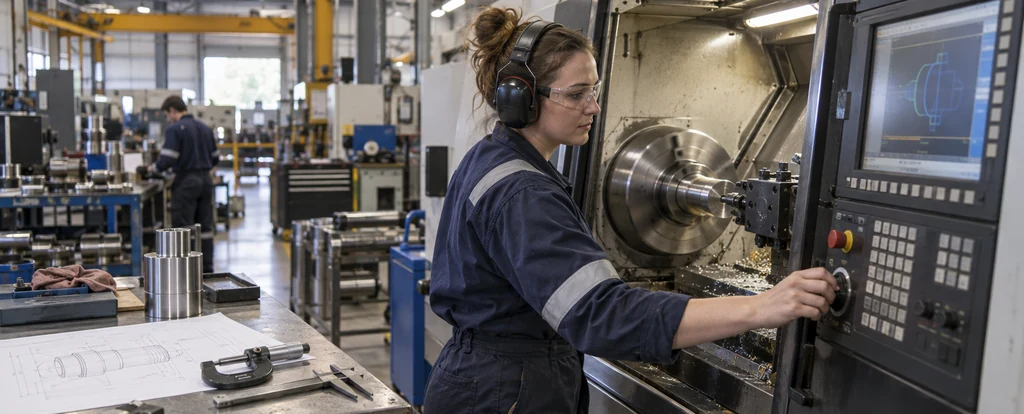
Fitter and turners machine metal parts to fine tolerances and fit them into machinery, keeping plant and production equipment running accurately.
- Median salary*
- $85,800
4.1%vs last year, before tax
- People employed
- 9,100
0.0%vs last year
- Projected growth*
- +0.3%
to 2035
- AI exposure*
- Moderate
- automation risk
- Average hours*
- 40/wk
matches all-jobs average
- Shortage status*
- In shortage
national
Fitter and turners work from engineering drawings in workshops, factories, mine sites and construction projects, setting up lathes, milling machines and machining centres to make or repair components, then fitting those components into the machines that use them. The fitting side is what separates them from a metal machinist, who mostly stays at the machine: fitter and turners are just as likely to be out on the floor aligning a drive, diagnosing a fault or rebuilding a pump. Manufacturing employs most of them, with the rest spread across mining, construction, maintenance and public utilities.
How much do fitter and turners earn?
The median full-time salary for a fitter and turner is $85,800 per annum, before tax, up $18,000 since 2018.
What you earn depends more on where you work than on the job title. General manufacturing workshops often pay close to the award rate plus overtime, while mining, oil and gas, heavy maintenance and some public utilities pay well above it through enterprise agreements, site allowances and shift loadings. Qualifications shift the figure too: a post-trade certificate or CNC programming skill moves you into a higher classification, and night shift and shutdown work add penalty rates on top of the base.
What does a fitter and turner do day to day?
The list below is what fills most weeks; the exact mix shifts with seniority and whatever stage the current work is at.
- Setting up and operating lathes, milling machines and CNC machining centres to cut metal components to size
- Reading engineering drawings, specifications and workshop instructions to work out machining, fitting and assembly requirements
- Measuring parts with micrometers, vernier calipers and gauges to check they meet the required tolerance
- Fitting, aligning and assembling machined components into machinery, then testing the assembly before it returns to service
- Diagnosing faults and repairing or replacing worn parts on production plant during breakdowns and planned shutdowns
What skills do fitter and turners need?
Employers look for reading plans and specifications, hand and power tool work, installation and maintenance, backed by Fanuc CNC controls fluency and strong problem solving.
Specialist skills
- Reading plans and specifications
- Hand and power tool work
- Installation and maintenance
- Fabrication and finishing
- Plant and equipment operation
- Worksite safety management
Software and tools
- Fanuc CNC controls
- Mastercam
- AutoCAD
- Mitutoyo micrometers and vernier calipers
- Mazak lathes and machining centres
General skills
- Problem solving
- Attention to detail
Is the job growing?
About 9,100 people work as fitter and turners in Australia, and employment is projected to grow 0.3% over the decade to 2035. That's modest growth: demand is steady rather than booming.
How do you become a fitter and turner?
Here's the path most fitter and turners take, step by step.
- 1Finish Year 10 or Year 12 with maths
Employers look for solid maths and a practical subject such as metalwork, design and technology or engineering studies, because the trade runs on measurements, clearances and speeds and feeds. A pre-apprenticeship or a short engineering course can help you stand out if you are applying straight from school.
- 2Start a Certificate III in Engineering (Mechanical Trade) apprenticeship
This is the standard entry and takes about four years. It is paid work from day one, combining on-the-job training with TAFE or a registered training organisation, and you finish with a nationally recognised trade qualification.
- 3Pick up the site licences your work needs
A White Card is required before you set foot on a construction site, and some roles need a high risk work licence for rigging, dogging or operating elevating work platforms. Requirements vary by state and territory, so check with the regulator where you plan to work.
- 4Add post-trade study once you are qualified
A Certificate IV or Diploma of Engineering, or a CAD/CAM course in software such as Mastercam, opens up CNC programming, maintenance planning and supervisory roles. Many tradespeople do this in the first few years after qualifying, often with employer support.
- 5Enter from a related trade if you already have one
Metal trades assistants, sheet metal workers and foundry moulders can move into fitting and turning through an apprenticeship with recognition of prior learning, which shortens the training because the tool, metal and safety skills are already there.
Ready to apply as a fitter and turner?
Whether you're working toward becoming a fitter and turner or already are one and want a hand with the next step (sharpening your resume for ATS screening, tightening your cover letter, or knowing what you'll actually be asked at interview), here are examples grounded in this specific role, not generic templates.
What jobs can a fitter and turner move to?
Moving into Metal Machinist typically comes with the biggest pay rise, worth $49,700 a year more on average.
| Move to | Typical pay change | Overlap | Retraining |
|---|---|---|---|
| Metal Machinist Fitter and turners bring precision machining and fitting skills to metal machining, allowing them to set up and operate machine tools to tight tolerances. | +$49,700 | 85% | reskill |
| Pressure Welder Fitter and turners with welding experience can specialise in pressure welding, using their metal knowledge to work on high-pressure piping and vessels. | +$10,400 | 85% | reskill |
| Fitter Fitter and turners can move into general fitting roles, applying their assembly, alignment and maintenance skills to a broader range of machinery. | +$5,200 | 100% | reskill |
| Welder Fitter and turners can take on welding work, combining their machining background with welding techniques to fabricate and repair metal components. | +$2,000 | 61% | reskill |
| Metal Fabricator Fitter and turners can move into metal fabrication, using their skills in reading drawings and working metal to cut, shape and assemble structures. | +$2,000 | 61% | reskill |
Moves are chosen from Jobs and Skills Australia's Data on Occupation Mobility, which follows income tax records between 2011-12 and 2020-21, together with entry requirements and skill overlap. A known move is one people were seen making in that data. Pay change compares median full-time pay for the two roles.
Who works as a fitter and turner?
The typical fitter and turner is 39 years old; 99% are men, 92% work full-time, and full-timers average 40 hours a week.
- 39
- Median age
- 1%
- Female share
- 92%
- Full-time
- +0h
- vs all-jobs avg
What's it like being a fitter and turner?
The job runs on two rhythms: planned work in the workshop, where you can think a setup through before cutting, and breakdowns that have to be sorted while a production line sits idle. It suits people who like seeing a job through from drawing to running machine, who are patient about measuring, and who don't mind the noise, oil and time on their feet that come with the trade. Tolerance work leaves no room for guessing, and that is also where the satisfaction sits.
What people like
- Making a part fit first time. Machining to within a few hundredths of a millimetre and watching the component slide into place is a result you can check with your own instruments.
- Work that changes with the job. One week you are on the lathe, the next you are on a mine site aligning a pump or rebuilding a gearbox, which keeps the trade from turning into the same task every day.
- Machines worth learning. Manual machining, CNC controls and CAD/CAM software each take time to get good at, and there is always another control or setup to add to your set.
- A qualification that travels. The trade is recognised across the country, and the same skills are wanted in workshops, food plants, mines, ports and water utilities.
What people find hard
- Tolerance is unforgiving. A setup that is slightly out shows up in the measurement, and a part that misses the tolerance may have to be reworked or scrapped, which is a costly mistake to explain.
- Heat, noise and standing. Most of the day is spent on your feet in a workshop or on a site, with coolant, swarf, dust and machines running close by.
- Breakdowns don't wait. When a line stops, the pressure to get it running is immediate and the diagnosis happens with production staff standing around waiting.
- Rosters away from home. Mining and remote construction work often means long swings and fly-in fly-out rosters, which suits some people and not others.
Based on our synthesis of professional-body surveys and public accounts of the role, not first-person verified reviews.
Which industries employ fitter and turners?
Manufacturing employs the largest share of fitter and turners, followed by Other Services.
Top employing industries
- 1Manufacturing
- 2Other Services
- 3Mining
- 4Construction
- 5Public Administration and Safety
Ranked by employment share; the source doesn't publish an exact percentage per industry.
| Certificate III/IV | 34% | |
|---|---|---|
| Diploma / Advanced Diploma | 26% | |
| Bachelor degree | 20% | |
| Year 12 or below | 20% |
Will AI replace fitter and turners?
Fitter and turning sits in the middle of the range for AI exposure. CAD/CAM software and CNC controls already generate much of the toolpath and cutting sequence, and machine monitoring tools flag problems before a line stops, which changes how a job is planned rather than whether someone is needed for it. Someone still has to clamp the work, read how the metal is cutting and decide what to do when a measurement is out, and most on-site fault finding, alignment and rebuild work stays in human hands.
Share of typical working time by exposure level
- Maintaining and repairing plant on sitePredictive maintenance software might flag a pump running hot, but stripping the machine, finding the cause and getting the shaft alignment right is hands-on work.40%low
- Programming and setting up CNC machinesCAM software such as Mastercam produces the cutting path, but you still prove the program, set the tool offsets and adjust feeds and speeds when the first part comes off the machine.25%moderate
- Measuring and checking parts against toleranceDigital micrometers and gauges can log readings automatically, though you still judge whether a borderline part can be reworked or needs remachining.20%moderate
- Reading drawings and planning the jobDrawings increasingly arrive as 3D models, which helps you picture the assembly, but the sequence, workholding and machining allowances are still your call.15%low
Moves least exposed to AI
These career moves from fitter and turner work are rated low for AI exposure:
- Pressure Welder
High skill overlap (85%), reskill to get there, and a low automation-risk profile.
- Welder
High skill overlap (61%), reskill to get there, and a low automation-risk profile.
- Metal Fabricator
High skill overlap (61%), reskill to get there, and a low automation-risk profile.
Common questions about becoming a fitter and turner
Straight answers to the questions people ask most.
How much does a fitter and turner earn?
Fitter and turners earn $85,800 per year before tax at the median. Pay moves with the industry you work in and the agreement covering you: mining and heavy maintenance pay more than general manufacturing, and shift work and overtime loadings add to the base.
How do you become a fitter and turner?
The usual route is a Certificate III in Engineering (Mechanical Trade) apprenticeship, which takes about four years and combines paid work with study at TAFE or another registered training organisation. Employers generally want Year 10 or Year 12 with maths, and you'll need a White Card before working on construction sites.
Are fitter and turners in demand?
Fitter and turners are currently in shortage nationally, and employment is projected to grow 0.3% over the decade to 2035 over the decade to 2035. With little change in the overall number of jobs, much of the hiring is about replacing tradespeople who retire or leave the trade, so a completed apprenticeship and site experience count for more than the timing of your application.
Will AI replace fitter and turners?
Not the whole job, and not quickly. CAD/CAM software and CNC controls now generate much of the cutting path, and predictive maintenance tools flag a bearing running hot before it fails, but someone still has to clamp the job, prove the program and judge what to do when a part measures out of tolerance. Fault finding, alignment and rebuild work on site remain hands-on.
What can a fitter and turner move into?
Common moves are sideways into general fitting ($5,200 more) or into precision machining as a metal machinist ($49,700 more), because the drawing, measuring and machine skills carry over almost unchanged. Adding welding opens pressure welding ($10,400 more). Many experienced fitter and turners eventually start their own machining, maintenance or mobile fitting business, which is often where earnings grow.
Do fitter and turners work long hours?
Full-time fitter and turners average 40 hours a week, and about 92% work full time. Overtime is common during shutdowns and breakdowns, and mining and remote site roles often run on rosters with long swings away from home.
Related roles
Not sure this is you? Take the career quiz and get a ranked shortlist of roles that fit how you like to work.