Home Manufacturing & Production
Metal Trades Assistant
Metal trades assistants support qualified tradespeople by cutting, positioning and moving metal and equipment so fabrication and maintenance jobs stay on schedule.
- Median salary*
- $67,600
3.5%vs last year, before tax
- People employed
- 7,700
0.0%vs last year
- Projected growth*
- +1%
to 2035
- AI exposure*
- Moderate
- automation risk
- Average hours*
- 40/wk
matches all-jobs average
- Shortage status*
- Not in shortage
national
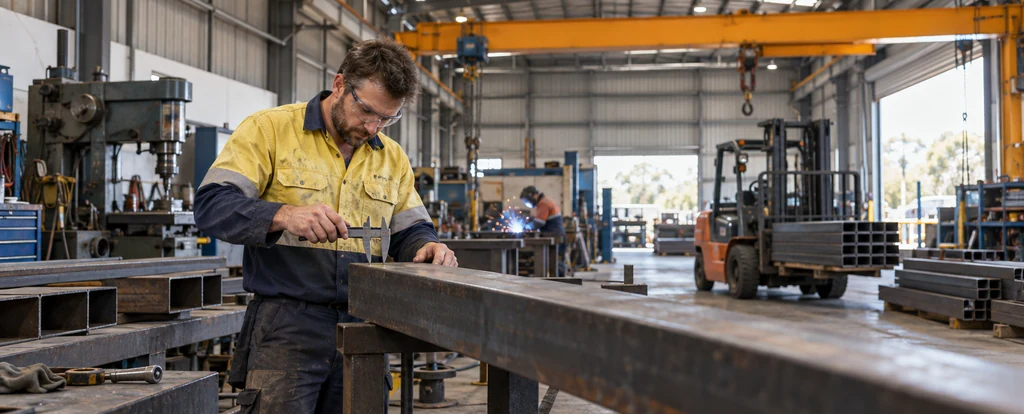
They work in workshops, factories, and on construction and mining sites, alongside welders, boilermakers, fitters and machinists. The role is a support one: the qualified tradesperson sets the plan and does the skilled work, while the assistant prepares materials, holds work in place, runs the crane or forklift and keeps tools and the work area in order. Many assistants come straight from school or from labouring work and learn the job on the floor.
How much do metal trades assistants earn?
The median full-time salary for a metal trades assistant is $67,600 per annum, before tax, up $14,400 since 2018.
Pay usually follows the manufacturing or building award, so base rates are modest and overtime, shift loadings and site allowances do much of the work. Mining and heavy industrial sites generally pay more than small workshops, and holding a forklift licence or a high risk work licence for rigging or crane work can lift the rate.
What does a metal trades assistant do day to day?
The list below is what fills most weeks; the exact mix shifts with seniority and whatever stage the current work is at.
- Cutting and grinding metal stock to size with angle grinders, drop saws and cutting torches
- Holding and positioning workpieces for welders, boilermakers and fitters
- Moving steel, components and finished work around the workshop with the gantry crane or forklift
- Measuring and checking parts against drawings before they go on to the next stage
- Cleaning down machines, checking hand tools and keeping walkways and benches clear, since a blunt blade or a stray offcut slows the whole crew
What skills do metal trades assistants need?
Employers look for hand and power tool work, fabrication and finishing, worksite safety management, backed by Angle grinder fluency and strong physical stamina and dexterity.
Specialist skills
- Hand and power tool work
- Fabrication and finishing
- Worksite safety management
- Plant and equipment operation
- Reading plans and specifications
- Installation and maintenance
Software and tools
- Angle grinder
- Oxy-acetylene cutting torch
- Overhead gantry crane
- Forklift
- Vernier calipers
General skills
- Physical stamina and dexterity
Is the job growing?
About 7,700 people work as metal trades assistants in Australia, and employment is projected to grow 1% over the decade to 2035. That's modest growth: demand is steady rather than booming.
How do you become a metal trades assistant?
Here's the path most metal trades assistants take, step by step.
- 1Consider a Certificate II in engineering
TAFE and private training providers offer it over roughly six months to a year, and it covers hand and power tools, safe workshop practice and a taste of machining and fabrication. Plenty of assistants start without it, but it makes an application stronger when you have no site experience.
- 2Get the licences employers ask for
A White Card is required before you set foot on a construction site, and a forklift licence opens up the material handling side of the job, which is a large part of the day in many workshops. Some employers also want a high risk work licence for dogging or rigging.
- 3Apply through workshops, labour hire and apprenticeships
Engineering firms, fabrication shops, maintenance contractors and labour hire agencies are the usual employers, and labour hire is a common way in because it lets a workshop try you on a short job first. Pay starts at an award rate and rises with experience and licences.
- 4Use the role as a route into a trade
An apprenticeship in engineering fabrication, mechanical trade or welding takes about three to four years, is paid, and builds directly on the tools and materials you already handle as an assistant. Employers often take on an assistant they know as an apprentice when one comes up.
Ready to apply as a metal trades assistant?
Whether you're working toward becoming a metal trades assistant or already are one and want a hand with the next step (sharpening your resume for ATS screening, tightening your cover letter, or knowing what you'll actually be asked at interview), here are examples grounded in this specific role, not generic templates.
What jobs can a metal trades assistant move to?
Moving into Fitter typically comes with the biggest pay rise, worth $23,400 a year more on average.
| Move to | Typical pay change | Overlap | Retraining |
|---|---|---|---|
| Fitter Assistants already handle the tools and materials fitters use, so an apprenticeship builds directly on that hands-on workshop experience. | +$23,400 | 86% | requalify |
| Welder Supporting welders gives assistants a foundation in the trade, and an apprenticeship turns that familiarity into a welding qualification. | +$20,200 | 50% | requalify |
| Fitter and Turner Turning and fitting work extends the assistant's familiarity with metal components, with an apprenticeship formalising the machining and assembly skills. | +$18,200 | 86% | requalify |
| Lagger Applying insulation and metal cladding uses the same site skills, and a short course covers the trade-specific requirements. | +$10,400 | 90% | short course |
| Sheet Metal Worker Fabricating and installing sheet metal builds on the assistant's cutting, forming and assembly work, with an apprenticeship required. | +$4,200 | 71% | requalify |
Moves are chosen from Jobs and Skills Australia's Data on Occupation Mobility, which follows income tax records between 2011-12 and 2020-21, together with entry requirements and skill overlap. A known move is one people were seen making in that data. Pay change compares median full-time pay for the two roles.
Who works as a metal trades assistant?
The typical metal trades assistant is 40 years old; 93% are men, 82% work full-time, and full-timers average 40 hours a week.
- 40
- Median age
- 7%
- Female share
- 82%
- Full-time
- +0h
- vs all-jobs avg
What's it like being a metal trades assistant?
The days are hands on and often start early, and the pace is set by the tradespeople you support rather than by a schedule of meetings. Work tends to come in jobs that last days rather than months, so you move between tasks and sometimes between sites, and the same job might mean workshop fabrication one week and a shutdown on a plant the next. People who enjoy it usually like the physical side and seeing something finished and solid at the end of the shift.
What people like
- You watch the job take shape. Cutting, fitting and finishing parts that become a real structure or machine gives a clear result at the end of the day, which suits people who like working with their hands.
- A practical way into the trades. The role lets you try fabrication, fitting and welding before committing to a multi-year apprenticeship, and much of what you learn carries straight into one.
- The work changes with the job. Different sites, materials and crews keep the week varied, and assistants who can turn their hand to whatever is needed are the ones workshops keep on.
- You work beside people who know their trade. There is a lot to pick up from watching a boilermaker lay out a job or a fitter set up a machine, and most tradespeople are willing to explain what they are doing.
What people find hard
- The work is physical and often dirty. You spend the shift on your feet, lifting, crouching and leaning over benches, and grinding dust, swarf and oil are part of the environment rather than something you avoid.
- Noise, heat and weather. Workshops are loud, and site work means whatever the day brings, from summer heat on a steel deck to cold and rain on an outdoor job.
- Progress depends on picking up a qualification. You can stay in the role for years without moving up, because the better paid work in the trades needs a Certificate III and an apprenticeship behind it.
- You take direction rather than run the job. The tradesperson decides how the work is set up and you follow that plan, which can be frustrating if you have your own idea about the best way to do it.
Based on our synthesis of professional-body surveys and public accounts of the role, not first-person verified reviews.
Which industries employ metal trades assistants?
Manufacturing employs the largest share of metal trades assistants, followed by Construction.
Top employing industries
- 1Manufacturing
- 2Construction
- 3Wholesale Trade
- 4Mining
- 5Other Services
Ranked by employment share; the source doesn't publish an exact percentage per industry.
| Certificate III/IV | 34% | |
|---|---|---|
| Diploma / Advanced Diploma | 26% | |
| Bachelor degree | 20% | |
| Year 12 or below | 20% |
Will AI replace metal trades assistants?
Metal trades assistant work is moderately exposed to automation, with the routine cutting and measuring parts of the job already handled by machines in many workshops. CNC profile cutters, robotic welding cells and CAD nesting software decide how plate and sheet are laid out and cut, which removes some of the marking out and hand cutting that used to fill the week. What stays with the assistant is the physical work around those machines: loading, holding, moving and finishing material, on jobs that are often one-offs.
Share of typical working time by exposure level
- Cutting and grinding metal to sizeCNC plasma and laser cutters take over the straight repetitive cuts, but the angle grinder still comes out for trimming, bevelling and fixing a cut that a machine cannot reach.30%moderate
- Holding and positioning work for welders and fittersSetting a workpiece square, clamping it and keeping it steady while someone welds it is hands-on work that depends on seeing and feeling the job in front of you.25%low
- Measuring, checking and finishing parts against drawingsDigital calipers, laser measuring and inspection software speed up checking against a drawing, though someone still has to decide whether a part is good enough to pass on to the next stage.25%high
- Moving steel and components around the workshopOverhead gantry cranes and forklifts are already the standard way to shift heavy stock, and automated guided vehicles appear in larger plants, but slinging a load and judging a safe lift still needs a person.20%moderate
Moves least exposed to AI
These career moves from metal trades assistant work are rated low for AI exposure:
- Lagger
High skill overlap (90%), short course to get there, and a low automation-risk profile.
- Welder
Solid skill overlap (50%), requalify to get there, and a low automation-risk profile.
Common questions about becoming a metal trades assistant
Straight answers to the questions people ask most.
How much do metal trades assistants earn?
The median full-time wage is $67,600 per year before tax, which is a midpoint across the role rather than a starting rate. Pay moves with the award or enterprise agreement you are on, how much overtime and shift work you pick up, and whether you are in a small workshop or on a mine site or large industrial project.
How do you become a metal trades assistant?
Most people start on the job and learn from the tradespeople they support, with no qualification required to begin. A Certificate II in engineering (MEM20105), a White Card for construction work and a forklift licence make you easier to employ, and an apprenticeship is the route to a trade qualification if you want to go further.
Are metal trades assistants in demand?
Metal trades assistants are currently not in shortage, and employment is projected to grow 1% over the decade to 2035 over that period. Hiring follows activity in manufacturing, construction and mining, so most openings come from replacing people who move on or into apprenticeships rather than from new positions being created.
Will AI or automation replace metal trades assistants?
Automation already handles part of the job, which is why the work rates as moderately exposed rather than secure. CNC profile cutters, robotic welding cells and nesting software take on some cutting and joining, but someone still has to prepare the material, hold the work in position, move it around the shop and finish it, and those tasks are hard to automate on one-off jobs.
What can a metal trades assistant move on to?
The steps into the trades you already support make sense because the tools and materials are the same, so a fitter earns $23,400 more and a welder $20,200 more, with an apprenticeship needed to qualify in either. Lagging is a shorter step at $10,400 more, since a short course covers the trade-specific requirements, while sheet metal work sits at $4,200 more.
Is the work physically demanding?
Yes, the job involves standing, lifting, crouching and working in noise and dust for a full shift, and employers look for physical stamina and good dexterity. It gets more manageable when you use the gantry crane, trolleys and lifting gear instead of carrying steel and components by hand.
Related roles
Not sure this is you? Take the career quiz and get a ranked shortlist of roles that fit how you like to work.