Home Manufacturing & Production
Food Quality Assurance Officer
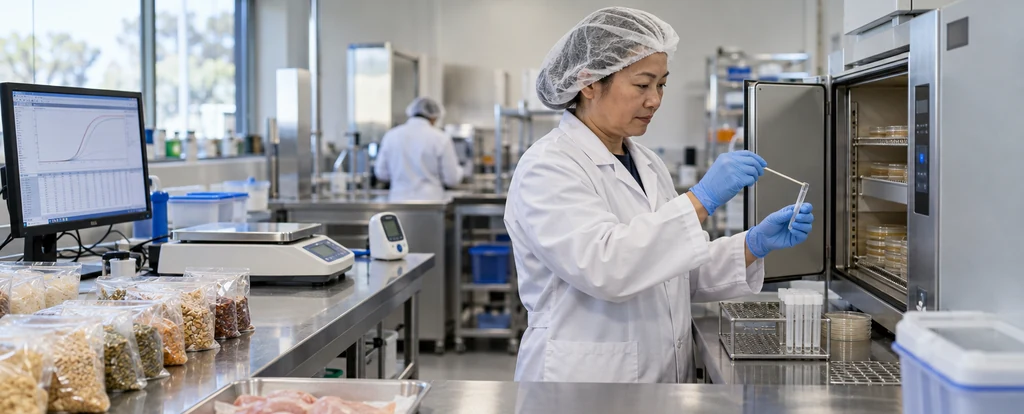
Food quality assurance officers test and audit food production so products are safe, meet their specifications and stay within food law.
- Median salary*
- $83,200
4.0%vs last year, before tax
- People employed
- 100
0.0%vs last year
- Projected growth*
- +3%
to 2035
- AI exposure*
- Moderate
- automation risk
- Average hours*
- 40/wk
matches all-jobs average
- Shortage status*
- Not in shortage
national
They work on the floor of food and beverage plants, in site laboratories and in warehouses, checking raw materials, product in progress and finished goods against specifications and the Food Standards Code. The job sits between production and the regulator: a food technologist develops the product and the process, while a quality assurance officer proves the process is still under control and keeps the records that show it. Most work for food and beverage manufacturers, with others in agriculture, retail supply chains and testing laboratories.
How much do food quality assurance officers earn?
The median full-time salary for a food quality assurance officer is $83,200 per annum, before tax, up $17,300 since 2018.
Pay follows the enterprise agreement or award covering the site, so a large processor and a small bakery can offer quite different rates for similar work. Shift rosters, night testing and weekend coverage usually attract penalty rates, and a lead auditor qualification or experience with a major retailer's own standard can lift you into a higher band. Moving from the production floor into a dedicated quality team often changes earnings more than any single certificate.
What does a food quality assurance officer do day to day?
The list below is what fills most weeks; the exact mix shifts with seniority and whatever stage the current work is at.
- Sampling and testing raw materials, in-process product and finished goods against specifications
- Maintaining and auditing HACCP, food safety and quality management systems
- Investigating non-conformance, recalls and customer complaints, then recording corrective actions
- Coordinating calibration, swabbing and verification of testing equipment and premises
- Preparing compliance records and reports for regulators, auditors and major customers
What skills do food quality assurance officers need?
Employers look for food safety and hygiene, laboratory analysis, auditing and assurance, backed by Laboratory information management system (LIMS) fluency and strong safety and compliance awareness.
Specialist skills
- Food safety and hygiene
- Laboratory analysis
- Auditing and assurance
- Regulatory compliance
- Process improvement
Software and tools
- Laboratory information management system (LIMS)
- SAP Quality Management
- Safefood 360
- Microsoft Excel
- Minitab
General skills
- Safety and compliance awareness
- Attention to detail
Is the job growing?
About 100 people work as food quality assurance officers in Australia, and employment is projected to grow 3% over the decade to 2035. That's modest growth: demand is steady rather than booming.
How do you become a food quality assurance officer?
Here's the path most food quality assurance officers take, step by step.
- 1Build the science base at school or TAFE
Chemistry and biology in Year 12, or a Certificate IV in food science and technology or food processing, give you the grounding for sampling, micro testing and reading a product specification.
- 2Consider a degree for the technical track
A bachelor degree in food science, food technology or applied science is the most common way in and the one employers ask for in laboratory, product development and auditing roles. A diploma can get you started as a quality technician, with the degree added later if you want to move up.
- 3Spend time on the production floor
Employers value people who know how a line actually runs, so a year or two as a quality technician, laboratory assistant or production worker makes the step into a quality assurance role much easier.
- 4Add food safety and auditing qualifications
HACCP training and an internal auditor course are the usual starting point, and a lead auditor qualification recognised by Exemplar Global is what lets you run audits for customer schemes such as SQF or BRCGS.
- 5Learn the rules that apply to your site
The Food Standards Code is set nationally through FSANZ, but enforcement and specific meat, dairy and seafood requirements sit with state health and agriculture authorities, so the day-to-day detail depends on where you work.
Ready to apply as a food quality assurance officer?
Whether you're working toward becoming a food quality assurance officer or already are one and want a hand with the next step (sharpening your resume for ATS screening, tightening your cover letter, or knowing what you'll actually be asked at interview), here are examples grounded in this specific role, not generic templates.
What jobs can a food quality assurance officer move to?
Moving into Quality Manager typically comes with the biggest pay rise, worth $64,700 a year more on average.
| Move to | Typical pay change | Overlap | Retraining |
|---|---|---|---|
| Quality Manager Quality assurance experience in food safety audits and compliance carries into managing quality systems and teams, with further management training. | +$64,700 | 40% | reskill |
| Food Technologist Food safety and production knowledge supports product development and testing, but a food science degree is needed to practise as a food technologist. | +$30,900 | 59% | requalify |
Moves are chosen from Jobs and Skills Australia's Data on Occupation Mobility, which follows income tax records between 2011-12 and 2020-21, together with entry requirements and skill overlap. A known move is one people were seen making in that data. Pay change compares median full-time pay for the two roles.
Who works as a food quality assurance officer?
The typical food quality assurance officer is 39 years old; 52% are women, 84% work full-time, and full-timers average 40 hours a week.
- 39
- Median age
- 52%
- Female share
- 84%
- Full-time
- +0h
- vs all-jobs avg
What's it like being a food quality assurance officer?
The rhythm follows production: a check on line start-up, samples through the day, then the paperwork that releases a batch or holds it back. The pressure comes from being the person who says stop when a production manager wants the run to continue, and from audit season, when customers and regulators want evidence for months of decisions. The people who settle into it tend to like order, evidence and a clear standard, and are comfortable being the one who holds the line.
What people like
- You see the whole process. Quality work touches receiving, production, packaging and dispatch, so you learn how the plant fits together rather than mastering one station.
- Problems usually have a cause. A failed micro test or a temperature excursion has an explanation, and tracing it back and fixing the batch is satisfying work.
- The standards are written down. Food safety rules give you a defensible position when you have to push back on a rushed run or a supplier's paperwork.
- The skills transfer between industries. HACCP, auditing and laboratory practice appear in dairies, meat plants, bakeries, breweries and retail supply chains, so you can move sectors without starting again.
What people find hard
- You are often the brake. Stopping a line or holding a batch costs money, and that conversation is rarely welcome in the moment it happens.
- The paperwork never really ends. Records, corrective actions and audit evidence take up a large part of the week, and small errors in them cause real problems later.
- Audits cluster together. Customer audits, third-party scheme audits and regulator visits can land in the same few months, on top of normal sampling and testing.
- Shifts and cold rooms. Sampling runs alongside production, so early starts, night shifts and time in cool rooms are part of the job in many plants.
Based on our synthesis of professional-body surveys and public accounts of the role, not first-person verified reviews.
Which industries employ food quality assurance officers?
Food Product Manufacturing employs the largest share of food quality assurance officers, followed by Beverage and Tobacco Product Manufacturing.
Top employing industries
- 1Food Product Manufacturing
- 2Beverage and Tobacco Product Manufacturing
- 3Agriculture, Forestry and Fishing
- 4Professional, Scientific and Technical Services
- 5Retail Trade
Ranked by employment share; the source doesn't publish an exact percentage per industry.
| Bachelor degree | 52% | |
|---|---|---|
| Postgraduate | 26% | |
| Diploma / Advanced Diploma | 13% | |
| Other | 9% |
Will AI replace food quality assurance officers?
This is a moderately exposed job. The record keeping, trend analysis and report writing that fill much of the week are already partly handled by laboratory information systems, quality management platforms such as Safefood 360 and statistical tools like Minitab. The parts that keep the rating moderate are the hands-on sampling, the sensory and hygiene checks that happen on the line, and the judgement and sign-off that customers and regulators expect from a named person on site.
Share of typical working time by exposure level
- Sampling and bench testingWeighing samples, plating micro tests, checking pH and moisture and running sensory checks on a batch are still done by hand, even where rapid swabs and automated analysers speed up the screening.30%low
- Keeping the quality management system and audit evidenceA platform can generate logs, version-controlled procedures and audit packs from the data staff enter, so the officer spends more time checking that entries are complete and correct than compiling documents.25%moderate
- Investigating non-conformances and tracebacksSoftware can flag a failed batch and trace the ingredient lots behind it in minutes, but working out what went wrong, what to do with the stock and what to tell a supplier is still a person's call.25%moderate
- Trend analysis and reporting to managementMinitab and dashboard reporting find the pattern in months of results, so the value you add is interpreting the trend and recommending the change rather than building the chart.20%high
Common questions about becoming a food quality assurance officer
Straight answers to the questions people ask most.
How much do food quality assurance officers earn?
Food quality assurance officers earn a median of $83,200 per annum, before tax. Pay depends heavily on the employer's enterprise agreement, shift loadings and whether you carry lead auditor duties, so rates in a large processor and a small bakery can sit well apart. Treat the median as a general guide rather than a starting rate.
How do you become a food quality assurance officer?
Most people enter through a bachelor degree in food science, food technology or applied science, or through a Certificate IV or diploma plus experience on the production floor. Either way, employers look for HACCP training and some time spent around real production before they hand you responsibility for releasing batches. From there, internal auditor and lead auditor courses open up the auditing side of the role.
Are food quality assurance officers in demand?
Food quality assurance officers are currently not in shortage, and employment is projected to grow 3% over the decade to 2035. Because the workforce is small, openings tend to appear as people move on or retire rather than through rapid expansion, so employers can afford to ask for relevant food industry experience. A qualification plus a year or two on site is what usually gets you shortlisted.
Will AI replace food quality assurance officers?
Automation has already taken over much of the recording side of the job, since laboratory systems and quality platforms log results, trend them and generate audit reports. That shifts your time towards reviewing exceptions and investigating what caused them rather than filling in sheets. Sampling, sensory checks and the decision to hold or release a batch still need someone on site, and regulators and customers expect a person to sign off on food safety calls.
What can a food quality assurance officer move into?
The usual step up is quality manager, which pays about $64,700 more and builds on the same audit and compliance experience with more responsibility for systems and staff. Moving across to product development as a food technologist uses your food safety knowledge, but you need a food science degree to practise in that role. People also come into quality assurance from meat inspection, distilling or process work, where hygiene, fermentation or line experience gives them a head start.
Is food quality assurance a good job for someone changing careers?
It suits people coming from food production, meat inspection or laboratory work, because the technical judgement is built on knowing how food is handled. A career changer usually needs to add formal food safety training and a recognised auditing qualification before employers will consider them for a quality role. Studying part time while working in a plant is a common route.
Related roles
Not sure this is you? Take the career quiz and get a ranked shortlist of roles that fit how you like to work.