Gas Network Technician
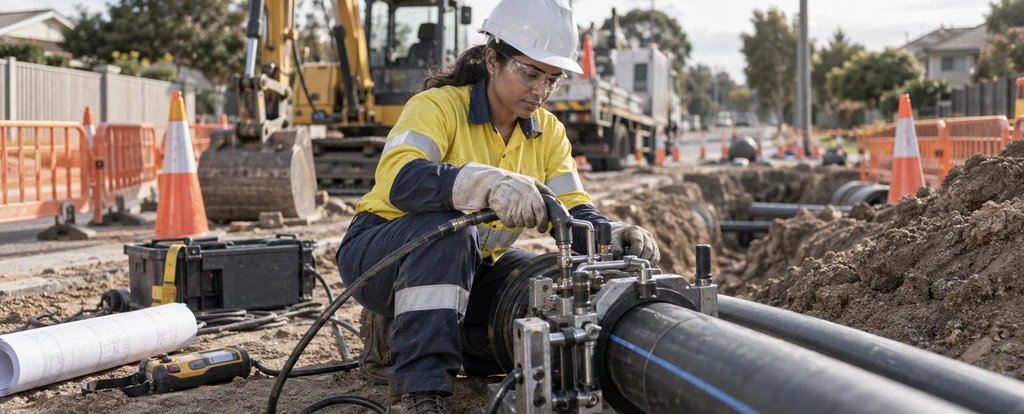
Gas network technicians build, test and repair the pipes and equipment that carry gas to homes and businesses.
- Median salary*
- $101,400
3.8%vs last year, before tax
- People employed
- 750
7.1%vs last year
- Projected growth*
- +4%
to 2035
- AI exposure*
- Moderate
- automation risk
- Average hours*
- 42/wk
+2h vs all jobs
- Shortage status*
- In shortage (regional)
national
Gas network technicians work on the distribution network that takes gas from transmission pipelines to household and business meters. They install and join mains and service pipes, test for leaks, monitor pressure and attend gas escapes, usually as part of a crew based at a depot. The job is mostly outdoors and rostered, and it is different from a gasfitter's work, which covers the pipework and appliances on the customer's side of the meter.
How much do gas network technicians earn?
The median full-time salary for a gas network technician is $101,400 per annum, before tax, up $21,000 since 2018.
The enterprise agreement covering your employer sets most of this, so a distribution business, a maintenance contractor and a civil contractor working on the same network can pay differently. Shift rosters, on-call availability and penalty rates for nights, weekends and public holidays are usually where the variation sits, and remote postings may carry allowances on top. Permit authority or network control experience also moves you into a higher band.
What does a gas network technician do day to day?
The list below is what fills most weeks; the exact mix shifts with seniority and whatever stage the current work is at.
- Installing and joining gas mains, service pipes and fittings, using fusion welding and mechanical joints
- Pressure-testing new sections with air or inert gas and proving each joint before it is backfilled
- Responding to gas escape reports and emergency call-outs, making the area safe before repairs start
- Commissioning and servicing regulators, meters and valves, and checking their readings against the network
- Reading network drawings in GIS and marking underground gas services ahead of excavation work
What skills do gas network technicians need?
Employers look for installation and maintenance, worksite safety management, plant and equipment operation, backed by SCADA systems fluency and strong problem solving.
Specialist skills
- Installation and maintenance
- Worksite safety management
- Plant and equipment operation
- Reading plans and specifications
- Hand and power tool work
- Regulatory compliance
- Field inspection and testing
Software and tools
- SCADA systems
- ArcGIS
- IBM Maximo
- Gas leak detection instruments
- Fusion welding equipment
General skills
- Problem solving
Is the job growing?
About 750 people work as gas network technicians in Australia, and employment is projected to grow 4% over the decade to 2035. That's modest growth: demand is steady rather than booming.
How do you become a gas network technician?
Here's the path most gas network technicians take, step by step.
- 1Finish Year 12 or a trade qualification
Network operators usually look for Year 12 or a Certificate III trade such as plumbing or electrotechnology, with reasonable maths, a driver's licence and a clear safety record. A trade background is not essential, but it shortens the training once you are on the network.
- 2Apply for a traineeship with a distributor or contractor
The usual way in is a paid traineeship that combines depot work with study toward a Certificate III in gas industry operations. Intakes are small and often advertised by the distribution businesses themselves or the contractors who maintain their networks, so it pays to apply directly as well as through job boards.
- 3Pick up the licences and qualifications for field work
Before you work on live assets you will generally need a White Card, confined space entry and first aid training, plus state-based registration or authorisation for work on gas installations. Requirements vary by state, so check what your state regulator requires.
- 4Or move across from a related trade
Gasfitters, electrical fitters and powerline workers already hold much of the maintenance, diagnostic and safety knowledge, and usually bridge into network work with a short course covering gas systems. Employers value the existing utility habits, such as isolation procedures and permit systems.
- 5Build towards permit authority or network control
With experience, technicians take on permit issuing, control room duties or crew supervision, where the responsibility shifts from the tools to coordinating the people who use them.
Ready to apply as a gas network technician?
Whether you're working toward becoming a gas network technician or already are one and want a hand with the next step (sharpening your resume for ATS screening, tightening your cover letter, or knowing what you'll actually be asked at interview), here are examples grounded in this specific role, not generic templates.
What jobs can a gas network technician move to?
Moving into Gas Plant Operator typically comes with the biggest pay rise, worth $82,300 a year more on average.
| Move to | Typical pay change | Overlap | Retraining |
|---|---|---|---|
| Gas Plant Operator Gas network technicians bring pipeline and safety expertise to gas plant operations, requiring reskilling in process control. | +$82,300 | 34% | reskill |
| Refinery Operator Gas network technicians bring fluid handling and safety skills to refinery operations, though substantial retraining is required. | +$82,300 | 34% | reskill |
| Power Station Operator Gas network technicians can apply process and safety knowledge to power station operations, with additional training in power generation. | +$2,600 | 34% | reskill |
Moves are chosen from Jobs and Skills Australia's Data on Occupation Mobility, which follows income tax records between 2011-12 and 2020-21, together with entry requirements and skill overlap. A known move is one people were seen making in that data. Pay change compares median full-time pay for the two roles.
Who works as a gas network technician?
The typical gas network technician is 42 years old; 97% are men, 92% work full-time, and full-timers average 42 hours a week.
- 42
- Median age
- 3%
- Female share
- 92%
- Full-time
- +2h
- vs all-jobs avg
What's it like being a gas network technician?
The week runs on a roster and a lot of it is spent in a ute moving between jobs, with a scheduled main replacement one day and a pressure fault the next. When gas is escaping the pace changes sharply, because the priority becomes making the area safe and keeping supply on for everyone else on the line. It suits people who like outdoor fault-finding, are comfortable working to procedures without being watched, and can stay steady under time pressure.
What people like
- Faults you can trace and fix. Chasing a pressure drop back to a corroded joint or a failed regulator, then seeing the section hold steady on the test, gives you a result you can check before you leave site.
- Outdoor work with real autonomy. Once you are on a job you largely decide how to sequence the excavation, the isolation and the test, with a supervisor or control room a radio call away rather than over your shoulder.
- Rostered days off midweek. Shift patterns mean your days off often fall on a Tuesday or a Wednesday, which suits people who would rather avoid weekend crowds than have a standard weekend.
- A safety line that matters. Gas escapes are a genuine risk to the public, and the permits, monitoring and checks you sign off are what stop an excavation or a repair turning into an incident.
What people find hard
- Call-outs at any hour. Gas escapes do not keep business hours, and an on-call week means dropping plans at short notice for a job that can run past midnight.
- Weather and ground conditions. Trench work in rain and heavy clay is slow going, and summer heat at the bottom of an excavation is its own problem, especially with PPE on.
- Confined spaces and deep pits. Some joints sit in pits, tunnels or under roadways, which brings entry permits, atmospheric monitoring and a much slower pace than open trench work.
- Compliance paperwork. Permits, isolation records, asset updates and photo evidence all have to be completed before a job is closed out, and it often eats into the end of a shift.
Based on our synthesis of professional-body surveys and public accounts of the role, not first-person verified reviews.
Which industries employ gas network technicians?
Gas Supply employs the largest share of gas network technicians, followed by Heavy and Civil Engineering Construction.
Top employing industries
- 1Gas Supply
- 2Heavy and Civil Engineering Construction
- 3Building Construction
- 4Oil and Gas Extraction
- 5Manufacturing
Ranked by employment share; the source doesn't publish an exact percentage per industry.
| Certificate III/IV | 34% | |
|---|---|---|
| Diploma / Advanced Diploma | 26% | |
| Bachelor degree | 20% | |
| Year 12 or below | 20% |
Will AI replace gas network technicians?
Automation reaches the monitoring and record-keeping side of this job more than the fieldwork. SCADA, pressure sensors and leak detection instruments already flag faults before a technician arrives, and that trend continues, but excavation, pipe jointing and emergency response remain physical work on site. That split is why the role sits at moderate exposure overall.
Share of typical working time by exposure level
- Locating and repairing gas leaksDetection instruments and GIS narrow the search to a section of main, but exposing the pipe, cutting out the damaged length and making the joint is manual work.35%low
- Responding to gas escapes and emergenciesDecisions about evacuating a street, isolating a main or shutting off supply turn on what you see on site, including neighbouring services and where gas is travelling.25%low
- Monitoring network pressure and flowSCADA flags pressure drops and unusual flow patterns before anyone drives out, though a person still decides what the alarm means and what to send to the site.20%moderate
- Recording permits, work notes and asset updatesMobile forms and systems such as Maximo capture job notes and asset changes as you go, which cuts the paperwork without replacing the inspection itself.20%high
Common questions about becoming a gas network technician
Straight answers to the questions people ask most.
How much does a gas network technician earn?
Gas network technicians earn a median of $101,400 per year before tax. That figure is for full-time workers, and shift loadings, on-call allowances and penalty rates can push actual earnings above the base rate in the enterprise agreement.
How do you become a gas network technician?
Most people enter through a paid traineeship with a gas distributor or a network maintenance contractor, combining depot work with a Certificate III in gas industry operations. Tradespeople such as gasfitters, electrical fitters and powerline workers can often move across with a short bridging course instead. A White Card, confined space training and a driver's licence are usually needed before you start on live assets.
Are gas network technicians in demand?
Gas network technicians are currently in shortage in regional areas, and employment is projected to grow 4% over the decade to 2035 over the coming decade. Hiring is tied to network replacement programs, new connections and maintenance schedules, so intake tends to be steady rather than sudden. Regional networks in particular rely on a small pool of trained people, which works in your favour if you are willing to live where the work is.
Will AI replace gas network technicians?
Not the fieldwork. Monitoring systems such as SCADA already flag pressure drops and flow anomalies before anyone drives out, and leak detection instruments and GIS narrow down where to dig, but excavation, jointing and emergency response stay with the technician on site. Record keeping is the part changing fastest, with job notes and asset updates increasingly captured on mobile forms rather than paper.
Where can a gas network technician move to?
Experienced technicians often move into gas plant or power station operations, where process and safety knowledge carries over and pay is typically $82,300 more at a gas plant. Refinery operations is another option for people willing to retrain in process control. Within the network, the usual step is into permit issuing, control room work or crew supervision.
Do gas network technicians work shifts?
Most depots run a roster covering days, afternoons and nights, with on-call rotations for gas escapes on top. Full-time hours average 42 a week, and adjusting to the roster is often the biggest change for someone coming from a Monday-to-Friday trade.
Related roles
Not sure this is you? Take the career quiz and get a ranked shortlist of roles that fit how you like to work.