Jewellery Designer
Jewellery designers work out what a piece will look like and how it will be made, turning sketches, metals and gemstones into rings, pendants and settings.
- Median salary*
- $70,200
3.5%vs last year, before tax
- People employed
- 690
1.4%vs last year
- Projected growth
- +20.9%
to 2035
- AI exposure*
- Moderate
- automation risk
- Average hours
- 41/wk
+1h vs all jobs
- Shortage status
- Not in shortage
national
Most jewellery designers work in small studios, manufacturing workshops or retail businesses, and many run a studio of their own alongside commissioned work. The role sits next to the jeweller's: designers decide what a piece should be and how it will be built, while jewellers do much of the bench work of forming, setting and finishing. Entry usually comes through a jewellery trade qualification, an apprenticeship, or a design qualification with a computer-aided design focus.
How much do jewellery designers earn?
The median full-time salary for a jewellery designer is $70,200 per annum, before tax, up $15,000 since 2018.
What you earn depends mostly on the setup you work in. A designer employed by a manufacturing jeweller or a retail chain is usually paid a salary or an award rate with set hours, while those working on commission take a share of each sale and carry the cost of metals, stones and casting. Bespoke and engagement work generally pays better than volume production runs, and designers who build a client list of their own often earn most from repeat and referral work.
What does a jewellery designer do day to day?
The list below is what fills most weeks; the exact mix shifts with seniority and whatever stage the current work is at.
- Sketching ideas for rings, pendants, earrings and bracelets, often to a client's brief and budget
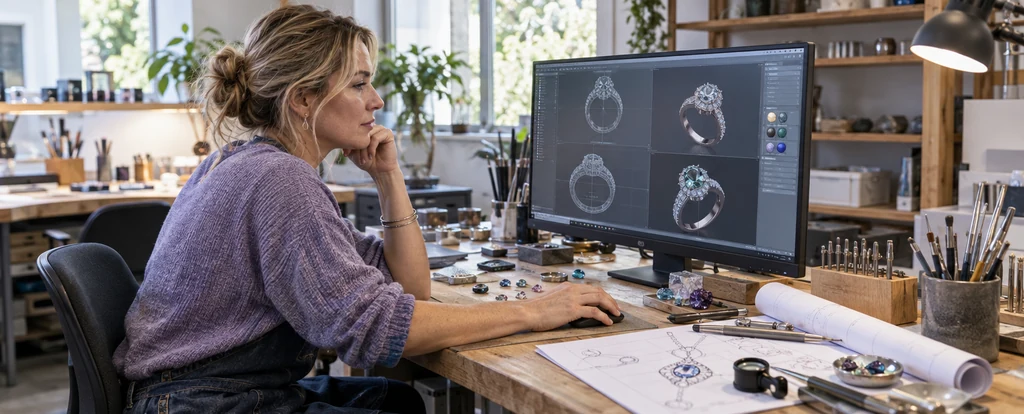
- Modelling pieces in CAD software such as Rhino or MatrixGold and rendering them so a client can picture the finished design
- Choosing metals, gemstones, settings and finishes, checking that stones will sit securely and the piece will wear well
- Preparing technical drawings and wax or resin models for casting, then working through the quote with the client
- Liaising with jewellers, stone setters and polishers through production and checking the finished piece against the design
What skills do jewellery designers need?
Employers look for craft and handmade production, visual design, creative software production, backed by Rhino 3D fluency and strong attention to detail.
Specialist skills
- Craft and handmade production
- Visual design
- Creative software production
- Selling and negotiation
Software and tools
- Rhino 3D
- MatrixGold
- Adobe Illustrator
- Adobe Photoshop
- ZBrush
General skills
- Attention to detail
- Client relationships and advisory
- Written communication
Is the job growing?
About 690 people work as jewellery designers in Australia, and employment is projected to grow 20.9% over the decade to 2035. That's very strong growth. Few roles in Australia are expanding this fast, and it points to solid demand for years to come.
How do you become a jewellery designer?
Here's the path most jewellery designers take, step by step.
- 1Choose between the trade and the design route
A Certificate III in Jewellery Manufacture (MEM30619), usually through an Australian Apprenticeship of about three to four years, is paid work and teaches casting, setting and finishing at the bench. A diploma or degree in jewellery and object design takes a similar amount of time, concentrates on drawing, CAD and materials, and often leaves the bench skills to be picked up on the job.
- 2Build the CAD skills employers ask for
Rhino, MatrixGold and Adobe Illustrator appear in most job ads for design roles. TAFE and private short courses teach them, and a modelling and rendering portfolio shows you can carry an idea from sketch to a file a workshop can cast from.
- 3Put together a portfolio of finished pieces
Employers and clients judge jewellery design on the objects, so include photographs of completed pieces, technical drawings and renders, and note which parts you made yourself rather than outsourced.
- 4Get studio or retail experience
Working for a manufacturing jeweller, a retail chain or a repair workshop teaches how pieces wear in daily life and what customers actually ask for, and it is where most designers build the contacts that lead to their own commissions.
Ready to apply as a jewellery designer?
Whether you're working toward becoming a jewellery designer or already are one and want a hand with the next step (sharpening your resume for ATS screening, tightening your cover letter, or knowing what you'll actually be asked at interview), here are examples grounded in this specific role, not generic templates.
What jobs can a jewellery designer move to?
Moving into Graphic Designer typically comes with the biggest pay rise, worth $26,000 a year more on average.
| Move to | Typical pay change | Overlap | Retraining |
|---|---|---|---|
| Graphic Designer Jewellery designers bring composition and visual design skills to graphic design, though digital tools and a reskill are required. | +$26,000 | 44% | reskill |
| Textile Designer Jewellery designers bring CAD, material and colour skills to textile design, with a diploma-level reskill in surface pattern. | +$7,800 | 67% | reskill |
| Visual Artist Jewellery designers bring making and material skills to visual art practice, with minimal retraining to work as a visual artist. | −$7,800 | 78% | minimal |
| Jeweller Jewellery designers bring design and gemstone knowledge to bench work, but a jewellery apprenticeship is needed to qualify as a jeweller.Known move | −$10,400 | 75% | requalify |
Moves are chosen from Jobs and Skills Australia's Data on Occupation Mobility, which follows income tax records between 2011-12 and 2020-21, together with entry requirements and skill overlap. A known move is one people were seen making in that data. Pay change compares median full-time pay for the two roles.
Who works as a jewellery designer?
The typical jewellery designer is 42 years old; 81% are women, 52% work full-time, and full-timers average 41 hours a week.
- 42
- Median age
- 81%
- Female share
- 52%
- Full-time
- +1h
- vs all-jobs avg
What's it like being a jewellery designer?
The work moves between quiet design time and conversations with clients, and the year tends to follow the retail calendar, with engagement and Christmas seasons filling the bench and quieter stretches in between. Much of it is small and precise, so a design that looks right on screen still has to survive casting, setting and years of wear. Designers who enjoy the puzzle of a custom brief, and the slow work of building a client list, tend to settle into it well.
What people like
- Watching a piece leave the bench. Something that began as a sketch comes back cast, set and polished, and it may stay in a family for decades.
- Every commission is different. Engagement rings, remodelling inherited stones and one-off commissions each carry their own constraints, so the work rarely settles into one product type.
- Hand skills alongside software. A day can move from pencil sketches to a CAD model to time at the bench checking how a setting actually sits.
- Building your own name. Many designers work towards their own label or studio, where the client list, the style and the pricing are theirs to set.
What people find hard
- Uneven income when you work for yourself. Commission work arrives in bursts, and metals and stones are paid for before the client settles the bill, so cash flow takes managing.
- Small errors are expensive. A miscalculated stone size or a setting that will not hold means remaking a piece in metal that has already been bought and cast.
- Revision rounds. Clients often change their mind after seeing a render, and each change can mean redrawing, remodelling and requoting the piece.
- Production runs get repetitive. Retail and wholesale ranges are made in multiples, so weeks can go into refining variations of the same piece to a wholesale price point.
Based on our synthesis of professional-body surveys and public accounts of the role, not first-person verified reviews.
Which industries employ jewellery designers?
Professional, Scientific and Technical Services employs the largest share of jewellery designers, followed by Retail Trade.
Top employing industries
- 1Professional, Scientific and Technical Services
- 2Retail Trade
- 3Manufacturing
Ranked by employment share; the source doesn't publish an exact percentage per industry.
| Bachelor degree | 33.5% | |
|---|---|---|
| Year 12 or below | 19.5% | |
| Diploma / Advanced Diploma | 18.9% | |
| Certificate III/IV | 14.7% | |
| Postgraduate | 7.4% |
Will AI replace jewellery designers?
AI reaches the drawing and modelling parts of this job more than the physical ones. Concept variations and photorealistic renders are quick now, and CAD tools such as MatrixGold speed up repetitive modelling and stone layout, which shortens the gap between an idea and something a client can approve. What stays manual is judging how a piece will wear, sourcing a stone to a real budget and getting someone to commit to a commission they cannot hold yet.
Share of typical working time by exposure level
- CAD modelling and renderingMatrixGold and Rhino plugins already automate stone layout and generate renders, so a task that once took an afternoon can take minutes, though the file still has to be buildable by a caster.35%high
- Drawing up design conceptsImage generators produce variations on a ring or pendant in seconds, which helps with early options, but choosing one that suits the stone, the budget and the client's taste is still the designer's call.25%moderate
- Sourcing stones and metals and costing a pieceSupplier databases and pricing tools speed up finding a stone to size and budget, but grading a stone in the hand and knowing what a workshop will charge for the setting still come from experience.20%moderate
- Client consultations and custom commissionsSitting with someone who is remodelling a grandparent's ring or choosing an engagement stone involves reading what they actually want, which a chatbot cannot do over a counter.20%low
Moves least exposed to AI
These career moves from jewellery designer work are rated low for AI exposure:
- Jeweller
High skill overlap (75%), requalify to get there, and a low automation-risk profile.
Common questions about becoming a jewellery designer
Straight answers to the questions people ask most.
How much do jewellery designers earn?
Jewellery designers earn a median of $70,200 per annum, before tax, which is around $1,350 a week for full-time work. That is a guide to the middle of the occupation rather than a rate you can expect, because pay here swings with whether you are employed, paid on commission or running your own studio.
How do you become a jewellery designer?
Most people come in through either a Certificate III in Jewellery Manufacture (MEM30619) apprenticeship or a design qualification in jewellery and object design, then add CAD skills and a portfolio. There is no licence or registration for the role, so what you can show and make counts for more than the name of the course.
Are jewellery designers in demand?
Jewellery designers are currently not in shortage, and employment in the role is projected to grow 20.9% over the decade to 2035. It is a small occupation, with about 690 people working in it, so openings tend to appear through studios, retail jewellers and self-employment rather than advertised vacancies.
Will AI replace jewellery designers?
AI has a moderate reach into the job: it speeds up concept variations and photorealistic renders, so a client can see options sooner and a designer can test more directions. The physical judgements stay with the designer, including whether a setting will hold a stone through daily wear, which gemstone suits a budget, and the fittings and remakes that only make sense in the hand.
What can jewellery designers move into?
Bench work as a jeweller uses the same metal and gemstone knowledge, and pay there is $10,400 less a year, though a jewellery apprenticeship is normally needed to qualify. Textile design draws on the same CAD, colour and material skills with a diploma-level reskill in surface pattern, while graphic design pays $26,000 more a year for a reskill into digital tools. Many designers work towards running their own studio or label instead, which is often where earnings grow.
What is the difference between a jewellery designer and a jeweller?
A jewellery designer decides what a piece will look like and how it will be made; a jeweller makes it, forming metal, setting stones and finishing at the bench. The roles overlap heavily in small studios, where one person often does both, but the trade qualification and apprenticeship sit with the jeweller.
Related roles
Not sure this is you? Take the career quiz and get a ranked shortlist of roles that fit how you like to work.