Periodontist
Periodontists treat the gums along with the bone and ligaments that hold teeth in place, so patients with advanced gum disease can often keep their own teeth.
- Median salary*
- $166,400
4.0%vs last year, before tax
- People employed*
- 450
12.5%vs last year
- Projected growth
- +35.8%
to 2035
- AI exposure*
- Low
- automation risk
- Average hours*
- 40/wk
matches all-jobs average
- Shortage status
- In shortage
national
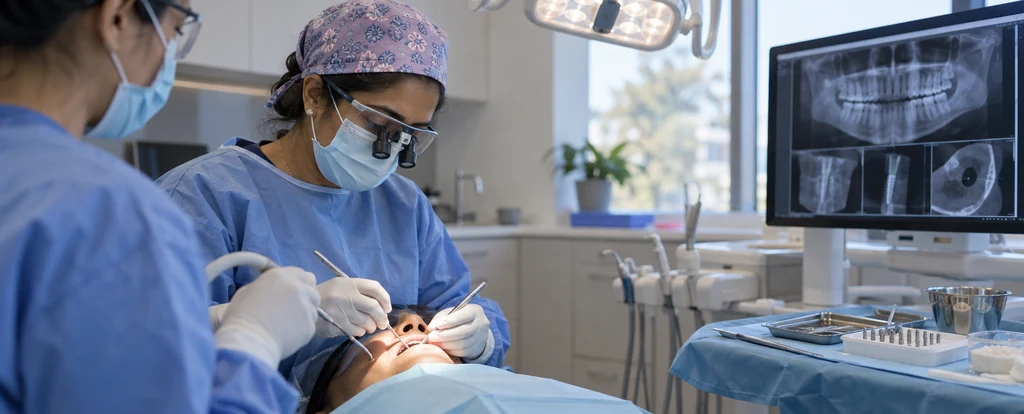
Periodontists are registered dental specialists, and their training and practice centre on the tissues around the tooth rather than the tooth itself. Most work in private specialist practices on referral from a general dentist, though some combine hospital clinic sessions with teaching or research. Implant placement and the long-term management of gum disease take up much of the week.
How much do periodontists earn?
The median full-time salary for a periodontist is $166,400 per annum, before tax, up $34,700 since 2018.
How you are paid depends on the setting, because specialists in private practice usually take a share of the fees they bill, so the referral base and case mix matter more than a set salary. Public hospital and university clinic roles pay against a health service or academic classification, which is steadier but generally lower. Practice owners carry the costs of equipment such as CBCT imaging and a surgical team, and their income reflects what is left after those.
What does a periodontist do day to day?
The list below is what fills most weeks; the exact mix shifts with seniority and whatever stage the current work is at.
- Diagnosing and treating gum disease, from early gingivitis through to advanced periodontitis
- Performing periodontal surgery such as flap surgery, crown lengthening and gum grafts
- Placing and maintaining dental implants, including the bone grafting some sites need first
- Reading radiographs and CBCT scans to assess bone levels and plan treatment
- Coaching patients through the home care and recall schedule that keeps gum disease under control
What skills do periodontists need?
Employers look for patient care and support, clinical assessment and treatment, infection control and hygiene, backed by Dentally fluency and strong attention to detail.
Specialist skills
- Patient care and support
- Clinical assessment and treatment
- Infection control and hygiene
- Care planning and coordination
- Health education and advice
Software and tools
- Dentally
- Exact
- Planmeca Romexis
- 3Shape
- Carestream Dental
General skills
- Attention to detail
- Written communication
- Empathy and interpersonal care
Is the job growing?
About 450 people work as periodontists in Australia, and employment is projected to grow 35.8% over the decade to 2035. That's very strong growth. Few roles in Australia are expanding this fast, and it points to solid demand for years to come.
How do you become a periodontist?
Here's the path most periodontists take, step by step.
- 1Complete a dental degree
A five-year Bachelor of Dental Surgery or Doctor of Dental Medicine accredited by the Dental Board of Australia is the starting point, and entry is competitive, usually resting on strong secondary results or a completed health science degree.
- 2Register and work as a dentist
General registration with AHPRA through the Dental Board of Australia lets you practise and build the clinical grounding in gum disease and implant cases that specialist training builds on. Most applicants spend at least a few years in general practice first.
- 3Finish accredited specialist training
Periodontics training runs through a university Doctor of Clinical Dentistry or an equivalent accredited program, generally three years full time, combining coursework, supervised clinical work and a research project.
- 4Register as a specialist
Specialist registration with AHPRA is separate from general registration and is what allows you to practise and advertise as a periodontist. You need the accredited qualification and the training program's completed requirements.
Ready to apply as a periodontist?
Whether you're working toward becoming a periodontist or already are one and want a hand with the next step (sharpening your resume for ATS screening, tightening your cover letter, or knowing what you'll actually be asked at interview), here are examples grounded in this specific role, not generic templates.
What jobs can a periodontist move to?
Moving into Dentist typically comes with the biggest pay rise, worth $1,700 a year more on average.
| Move to | Typical pay change | Overlap | Retraining |
|---|---|---|---|
| Dentist Specialist skills in gum disease and implant surgery carry across to general dental practice, where complex periodontal cases are common.Known move | +$1,700 | 44% | requalify |
Moves are chosen from Jobs and Skills Australia's Data on Occupation Mobility, which follows income tax records between 2011-12 and 2020-21, together with entry requirements and skill overlap. A known move is one people were seen making in that data. Pay change compares median full-time pay for the two roles.
Who works as a periodontist?
The typical periodontist is 45 years old; 68% are men, 78% work full-time, and full-timers average 40 hours a week.
- 45
- Median age
- 32%
- Female share
- 78%
- Full-time
- +0h
- vs all-jobs avg
What's it like being a periodontist?
The week mixes procedural sessions with consultation and review appointments, and most of it is booked weeks ahead because patients arrive on referral and then stay for years of maintenance. Surgery days are focused and physically demanding, with long periods standing and fine work in a small field, while review visits are quieter and more conversational. It suits people who like precision, continuity with the same patients and the diagnostic puzzle of working out why a case is not settling.
What people like
- Saving teeth that would otherwise be lost. A good deal of periodontal treatment keeps a tooth that another clinician expected to extract, and the result shows on a radiograph years later.
- A mix of surgery and diagnosis. The week alternates between operating and working out why a case is not settling, so it never becomes one long clinic.
- Patients you follow for years. Maintenance care means seeing the same people on a regular recall, and you know their history without going back through the file.
- Referral-based work. Patients arrive after another dentist has identified the problem, so the caseload stays within what you trained to treat.
What people find hard
- Cases arrive late. Many referrals come when bone loss is already advanced, so a lot of the work is managing disease rather than reversing it.
- Physically demanding surgery days. Long hours standing, fine instruments in a small field and awkward angles take a toll on the neck, shoulders and back.
- Delivering hard news. When a tooth cannot be saved, the conversation about extraction and replacement options falls to you.
- Location matters more than in general dentistry. Specialist referral numbers have to support a practice, so the work concentrates in larger centres and there are fewer places to choose from.
Based on our synthesis of professional-body surveys and public accounts of the role, not first-person verified reviews.
Which industries employ periodontists?
Dental services employs the largest share of periodontists, followed by Hospitals.
Top employing industries
- 1Dental services
- 2Hospitals
- 3Specialist medical services
- 4Tertiary education
- 5Health administration
Ranked by employment share; the source doesn't publish an exact percentage per industry.
| Bachelor degree | 52% | |
|---|---|---|
| Postgraduate | 26% | |
| Diploma / Advanced Diploma | 13% | |
| Other | 9% |
Will AI replace periodontists?
Exposure is low, because the work is surgical and hands-on: gum surgery and implant placement depend on direct assessment of tissue inside a patient's mouth. Imaging software and CBCT analysis already assist with measuring bone loss, and correspondence can be drafted automatically, but these support the clinician's judgement rather than replace the procedure. The diagnostic reasoning and the physical skill of operating in a small field are what hold their value.
Share of typical working time by exposure level
- Periodontal surgeryFlap surgery, grafts and crown lengthening are done by hand with direct sight and feel of the tissue, and no automated system performs them.30%low
- Implant placementGuided surgery software can help plan a site, but position and depth are still judged from the imaging and the feel of the bone as the site is prepared.30%low
- Assessing radiographs and CBCT scansSoftware now flags bone loss and takes measurements, which speeds up review, while interpreting the pattern and deciding what to treat stays with the periodontist.25%moderate
- Clinical records and referral correspondenceNotes and letters back to the referring dentist can be drafted from the appointment record, though they still need checking before they go out.15%high
Common questions about becoming a periodontist
Straight answers to the questions people ask most.
How much do periodontists earn?
The median is $166,400 per year before tax for full-time periodontists. Pay depends heavily on the setting, because private specialist practice earnings follow the fees you bill while public hospital and university roles pay a salaried classification. Practice owners also carry equipment and staffing costs, so their income reflects what the practice earns after those.
How do you become a periodontist?
You need a dental degree, general registration as a dentist, then an accredited specialist program in periodontics such as a Doctor of Clinical Dentistry, which usually takes three years. Specialist registration with AHPRA through the Dental Board of Australia follows. Most people work as a general dentist for a few years before applying.
Are periodontists in demand in Australia?
Periodontists are currently in shortage nationally, and employment is projected to grow 35.8% over the decade to 2035. Almost all patients arrive on referral from a general dentist, so demand depends on how much advanced gum disease is being diagnosed and treated across the wider dental system. Most of the work sits in private specialist practices.
Will AI replace periodontists?
Exposure here is low, because the core of the job is surgery and hands-on assessment of tissue inside a patient's mouth. Imaging software already helps with measuring bone loss on radiographs and CBCT scans, and clinical notes can be drafted automatically, but none of that places an implant or raises a flap. Diagnosis and planning still need a clinician who has examined the patient.
What other jobs can a periodontist move into?
Moving into general dentistry is common, where periodontal cases sit within a broader practice and pay is $1,700 more. Some periodontists move into university teaching, hospital dental departments or health administration, though these are less frequently recorded as moves. Many who stay in the field end up owning or running their own specialist practice, which is often where earnings grow.
How long does it take to become a periodontist?
Usually at least eight years after school: a five-year dental degree, a few years in general practice, then a three-year accredited specialist program. A research year or fellowship adds more time on top. The specialist qualification is the part that cannot be shortened.
Specialisation of
Related roles
Not sure this is you? Take the career quiz and get a ranked shortlist of roles that fit how you like to work.