Home Manufacturing & Production
Recycling Worker
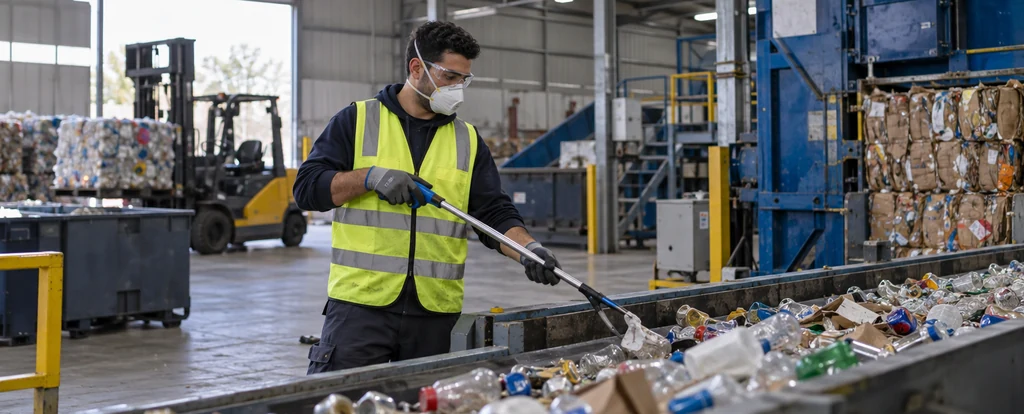
Recycling workers sort the mixed paper, glass, plastic and metal that arrives at a materials recovery facility, separating what can be sold on from what goes to landfill.
- Median salary*
- $59,800
4.0%vs last year, before tax
- People employed
- 3,000
0.0%vs last year
- Projected growth*
- +2%
to 2035
- AI exposure*
- Moderate
- automation risk
- Average hours*
- 38/wk
−2h vs all jobs
- Shortage status*
- Not in shortage
national
Recycling workers spend their shifts at a materials recovery facility, where household and commercial recycling arrives mixed together and leaves as separated bales of paper, glass, plastic and metal. The job is different from waste collection: collectors pick up the bins, while recycling workers sort and process what comes out of them. Most work for waste management companies, councils or the contractors that run council facilities.
How much do recycling workers earn?
The median full-time salary for a recycling worker is $59,800 per annum, before tax, up $12,400 since 2018.
Pay comes from the waste management award or a site enterprise agreement, so shift loadings, weekend work and overtime make up a real part of what lands in your account. Holding a forklift or front-end loader licence usually moves you onto a higher classification, and permanent roles with a council or a large contractor generally pay better than casual work through a labour hire agency.
What does a recycling worker do day to day?
The list below is what fills most weeks; the exact mix shifts with seniority and whatever stage the current work is at.
- Picking paper, plastic and glass off a moving conveyor and dropping each material into the right bunker
- Lifting out contaminants such as plastic bags, batteries and textiles before they jam the machinery
- Feeding cardboard and plastic into the baler and tying off the finished bales
- Driving a forklift to move baled material around the yard and load trucks
- Hosing down the sorting floor and checking guards, emergency stops and personal protective equipment at the start of a shift
What skills do recycling workers need?
Employers look for operations management, plant and equipment operation, worksite safety management, backed by Conveyor sorting systems fluency and strong physical stamina and dexterity.
Specialist skills
- Operations management
- Plant and equipment operation
- Worksite safety management
- Cleaning and grounds maintenance
Software and tools
- Conveyor sorting systems
- Baling machines
- Forklifts
- PPE (gloves, masks, high-vis vests)
- Material recovery facility equipment
General skills
- Physical stamina and dexterity
- Attention to detail
- Safety and compliance awareness
Is the job growing?
About 3,000 people work as recycling workers in Australia, and employment is projected to grow 2% over the decade to 2035. That's modest growth: demand is steady rather than booming.
How do you become a recycling worker?
Here's the path most recycling workers take, step by step.
- 1Start in a labouring role at a facility
Most recycling workers begin on the sorting line, either through a labour hire agency or by applying directly to a waste management company. The site trains you on the conveyor, safe manual handling and the protective equipment you need.
- 2Get a forklift licence
A forklift licence, issued as the LF high risk work licence, is the qualification employers ask for once you move off the line. It opens up baler, yard and truck loading work, which is generally paid at a higher classification.
- 3Add plant operating experience
Training in front-end loader or excavator operation lets you move material around the site rather than sort it by hand. It is usually picked up on the job or through a short course, and it is the step that leads towards plant operator roles.
- 4Consider a Certificate III in waste management
A Certificate III in waste management covers material recovery, contamination control and site safety, and it can be studied while you work. It is the qualification to aim for if you want to supervise a shift or help run a facility.
Ready to apply as a recycling worker?
Whether you're working toward becoming a recycling worker or already are one and want a hand with the next step (sharpening your resume for ATS screening, tightening your cover letter, or knowing what you'll actually be asked at interview), here are examples grounded in this specific role, not generic templates.
What jobs can a recycling worker move to?
Moving into Loader Operator typically comes with the biggest pay rise, worth $34,800 a year more on average.
| Move to | Typical pay change | Overlap | Retraining |
|---|---|---|---|
| Loader Operator Recycling workers handle materials and operate equipment, which transfers to operating loaders in plant settings. | +$34,800 | 63% | short course |
| Aircraft Refueller Recycling workers handle hazardous materials safely, a skill that transfers to refuelling aircraft. | +$20,800 | 75% | short course |
| Waste Collector Recycling workers understand waste sorting and material recovery, which carries into collecting and transporting waste. | +$16,200 | 61% | minimal |
| Scrap Metal Recycler Recycling workers sort materials, a skill that transfers to separating and processing scrap metal. | +$8,700 | 52% | short course |
| Glass Production Operator Recycling workers sort and process materials, a background that carries into glass production operations. | +$5,200 | 67% | minimal |
Moves are chosen from Jobs and Skills Australia's Data on Occupation Mobility, which follows income tax records between 2011-12 and 2020-21, together with entry requirements and skill overlap. A known move is one people were seen making in that data. Pay change compares median full-time pay for the two roles.
Who works as a recycling worker?
The typical recycling worker is 38 years old; 79% are men, 51% work full-time, and full-timers average 38 hours a week.
- 38
- Median age
- 21%
- Female share
- 51%
- Full-time
- −2h
- vs all-jobs avg
What's it like being a recycling worker?
The rhythm of the job is set by the line: shifts begin with safety checks, run at whatever speed the machines are set to, and finish once the day's material is baled. It suits people who prefer steady physical work with a visible result and who don't mind noise, dust and early starts. The main pressure is volume, because a badly contaminated load or a breakdown can back the whole line up.
What people like
- You can see what you sorted by the end of the shift. The line turns mixed bin contents into stacked bales of clean material, and the day's progress is right there in the yard.
- A set routine and a fixed shift. The crew starts at the same time each day and works through a known sequence of checks, sorting and baling, so there are few surprises in how the day runs.
- You can start without experience or a qualification. Facilities train new starters on the line, so a labouring job at a materials recovery facility is a realistic first step for someone with no industry background.
- Work that keeps you on your feet. Shifts are active and the day tends to pass quickly, which appeals to people who would rather move than sit.
What people find hard
- Noise, dust and odour. The plant runs loud machinery and the air carries dust and smell from the incoming material, so hearing protection and masks are part of the job rather than optional extras.
- Contamination and sharps. Batteries, needles and rotting food waste turn up in the stream, and pulling them out of the line is the least pleasant part of a shift.
- Weather and shift patterns. Yard and loading work continues through heat and rain, and many facilities run early starts, weekend rosters or rotating shifts.
- Repetitive line work. Picking from a conveyor for a full shift is hard on the hands and shoulders, and the pace is set by the machines rather than by you.
Based on our synthesis of professional-body surveys and public accounts of the role, not first-person verified reviews.
Which industries employ recycling workers?
Electricity, Gas, Water and Waste Services employs the largest share of recycling workers, followed by Wholesale Trade.
Top employing industries
- 1Electricity, Gas, Water and Waste Services
- 2Wholesale Trade
- 3Health Care and Social Assistance
- 4Manufacturing
- 5Administrative and Support Services
Ranked by employment share; the source doesn't publish an exact percentage per industry.
| Certificate III/IV | 34% | |
|---|---|---|
| Diploma / Advanced Diploma | 26% | |
| Bachelor degree | 20% | |
| Year 12 or below | 20% |
Will AI replace recycling workers?
Sorting is the part of this job most exposed to automation, and it sits at a moderate level overall. Optical sorters and robotic picking arms already separate some materials faster than a person can and will take on more of the repetitive picking, but the condition of the incoming material keeps people in the process, because tangled bags, batteries and mixed loads still need someone to pull them out. Balers, forklifts and site safety remain firmly in human hands.
Share of typical working time by exposure level
- Picking and sorting materials on the conveyorAutomated optical and near-infrared sorters can identify and eject plastics, paper and metal faster than a person, so this is where the line is most likely to shrink.30%high
- Operating balers, forklifts and plantBaler controls and forklift telematics are becoming more automated, but setting up a bale, clearing a jam and moving stock around a busy yard still needs an operator.25%moderate
- Cleaning the site and doing safety checksHosing down the sorting floor, checking guards and emergency stops and managing traffic in the yard are hands-on tasks that no current system performs on its own.25%low
- Removing contaminants and checking load qualitySensors can flag a contaminated load, but someone still has to climb in, pull out the plastic wrap or battery and decide whether the rest is worth processing.20%moderate
Moves least exposed to AI
These career moves from recycling worker work are rated low for AI exposure:
- Loader Operator
High skill overlap (63%), short course to get there, and a low automation-risk profile.
- Aircraft Refueller
High skill overlap (75%), short course to get there, and a low automation-risk profile.
Common questions about becoming a recycling worker
Straight answers to the questions people ask most.
How much do recycling workers earn?
Recycling workers earn $59,800 per year before tax. The figure depends on your classification under the waste management award, shift loadings and whether you hold a forklift or loader licence.
How do I become a recycling worker?
Most people start in a labouring or production role at a materials recovery facility, where the employer trains you on the sorting line. A forklift licence helps you move into baler and yard work, and a Certificate III in waste management is useful if you want to supervise. You don't need a degree to get started.
Are recycling workers in demand?
Recycling workers are currently not in shortage, and employment is projected to grow 2% over the decade to 2035. The practical step if you're looking for work is to contact the waste management companies and councils that run facilities in your area, since hiring happens site by site.
Will AI or robots replace recycling workers?
Automated optical sorters and robotic picking arms already handle part of the sorting line, and they will take on more of the repetitive picking. They still struggle with tangled or heavily contaminated loads, so manual sorting, quality checks, plant operation and yard work remain in human hands.
What other jobs can recycling workers move into?
Knowledge of material streams carries into waste collection, where pay is $16,200 more, and the equipment and material handling experience leads into loader operation, where pay is $34,800 more. Sorting and processing experience also transfers to glass production operator roles.
Do I need a White Card to work as a recycling worker?
Not for a standard materials recovery facility, though some employers ask for one if you will be working at construction and demolition waste sites. The White Card is the general construction induction card required to enter construction sites in Australia.
Related roles
- Waste Collector
- Scrap Metal Recycler
- Loader Operator
- Glass Production Operator
- Aircraft Refueller
- Laundry Worker
Not sure this is you? Take the career quiz and get a ranked shortlist of roles that fit how you like to work.