Home Manufacturing & Production
Sail Maker
Sail makers cut, sew and finish the sails and canvas covers that boats rely on, working from design plans and the boat's own measurements.
- Median salary*
- $61,400
4.2%vs last year, before tax
- People employed
- 200
0.0%vs last year
- Projected growth
- +6%
to 2035
- AI exposure*
- Moderate
- automation risk
- Average hours
- 39/wk
−1h vs all jobs
- Shortage status
- Not in shortage
national
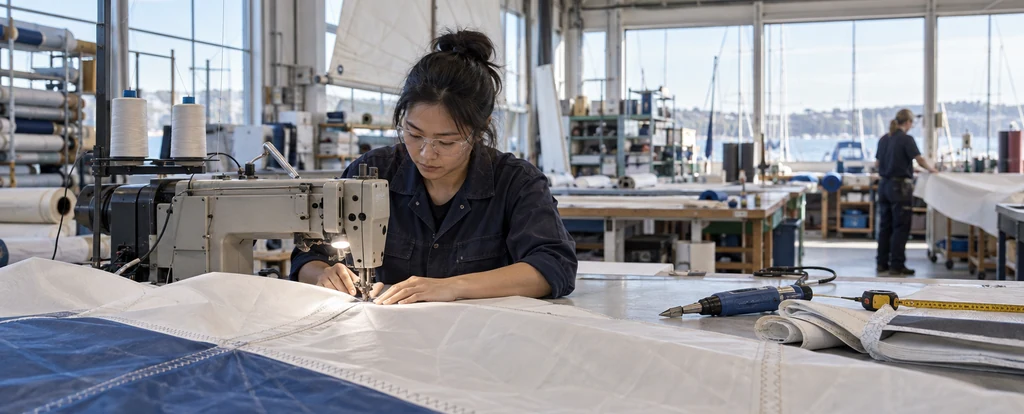
Most sail makers work in a loft, where panels of sailcloth are spread across a long clear floor for cutting, joining and finishing. The trade sits close to canvas goods making, but sail work adds the shape of the sail itself: the curve cut into each panel and the way the seams hold that curve under load. With about 200 people in the trade, lofts are usually small businesses where the same person measures a boat, quotes the job, cuts, sews and fits.
How much do sail makers earn?
The median full-time salary for a sail maker is $61,400 per annum, before tax, up $12,900 since 2018.
Almost all sail makers work for small manufacturing businesses, so pay follows the award or enterprise agreement that covers the loft rather than a large employer's salary scale. Experience with high-performance sailcloth, design software or the fitting side of the trade is what usually moves a sail maker up the scale. Weekend and evening work in the busy season often attracts penalty rates.
What does a sail maker do day to day?
The list below is what fills most weeks; the exact mix shifts with seniority and whatever stage the current work is at.
- Measuring boats and marking sailcloth from design plans and client specifications
- Laying out and cutting panels on the loft floor, keeping the cloth flat and square
- Joining panels on industrial sewing machines and bonding equipment
- Fitting hardware, batten pockets, reefing points and telltales
- Inspecting, repairing and re-cutting worn sails and canvas covers
What skills do sail makers need?
Employers look for craft and handmade production, hand and power tool work, reading plans and specifications, backed by Sailpack design software fluency and strong attention to detail.
Specialist skills
- Craft and handmade production
- Hand and power tool work
- Reading plans and specifications
- Plant and equipment operation
Software and tools
- Sailpack design software
- Rhino 3D
- Industrial walking-foot sewing machines
- Ultrasonic welding equipment
- Hot knife cutters
General skills
- Attention to detail
- Time and deadline management
- Client relationships and advisory
Is the job growing?
About 200 people work as sail makers in Australia, and employment is projected to grow 6% over the decade to 2035. That's modest growth: demand is steady rather than booming.
How do you become a sail maker?
Here's the path most sail makers take, step by step.
- 1Learn to sew heavy fabric
Industrial sewing, canvas work or upholstery is the usual starting point, whether through a TAFE certificate, a school based placement or a job in a canvas goods workshop. Being able to run a walking foot machine and handle a hot knife gives you a real grounding before you approach a loft.
- 2Approach lofts directly
Sail making is a small trade and apprenticeships are advertised rarely, so a short resume plus a call or visit to lofts in your area is the usual way in. Starting on repairs, covers and general hand work lets you learn the trade while the loft gets to know you.
- 3Complete an apprenticeship or certificate
Where a sail making apprenticeship is available it combines paid work in a loft with a certificate III, and otherwise a certificate III or IV in textile fabrication or a related field covers similar ground. Either way the qualification is built around years of supervised work, not classroom study alone.
- 4Build sea knowledge
Time on boats, racing or cruising, teaches how a sail sets under load and makes more sense of the measurements you take on a rig. Lofts value it because fitting a finished sail at the dock is part of the job.
- 5Learn the design and layout side
Sail design software such as Sailpack and 3D tools like Rhino are part of how panels are planned, and learning them separates someone working on the floor from someone who can quote and plan a whole sail.
Ready to apply as a sail maker?
Whether you're working toward becoming a sail maker or already are one and want a hand with the next step (sharpening your resume for ATS screening, tightening your cover letter, or knowing what you'll actually be asked at interview), here are examples grounded in this specific role, not generic templates.
What jobs can a sail maker move to?
Moving into Upholsterer typically comes with the biggest pay rise, worth $18,000 a year more on average.
| Move to | Typical pay change | Overlap | Retraining |
|---|---|---|---|
| Upholsterer Sail makers' industrial sewing and fabric fitting suit upholstery, though furniture framing and finishing require a separate apprenticeship. | +$18,000 | 28% | requalify |
| Canvas Goods Maker Sail makers bring heavy canvas cutting and stitching to making awnings, tents and covers, with extra training in non-marine products. | +$1,000 | 50% | reskill |
| Garment Cutter Sail makers measure, mark and cut technical fabrics, so garment cutting uses the same hand skills with little retraining. | −$1,600 | 62% | minimal |
Moves are chosen from Jobs and Skills Australia's Data on Occupation Mobility, which follows income tax records between 2011-12 and 2020-21, together with entry requirements and skill overlap. A known move is one people were seen making in that data. Pay change compares median full-time pay for the two roles.
Who works as a sail maker?
The typical sail maker is 50 years old; 87% are men, 73% work full-time, and full-timers average 39 hours a week.
- 50
- Median age
- 13%
- Female share
- 73%
- Full-time
- −1h
- vs all-jobs avg
What's it like being a sail maker?
Loft work runs to the sailing calendar: quieter weeks spent building new sails, then a rush before the season starts and a steady run of repairs after heavy weather. The day moves between computer based design work and long stretches standing at a cutting table or a machine, so it suits someone who likes both the planning and the physical finish. Accuracy counts ahead of speed, because a sail that sets badly is expensive to redo.
What people like
- Your work ends up on the water. A sail leaves the loft with a boat's name on it, and you often see it out racing or cruising within the same season.
- Varied work across the week. Measuring a boat, plotting panels, sewing seams and fitting hardware at the dock are distinct jobs, so the days do not blur into one.
- Craft that shows in the result. A few millimetres in panel layout changes how a sail sets, which gives you a clear link between careful work and a good outcome.
- Small teams and direct feedback. In a loft of a few people you deal with the owner whose sail you are making, so you hear quickly whether it worked.
What people find hard
- Few employers to choose from. Sail making is concentrated in a small number of lofts, usually near the water, so work can mean a move or a long commute.
- Hard on the body. Spreading and pulling heavy cloth across a concrete floor, kneeling to fit hardware and standing at a machine all day add up over a week.
- Seasonal crunches. Repairs and new sails cluster in the weeks before the season and after rough weather, so those periods run long and sometimes through weekends.
- Work tied to owners' budgets. When boat owners put off a new sail or a repair, the loft's workload drops, and a small business feels that within a month.
Based on our synthesis of professional-body surveys and public accounts of the role, not first-person verified reviews.
Which industries employ sail makers?
Manufacturing employs the largest share of sail makers.
Top employing industries
- 1Manufacturing
Ranked by employment share; the source doesn't publish an exact percentage per industry.
| Certificate III/IV | 46.8% | |
|---|---|---|
| Year 12 or below | 39.8% | |
| Diploma / Advanced Diploma | 7% | |
| Bachelor degree | 3.5% | |
| Postgraduate | 1.5% |
Will AI replace sail makers?
Sail making sits in the middle: design and panel layout now lean on software like Sailpack and Rhino, and cutting is increasingly done by computer controlled machines rather than by hand. The cloth still has to be spread, tensioned and stitched by hand on heavy industrial machines, and measuring a rig or fitting a sail at the dock is physical work done on site.
Share of typical working time by exposure level
- Cutting and assembling sailcloth panelsPanel shapes are plotted in design software and cut by machine more often than by hand, but the cloth still has to be spread, aligned and watched as it goes through.30%moderate
- Sewing and bonding seamsIndustrial machines and ultrasonic bonding handle the join, yet steering long, heavy seams and keeping tension even is still a person's job at the machine.30%moderate
- Measuring boats and fitting sails on the dockReading a rig, taking measurements and checking how a sail sets on the day depends on being at the boat and adjusting there.25%low
- Talking with owners and quoting workWorking out what a customer actually needs from a tired sail or a new set comes from a conversation and a look at how they sail.15%low
Moves least exposed to AI
These career moves from sail maker work are rated low for AI exposure:
- Upholsterer
Some skill overlap (28%), requalify to get there, and a low automation-risk profile.
Common questions about becoming a sail maker
Straight answers to the questions people ask most.
How much does a sail maker earn?
Sail makers earn around $61,400 per annum, before tax, for full-time work. The range is wide because lofts are small businesses and pay often follows the manufacturing award plus whatever the individual employer offers. Experience with high-performance sails, design software or fitting is what tends to lift it.
How do you become a sail maker?
About 47% of sail makers hold a certificate III or IV, usually from a sail making apprenticeship or a textile fabrication course, while others learn the work on the job in a loft. Because the trade is small, apprenticeships are advertised rarely, so approaching lofts directly and starting on repairs and covers is a common route in.
Are sail makers in demand?
Sail makers are currently not in shortage, and employment is projected to grow 6% over the decade to 2035. Because the trade is tiny, that change amounts to a handful of jobs, so whether a loft near you is hiring matters more to your chances than the national trend. Skills in design software or high-performance sailcloth broaden the lofts that will consider you.
Will AI replace sail makers?
Design and panel layout are the most exposed parts of the job, and software such as Sailpack and Rhino already does work that was once drawn and lofted by hand. Cutting and joining are partly automated too, but spreading, aligning and stitching heavy cloth still needs a person at the machine. Measuring boats and fitting sails on the dock stays hands-on.
What jobs can a sail maker move into?
Canvas goods making uses the same heavy fabric cutting and industrial stitching as sail work, with a move paying $1,000 more. Garment cutting shares the pattern layout and cutting skills with little retraining, and pays $1,600 less. Experienced sail makers often end up running or taking over a loft, which is usually where earnings grow.
Do you need to sail to be a sail maker?
No, though it helps. Understanding how a sail sets under load makes more sense of measuring a rig or fitting hardware at the dock, and plenty of people come into the trade from canvas work, upholstery or industrial sewing with no racing background.
Related roles
Not sure this is you? Take the career quiz and get a ranked shortlist of roles that fit how you like to work.