Stonemason
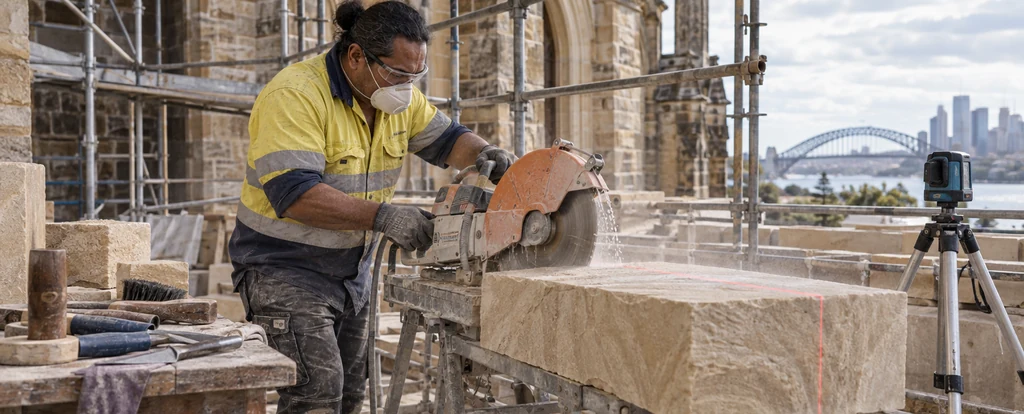
Stonemasons cut, shape and set natural stone for walls, floors, facades and monuments, working the material by hand and with power tools.
- Median salary*
- $72,800
3.7%vs last year, before tax
- People employed
- 4,800
0.0%vs last year
- Projected growth
- +9.8%
to 2035
- AI exposure*
- Low
- automation risk
- Average hours
- 42/wk
+2h vs all jobs
- Shortage status
- In shortage
national
Stonemasons work with granite, sandstone, marble and bluestone in workshops, on construction sites and on heritage buildings. Where bricklayers lay manufactured bricks and blocks that arrive at a standard size, stonemasons measure, cut and finish each piece themselves, which is why the trade takes longer to learn and is often called on for restoration. Most are employed by specialist stone companies, construction firms or monumental masons, and some work for themselves on smaller jobs.
How much do stonemasons earn?
The median full-time salary for a stonemason is $72,800 per annum, before tax, up $15,000 since 2018.
What you earn follows the building and construction award, so your classification, whether you have finished your apprenticeship and any site or enterprise agreement set the base rate. Heritage restoration, memorial work and stone benchtop fabrication sit at different rates, and penalty rates and overtime on commercial sites add to weekly pay. Stonemasons who subcontract or run their own business price each job themselves, so their earnings move with the work they can win.
What does a stonemason do day to day?
The list below is what fills most weeks; the exact mix shifts with seniority and whatever stage the current work is at.
- Cutting and shaping stone blocks and slabs with chisels, mallets, masonry saws and angle grinders
- Setting stone in mortar or with mechanical fixings for walls, floors, facades and paving
- Reading plans and specifications and setting out dimensions before the first cut
- Mixing mortar and grout, then sealing and finishing stone surfaces
- Repointing and restoring heritage stonework to match original material and profiles
What skills do stonemasons need?
Employers look for craft and handmade production, hand and power tool work, reading plans and specifications, backed by Masonry saw fluency and strong attention to detail.
Specialist skills
- Craft and handmade production
- Hand and power tool work
- Reading plans and specifications
- Worksite safety management
- Building codes and standards
Software and tools
- Masonry saw
- Angle grinder
- Stone chisels and mallets
- Diamond blades
- Laser level
General skills
- Attention to detail
- Physical stamina and dexterity
Is the job growing?
About 4,800 people work as stonemasons in Australia, and employment is projected to grow 9.8% over the decade to 2035. That's modest growth: demand is steady rather than booming.
How do you become a stonemason?
Here's the path most stonemasons take, step by step.
- 1Finish Year 10 or Year 12
Most employers want Year 10 as a minimum, and maths, technical drawing or woodwork subjects help you read plans and work out quantities. There is no prerequisite beyond that.
- 2Get a White Card before you step on site
The general construction induction card is required to work on a construction site in every state and territory. It takes a day of training and a short assessment, delivered by registered training organisations.
- 3Start a Certificate III in Stonemasonry apprenticeship
The apprenticeship usually runs three to four years and combines paid work with an employer and off-the-job training with a registered training organisation. You finish as a qualified stonemason who can work unsupervised in the trade.
- 4Choose a specialisation
Stonemasons tend to settle into heritage restoration, monumental and memorial work, or benchtops and interior stone, and the tools and skills differ between them. Benchtop work is mostly workshop-based, while restoration involves site assessment and matching old material.
- 5Come across from another trade
Bricklayers, cabinet makers and concreters already bring setting out, cutting and finishing skills, and some employers will take them on with recognition of prior learning toward the Certificate III. Builder's labourers usually enter through the apprenticeship instead.
Ready to apply as a stonemason?
Whether you're working toward becoming a stonemason or already are one and want a hand with the next step (sharpening your resume for ATS screening, tightening your cover letter, or knowing what you'll actually be asked at interview), here are examples grounded in this specific role, not generic templates.
What jobs can a stonemason move to?
Moving into Bricklayer typically comes with the biggest pay rise, worth $47,700 a year more on average.
| Move to | Typical pay change | Overlap | Retraining |
|---|---|---|---|
| Bricklayer Masonry skills in cutting and laying stone transfer directly to bricklaying, with the same setting out and mortar work.Known move | +$47,700 | 62% | reskill |
| Concreter Stonemasons already work with formwork, reinforcement and finishing, so moving into concreting needs little retraining. | +$42,100 | 67% | minimal |
| Carpenter Stonemasons bring structural setting out and precise cutting to carpentry, a common next step in building trades.Known move | +$18,700 | 57% | reskill |
| Landscaper Stonemasons bring stone cutting and setting skills to landscaping, building garden walls, paving and features.Known move | −$7,800 | 36% | reskill |
| Tiler Laying and cutting stone tiles draws on stonemasonry skills, making tiling an adjacent trade with shared tools. | −$11,400 | 62% | reskill |
Moves are chosen from Jobs and Skills Australia's Data on Occupation Mobility, which follows income tax records between 2011-12 and 2020-21, together with entry requirements and skill overlap. A known move is one people were seen making in that data. Pay change compares median full-time pay for the two roles.
Who works as a stonemason?
The typical stonemason is 38 years old; 99% are men, 79% work full-time, and full-timers average 42 hours a week.
- 38
- Median age
- 1%
- Female share
- 79%
- Full-time
- +2h
- vs all-jobs avg
What's it like being a stonemason?
Stonemasonry is slow, physical work with a clear rhythm: cutting and finishing in the workshop, then fitting on site in dust and weather. The trade rewards patience and precision more than speed, because stone is expensive and a wrong cut is hard to undo. It suits people who like working with their hands and want to see a finished piece still standing in decades.
What people like
- Working with natural material. Every block of sandstone or granite behaves a little differently, so the job never becomes purely repetitive.
- Work that lasts. A wall, facade or memorial you set can stand for generations, and restoration jobs put your work on buildings people visit.
- Hand skills that keep improving. The craft rewards practice, since chisel work and finishing are things you get noticeably better at over years, and experienced stonemasons are valued on site.
- Changing settings. One week might be a workshop bench, the next a heritage church, a cemetery or a new office lobby, so the working environment shifts.
What people find hard
- Dust and silica. Cutting and grinding stone produces crystalline silica dust, which causes silicosis, so the job comes with strict controls such as water suppression, extraction and respirators that you wear every time.
- Physically punishing. Stone is heavy, and lifting, kneeling and working overhead add up over a career. Most stonemasons feel it in their back, shoulders and hands.
- Weather and site conditions. Outdoor setting is cold, wet and hot work, and heritage jobs often mean scaffolding, hoists and tight access.
- Gaps between projects. Small stone firms work project to project, so there can be quiet stretches between contracts, and self-employed stonemasons carry the cost of quoting and waiting.
Based on our synthesis of professional-body surveys and public accounts of the role, not first-person verified reviews.
Which industries employ stonemasons?
Manufacturing employs the largest share of stonemasons, followed by Construction.
Top employing industries
- 1Manufacturing
- 2Construction
Ranked by employment share; the source doesn't publish an exact percentage per industry.
| Year 12 or below | 45.4% | |
|---|---|---|
| Certificate III/IV | 40.4% | |
| Diploma / Advanced Diploma | 4.7% | |
| Bachelor degree | 4.3% | |
| Postgraduate | 0.7% |
Will AI replace stonemasons?
Stonemasonry is low exposure to AI and automation because the work is physical, happens on site, and changes with every piece of stone. Machine cutting, waterjet and CNC benchtop fabrication, and laser templating have taken over some repetitive shaping in the workshop, which shifts how the cutting is done rather than removing the need for a stonemason. Setting, finishing and restoration stay with the person holding the chisel.
Share of typical working time by exposure level
- Setting stone on site in mortar or fixingsLevelling a course of sandstone against a wall, or fixing a facade panel several metres up, depends on reading the building in front of you.30%low
- Cutting stone to size with saws and grindersBench saws and waterjet or CNC machines handle straight cuts and repeated benchtop profiles quickly, but angled cuts, thick blocks and matching an existing profile still come down to the operator.25%moderate
- Reading plans and setting out dimensionsDigital drawings and laser templating speed up measuring a kitchen or a facade, but someone still has to translate the plan into lines on stone and check it against the site.25%low
- Repointing and restoring heritage stoneworkMatching an 1890s mortar mix and carving a replacement corbel to the original profile is judgement and hand skill, and heritage approvals expect a qualified tradesperson on the job.20%low
Common questions about becoming a stonemason
Straight answers to the questions people ask most.
How much do stonemasons earn?
Stonemasons earn a median of $72,800 per annum, before tax. What you actually take home depends on your employer, your classification under the building award, and whether you work in a workshop, on commercial sites or on heritage projects.
How do you become a stonemason?
The usual route is a Certificate III in Stonemasonry (CPC32320) apprenticeship, which takes three to four years and is paid while you train. You also need a White Card to work on a construction site, and employers generally expect Year 10 or Year 12.
Are stonemasons in demand?
Stonemasons are currently in shortage nationally, and employment is projected to grow 9.8% over the decade to 2035 over the decade to 2035. For someone finishing an apprenticeship, that points to steady work rather than a crowded field, though most jobs still come through specialist stone firms and construction employers.
Will AI or automation replace stonemasons?
The trade rates as low exposure. Cutting, setting and restoring stone is physical, hands-on work in a setting where every piece is different, and site work cannot be templated or automated. Where technology has arrived it is in the workshop, with CNC and waterjet machines cutting benchtops and laser templating measuring a kitchen before fabrication, which changes how the cutting is done rather than removing the trade.
What else can a stonemason do?
Bricklaying is a common move and pays $47,700 more, and concreting is another at $42,100 more, because stonemasons already work with formwork, reinforcement and finishing. Cabinet makers move the other way into stonemasonry, bringing precision cutting and fitting to benchtop work. Many stonemasons eventually run their own stone business or subcontract, which is often where earnings grow.
What is the difference between a stonemason and a bricklayer?
Stonemasons cut and finish natural stone to size, while bricklayers lay manufactured bricks and blocks that arrive in standard dimensions. The trades share mortar work and setting out, and plenty of stonemasons move into bricklaying, but stone work demands far more measuring, shaping and finishing of the material itself.
Related roles
Not sure this is you? Take the career quiz and get a ranked shortlist of roles that fit how you like to work.