Tree Faller
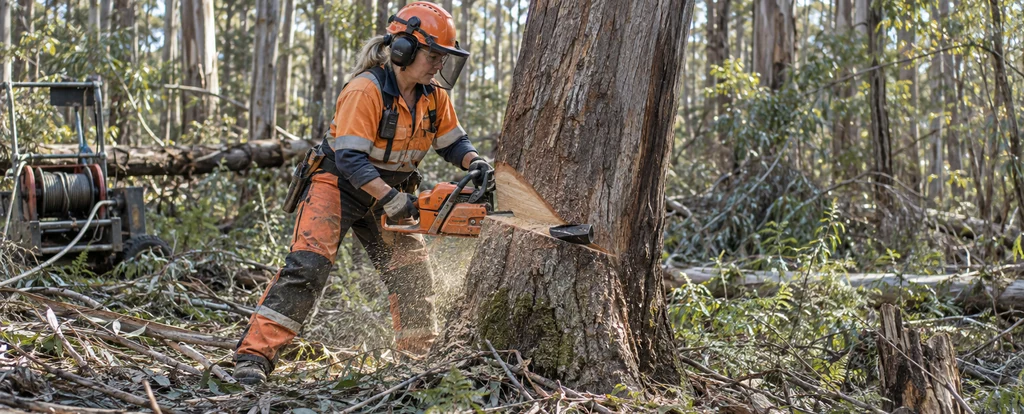
Tree fallers cut down trees in native forest, plantation and land clearing operations, controlling the direction of the fall so people, machinery and standing timber stay safe.
- Median salary*
- $77,000
3.6%vs last year, before tax
- People employed
- 590
1.7%vs last year
- Projected growth
- +6.3%
to 2035
- AI exposure*
- Low
- automation risk
- Average hours
- 49/wk
+9h vs all jobs
- Shortage status*
- In shortage (regional)
national
Tree fallers work outdoors in forests, plantations and on clearing sites, usually as part of a small crew and often a long drive from the nearest town. What separates the job from forestry work generally is the falling itself: reading lean, wind and defects in the tree, then cutting so it lands where it was planned to land. Most are employed by forestry contractors or land management businesses, and entry is usually through a traineeship rather than a degree.
How much do tree fallers earn?
The median full-time salary for a tree faller is $77,000 per annum, before tax, up $15,900 since 2018.
Pay depends on whether you are employed on wages or contracted by volume, and the rate reflects the size and species of the timber you cut. Remote and regional operations sometimes add travel or camp allowances, and work on construction or land clearing sites is structured differently from plantation forestry. Experience with larger trees and a consistent safety record is what moves a faller up the rates.
What does a tree faller do day to day?
The list below is what fills most weeks; the exact mix shifts with seniority and whatever stage the current work is at.
- Assessing tree species, lean, defects and surrounding hazards before cutting
- Planning and clearing an escape route away from the fall line
- Operating chainsaws to make directional scarf cuts and back cuts
- Using wedges, levers and winches to guide the direction of fall
- Limbing and cutting felled trees to log lengths, and maintaining saws in the field
What skills do tree fallers need?
Employers look for hand and power tool work, plant and equipment operation, worksite safety management, backed by Stihl chainsaws fluency and strong safety and compliance awareness.
Specialist skills
- Hand and power tool work
- Plant and equipment operation
- Worksite safety management
Software and tools
- Stihl chainsaws
- Husqvarna chainsaws
- Felling wedges and levers
- Forestry winch
- Two-way radio
General skills
- Safety and compliance awareness
- Physical stamina and dexterity
- Attention to detail
- Problem solving
Is the job growing?
About 590 people work as tree fallers in Australia, and employment is projected to grow 6.3% over the decade to 2035. That's modest growth: demand is steady rather than booming.
How do you become a tree faller?
Here's the path most tree fallers take, step by step.
- 1Get on a forestry or land management crew
Most fallers start as a forestry worker, bush crew member or labourer, learning saw handling on small trees under supervision. No formal entry requirement applies, but employers look for fitness, reliability and a willingness to follow safety procedures.
- 2Complete a Certificate III in Forest Operations
The qualification covers felling technique, chainsaw maintenance, hazard assessment and first aid, and is often done as a traineeship so you earn while you train. About 62% of people in the job have Year 12 or below as their highest qualification, which reflects how much of the skill is learned on the ground.
- 3Build up through tree size and site type
Fellers usually start on plantation or small regrowth timber and move to larger native trees as skill, judgement and a clean safety record accumulate. Moving up too quickly is how most serious injuries happen.
- 4Keep qualifications and licences current
Chainsaw competency units, first aid and, on construction or clearing sites, a White Card are commonly required. A heavy vehicle licence helps if you want to combine falling with hauling, and native forest harvesting rules differ between states.
Ready to apply as a tree faller?
Whether you're working toward becoming a tree faller or already are one and want a hand with the next step (sharpening your resume for ATS screening, tightening your cover letter, or knowing what you'll actually be asked at interview), here are examples grounded in this specific role, not generic templates.
What jobs can a tree faller move to?
Moving into Truck Driver typically comes with the biggest pay rise, worth $24,900 a year more on average.
| Move to | Typical pay change | Overlap | Retraining |
|---|---|---|---|
| Truck Driver Tree fallers can move into truck driving, using machinery and site safety experience, but need heavy vehicle training and licensing.Known move | +$24,900 | 14% | reskill |
| Forestry Worker Forestry work uses the same harvesting and safety knowledge, with a short course covering broader forestry duties.Known move | −$12,000 | 58% | short course |
| Gardener Tree fallers bring chainsaw and tree care skills to gardening, though a horticulture qualification is needed to work independently.Known move | −$17,200 | 45% | reskill |
Moves are chosen from Jobs and Skills Australia's Data on Occupation Mobility, which follows income tax records between 2011-12 and 2020-21, together with entry requirements and skill overlap. A known move is one people were seen making in that data. Pay change compares median full-time pay for the two roles.
Who works as a tree faller?
The typical tree faller is 39 years old; 96% are men, 81% work full-time, and full-timers average 49 hours a week.
- 39
- Median age
- 4%
- Female share
- 81%
- Full-time
- +9h
- vs all-jobs avg
What's it like being a tree faller?
Tree falling is weather-dependent outdoor work with a long day either side of it, and the average full-time week runs to about 49 hours. The rhythm is set by the block or the job site rather than by a clock, with early starts, travel to remote coupes and pauses when wind or wet ground makes the work unsafe. People who do well tend to be comfortable deciding alone, careful with equipment, and willing to spend years building up to bigger timber.
What people like
- You see what you did by the end of the day. Felling is measurable work: trees down, cut to length and extracted, with a block that is finished when you leave it.
- Your own judgement, outdoors. Once the plan is set, the cuts are yours to make. There is little supervision in the bush, and the job suits people who prefer that.
- Skills that carry across the bush. Chainsaw, machinery and safety skills move into forestry crews, fire and emergency work and land management roles.
- Small crews, clear roles. You usually work with two or three others, with the faller, the machine operator and the extraction crew each knowing their part.
What people find hard
- Weather takes days you do not get paid for. Wind, wet ground and total fire bans stop falling, and contract or casual crews absorb those lost days themselves.
- The danger does not fade with experience. Dead limbs, trees under tension and hung-up timber can hurt a veteran as easily as a beginner, which is why escape routes and staged cuts matter on every tree.
- Long days, often far from home. Remote blocks mean early starts, long drives and, on some jobs, weeks in camp accommodation away from family.
- Hard on the body. Carrying saws and fuel over rough ground, chainsaw vibration and constant noise take a toll, and many fallers manage knee, back and hearing problems over a career.
Based on our synthesis of professional-body surveys and public accounts of the role, not first-person verified reviews.
Which industries employ tree fallers?
Agriculture, Forestry and Fishing employs the largest share of tree fallers, followed by Administrative and Support Services.
Top employing industries
- 1Agriculture, Forestry and Fishing
- 2Administrative and Support Services
- 3Manufacturing
Ranked by employment share; the source doesn't publish an exact percentage per industry.
| Year 12 or below | 61.8% | |
|---|---|---|
| Certificate III/IV | 29.4% | |
| Diploma / Advanced Diploma | 2.7% | |
| Bachelor degree | 1.2% | |
| Postgraduate | 1% |
Will AI replace tree fallers?
This is a low-exposure job, because a chainsaw is a hand tool and the decisions that matter are made on the spot, tree by tree, in conditions that change as the day goes on. Mechanised harvesters have taken over felling on flatter plantation sites and mapping software now plans blocks and marks hazards, but on steep, native and urban sites the falling is still done by hand.
Share of typical working time by exposure level
- Making the scarf and back cutsThe directional cut and the back cut are made by hand, and the strip of timber left between them steers where the tree lands.35%low
- Limbing, cutting to length and keeping saws sharpMachine processors handle this on plantation sites, but a hand faller still strips limbs, cuts to the lengths the mill wants and files the chain in the field.30%moderate
- Reading the tree before the first cutLean, species, dead limbs and what sits around the fall line decide where and how the cuts go, and that call is made standing at the stump.20%low
- Planning the drop zone with the crewRadio calls and agreed escape routes keep the faller, the machine operator and the extraction crew out of each other's way, with mapping apps showing boundaries and hazards.15%moderate
Common questions about becoming a tree faller
Straight answers to the questions people ask most.
How much does a tree faller earn?
Tree fallers earn $77,000 per year before tax, based on full-time workers. Whether you are paid wages or by the volume you cut is the biggest single factor, followed by tree size and how much of the year the weather lets you work.
How do you become a tree faller?
Most people start on a forestry crew and learn under an experienced faller, often through a traineeship while completing a Certificate III in Forest Operations (FWP30122). That course covers chainsaw use, felling technique, maintenance and hazard assessment, and you build from small plantation trees to larger timber as your record grows.
Are tree fallers in demand?
Tree fallers are currently in shortage in regional areas, and employment is projected to grow 6.3% over the decade to 2035. With about 590 people in the job nationally, vacancies tend to appear through the contractors and crews already working in a region, so local contacts and a current chainsaw qualification count for a lot.
Will automation replace tree fallers?
Automation already does part of the job: on flatter plantation sites, mechanised harvesters fell and process trees that were once cut by hand, and mapping software now plans blocks and marks hazards. Hand falling is still used on steep, native and urban sites where machines cannot safely go, and the judgement about lean, defects and escape routes stays with the faller.
Do you need a licence to fell trees?
There is no single national licence for tree falling, but employers and contractors expect recognised chainsaw competency units, first aid and, on construction or clearing sites, a White Card. Rules for harvesting native forest differ between states, so check the requirements where you plan to work.
What can a tree faller move into later?
Forestry work uses the same harvesting and safety knowledge, with about 58% of the skills in common, and a short course covers the wider duties of the role. Gardening applies similar tree care and chainsaw skills and pays about $17,200 less, though working independently needs a horticulture qualification, while truck driving pays about $24,900 more and requires heavy vehicle training and licensing. Many experienced fallers also end up contracting or running a small felling crew of their own, and that is often where earnings grow.
Related roles
Not sure this is you? Take the career quiz and get a ranked shortlist of roles that fit how you like to work.