Air Conditioning Technician
Air conditioning technicians install, service and repair the systems that keep homes, offices and warehouses at the right temperature.
- Median salary
- $109,200
4.4%vs last year, before tax
- People employed
- 29,700
1.0%vs last year
- Projected growth
- +6.7%
to 2035
- AI exposure*
- Low
- automation risk
- Average hours
- 43/wk
+3h vs all jobs
- Shortage status
- In shortage
national
Air conditioning technicians work across residential, commercial and industrial sites, from a single split system in a lounge room to ducted plant serving an office tower. The trade sits close to refrigeration mechanics, since both work on sealed refrigerant systems, but it differs from general electrical work because the focus is airflow, ductwork and refrigerant rather than wiring alone. Most technicians work for HVAC contractors or building services firms, with construction and other trade services the main sources of work.
How much do air conditioning technicians earn?
The median full-time salary for an air conditioning technician is $109,200 per annum, before tax, up $23,100 since 2018.
Where you work and what hours you work move the figure most. Commercial and industrial technicians covered by enterprise agreements generally earn more than residential installers, and overtime, after-hours callouts and breakdown work in summer add to a weekly wage. Running your own contracting business is the other common way earnings grow, though it comes with the cost of a van, tools and refrigerant handling gear.
What does an air conditioning technician do day to day?
The list below is what fills most weeks; the exact mix shifts with seniority and whatever stage the current work is at.
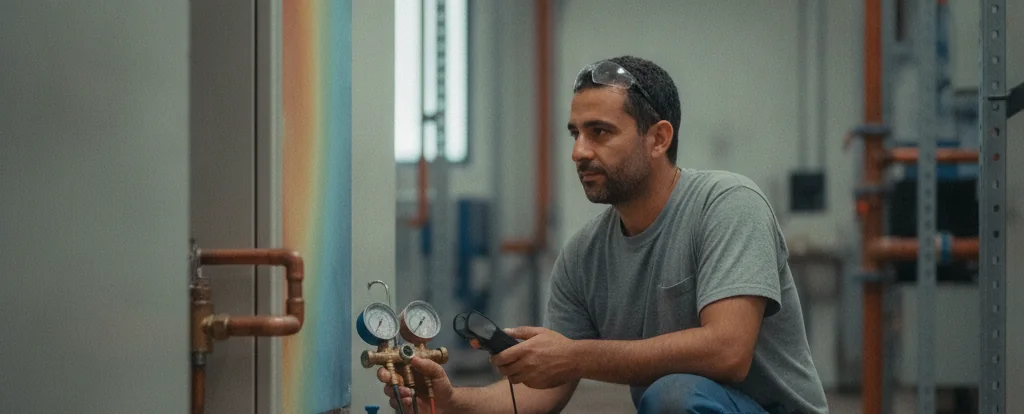
- Diagnosing why a system has stopped cooling using gauges and meters before deciding what actually needs replacing
- Squeezing into roof spaces, ceiling cavities and plant rooms to install or service ducted and split systems
- Handling refrigerant safely while repairing compressors, coils and pipework without leaks
- Testing airflow and temperatures across a building once work is finished to confirm the system is actually performing
- Fitting extra callouts around the installation schedule when summer heat pushes breakdown jobs to the top of the list
What skills do air conditioning technicians need?
Employers look for hand and power tool work, reading plans and specifications, installation and maintenance, backed by Refrigerant recovery machine fluency and strong problem solving.
Specialist skills
- Hand and power tool work
- Reading plans and specifications
- Installation and maintenance
- Worksite safety management
- Plant and equipment operation
- Building codes and standards
Software and tools
- Refrigerant recovery machine
- Digital multimeter
- Pressure gauge set
- Thermal imaging camera
- Ductwork fabrication tools
General skills
- Problem solving
- Attention to detail
Is the job growing?
About 29,700 people work as air conditioning technicians in Australia, and employment is projected to grow 6.7% over the decade to 2035. That's modest growth: demand is steady rather than booming.
How do you become an air conditioning technician?
Here's the path most air conditioning technicians take, step by step.
- 1Get an apprenticeship with an HVAC contractor
The usual entry point is a four-year apprenticeship that combines paid on-the-job training with study, so you earn while you learn. Larger mechanical services firms often advertise intakes late in the year, and applying directly to local contractors works too.
- 2Complete a Certificate III in Air Conditioning and Refrigeration
Delivered through TAFE or another registered training organisation as part of the apprenticeship. It covers refrigeration theory, electrical principles, brazing, ductwork and safe refrigerant handling.
- 3Get your refrigerant handling licence
The Australian Refrigeration Council issues the licence you need to buy, handle and recover refrigerant. You apply once you have finished the qualification, and it is renewed each year.
- 4Add the restricted electrical licence for your state
Wiring rules and licensing differ between states and territories, so check what your local regulator requires before you disconnect or reconnect a system to mains power. In most states this is a separate licence on top of the refrigeration qualification.
- 5Use your existing trade if you have one
Electricians and plumbers can often have prior training recognised and complete the refrigeration units rather than start a new apprenticeship. It is a shorter route in, but you still need the refrigerant licence before working unsupervised.
Ready to apply as an air conditioning technician?
Whether you're working toward becoming an air conditioning technician or already are one and want a hand with the next step (sharpening your resume for ATS screening, tightening your cover letter, or knowing what you'll actually be asked at interview), here are examples grounded in this specific role, not generic templates.
What jobs can an air conditioning technician move to?
Moving into Construction Manager typically comes with the biggest pay rise, worth $85,900 a year more on average.
| Move to | Typical pay change | Overlap | Retraining |
|---|---|---|---|
| Construction Manager Trade knowledge and site experience support the move into construction management, with a building diploma needed to take on the role.Known move | +$85,900 | 29% | reskill |
| Electrician Electrical training and wiring skills carry across directly, making general electrical work a natural sideways step for this trade.Known move | +$4,700 | 74% | reskill |
| Plumber Air conditioning technicians bring pipework and electrical fault-finding experience, though registration as a plumber requires further training.Known move | −$5,700 | 85% | requalify |
| Mechanical Services Plumber This specialism covers chilled water and hydronic systems, the same commercial pipework air conditioning technicians already install and service. | −$13,000 | 100% | requalify |
| Sheet Metal Worker Air conditioning technicians already fabricate and fit ductwork, so sheet metal work builds on existing metal-shaping and installation skills.Known move | −$37,400 | 61% | requalify |
Moves are chosen from Jobs and Skills Australia's Data on Occupation Mobility, which follows income tax records between 2011-12 and 2020-21, together with entry requirements and skill overlap. A known move is one people were seen making in that data. Pay change compares median full-time pay for the two roles.
Who works as an air conditioning technician?
The typical air conditioning technician is 31 years old; 99% are men, 91% work full-time, and full-timers average 43 hours a week.
- 31
- Median age
- 1%
- Female share
- 91%
- Full-time
- +3h
- vs all-jobs avg
What's it like being an air conditioning technician?
The trade runs on the seasons. Spring and autumn are heavy with installations and scheduled maintenance, while a run of hot days turns the schedule into a queue of breakdowns and the technician on call goes wherever the failures are. It suits people who like tracing a fault back to its cause and don't mind heat, heights or tight spaces, and it rewards a methodical approach because refrigerant work leaves little room for guesswork.
What people like
- Faults give you something to work out. A system that has stopped cooling rarely announces its own problem, so you work through pressures, temperatures and airflow until the cause is clear. That diagnostic part of the job is what many technicians enjoy most.
- You can see the result. By the end of an install or a repair the room is cool and the system is running to specification, and the customer notices straight away. The work is tangible.
- The job moves around. You spend the week moving between plant rooms, roofs, new builds and occupied homes rather than sitting at one desk. The range of equipment, from small splits to chilled water plant, keeps the work varied.
- Skills that travel. Refrigeration and air conditioning work exists in every city and town, and the Certificate III is recognised across Australia. That gives you room to move without starting over.
What people find hard
- Ceiling spaces in a heatwave. The busiest time of year is also the hardest time to be up a ladder or inside a roof cavity, and breakdown callouts often land in the hottest part of the day.
- Breakdowns don't wait for the schedule. A failure at a supermarket, aged care home or data centre can mean dropping the planned job and driving across town. After-hours rosters are common in commercial service work.
- The paperwork is real. Every job needs refrigerant records, job notes and often a compliance certificate, and that side of the trade has grown as regulation has tightened.
- Installs can get repetitive. New-build work sometimes means fitting the same split system or duct run dozens of times in a row. It's steady work, but not the interesting end of the trade.
Based on our synthesis of professional-body surveys and public accounts of the role, not first-person verified reviews.
Which industries employ air conditioning technicians?
Construction employs the largest share of air conditioning technicians, followed by Other Services.
Top employing industries
- 1Construction
- 2Other Services
Ranked by employment share; the source doesn't publish an exact percentage per industry.
| Certificate III/IV | 69.2% | |
|---|---|---|
| Year 12 or below | 21.4% | |
| Diploma / Advanced Diploma | 4.8% | |
| Bachelor degree | 2.6% | |
| Postgraduate | 0.5% |
Will AI replace air conditioning technicians?
This is a low-exposure trade. Scheduling, quoting, job notes and refrigerant records are increasingly generated from templates and photos, and some diagnostic software suggests likely faults, but the work happens in buildings that are each a bit different. Running pipework, brazing, recovering refrigerant and confirming a system performs still need someone on site with tools.
Share of typical working time by exposure level
- Installing and fitting equipmentRunning copper lines, hanging units and fitting ductwork in occupied homes and tight plant rooms is physical site work that no robot does yet.35%low
- Servicing and refrigerant handlingRecovering, weighing in and leak testing refrigerant is licensed work done by hand, and the readings only tell you what to do next if you know the system.25%low
- Diagnosing faults on siteSoftware can point to a likely cause, but you still trace the problem with gauges and a multimeter, and older or badly installed systems rarely match the fault codes.20%moderate
- Quoting, job notes and compliance recordsPhoto-to-quote tools and template-generated job reports and refrigerant records already cut the time this takes on a typical service call.20%high
Common questions about becoming an air conditioning technician
Straight answers to the questions people ask most.
How much does an air conditioning technician earn?
Full-time air conditioning technicians earn a median of $109,200 per year before tax. Pay moves with your sector and your hours: commercial and industrial service work generally pays more than residential installation, and overtime and after-hours callouts add to weekly earnings.
How do you become an air conditioning technician?
The standard path is a four-year apprenticeship with an HVAC contractor while you complete a Certificate III in Air Conditioning and Refrigeration (UEE32225) through TAFE or another registered training organisation. You then need a refrigerant handling licence from the Australian Refrigeration Council, and in most states a restricted electrical licence to disconnect and reconnect equipment.
Are air conditioning technicians in demand?
Air conditioning technicians are currently in shortage nationally, and employment is projected to grow 6.7% over the decade to 2035 over the decade. The growth figure describes the longer trend while the current picture tells you how the market looks right now, and the qualification employers ask for is the same either way.
Will AI replace air conditioning technicians?
Not in the near term. Software is changing the office side of the job, with scheduling, quoting, job notes and refrigerant records increasingly generated from templates and photos, and some diagnostic tools suggest likely faults. The work itself happens in buildings that are each a bit different, and running pipework, brazing, recovering refrigerant and confirming a system performs still need someone on site with tools.
What can air conditioning technicians move into?
General electrical work is a common move because the circuit and wiring knowledge carries across, and electricians are paid $4,700 more. Moving into plumbing means requalifying, and plumbers are paid $5,700 less. Construction management pays $85,900 more and needs a building diploma, and plenty of technicians eventually start their own contracting business, which is often where earnings grow.
Is the job physically demanding?
Yes. It involves lifting, kneeling, crawling through ceiling spaces and carrying tools and equipment up ladders, often in hot or cramped conditions. Most technicians build up a tolerance over the apprenticeship, and heavier installation work is usually shared across a crew rather than done alone.
Related roles
Not sure this is you? Take the career quiz and get a ranked shortlist of roles that fit how you like to work.