Animal Husbandry Technician
Animal husbandry technicians look after livestock day to day, handling feeding, health checks and breeding records on farms and in research or animal health settings.
- Median salary*
- $62,400
4.0%vs last year, before tax
- People employed
- 380
5.0%vs last year
- Projected growth*
- +3.5%
to 2035
- AI exposure*
- Moderate
- automation risk
- Average hours*
- 40/wk
matches all-jobs average
- Shortage status*
- In shortage (regional)
national
Most animal husbandry technicians work on beef, dairy, sheep or poultry properties, where they are the people who notice and record what is happening in a herd or flock under the direction of a farm manager or veterinarian. The role sits closer to production than an animal attendant's, which is mostly companion animals in clinics, shelters and kennels. A technician might run a small mob on a family farm or work a shed of thousands of birds, and much of the job happens on foot, on a quad bike or from a ute.
How much do animal husbandry technicians earn?
The median full-time salary for an animal husbandry technician is $62,400 per annum, before tax, up $13,000 since 2018.
On-farm livestock work is covered by the Pastoral Award for most employers, which sets minimum rates for ordinary hours and higher rates for overtime and public holidays. What you take home depends on whether the position is full time, casual or seasonal, and on whether the farm provides housing, a vehicle or other allowances as part of the package. Responsibility moves pay more than length of service: technicians who run herd health programs, breeding records or a poultry shed on their own sit above the entry rate.
What does an animal husbandry technician do day to day?
The list below is what fills most weeks; the exact mix shifts with seniority and whatever stage the current work is at.
- Feeding and watering stock to the ration or pasture plan the farm manager sets
- Checking animals for lameness, weight loss or illness, then treating or reporting what you find
- Assisting with joining, pregnancy scanning, calving or lambing and artificial insemination programs
- Maintaining fences, yards, troughs and shelter so stock stay contained, watered and dry
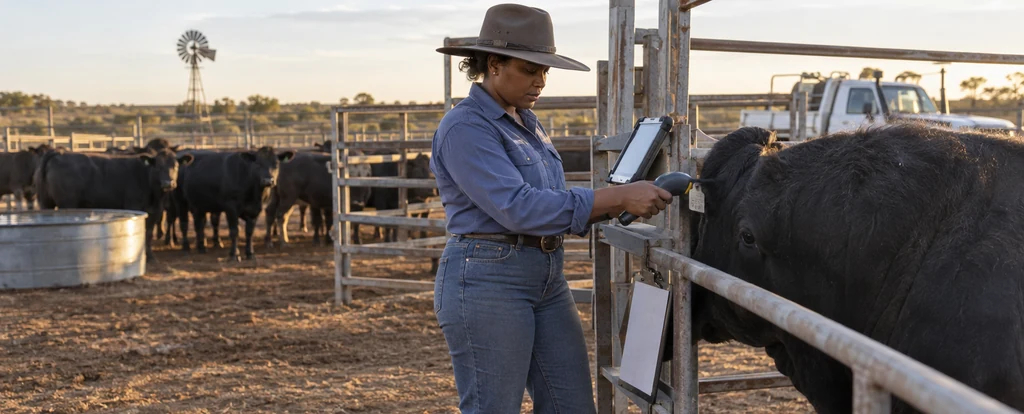
- Recording treatments, movements and production data in herd management software and scanning ear tags with an EID reader
What skills do animal husbandry technicians need?
Employers look for animal care and handling, operations management, backed by Herd management software fluency and strong attention to detail.
Specialist skills
- Animal care and handling
- Operations management
Software and tools
- Herd management software
- RFID scanners
- Electronic identification (EID) systems
- Farm management software
General skills
- Attention to detail
- Written communication
- Problem solving
- Physical stamina and dexterity
Is the job growing?
About 380 people work as animal husbandry technicians in Australia, and employment is projected to grow 3.5% over the decade to 2035. That's modest growth: demand is steady rather than booming.
How do you become an animal husbandry technician?
Here's the path most animal husbandry technicians take, step by step.
- 1Finish Year 12 or an equivalent
No farm background is required to start, though biology or agriculture subjects make the theory in a certificate easier to follow. Many people come into the role straight from school.
- 2Complete a Certificate III in Agriculture
This is the standard entry qualification and covers livestock handling, nutrition, animal health and safe work. It is often done as a traineeship or school-based apprenticeship on a property, so you earn while you learn.
- 3Build supervised experience with livestock
Employers look for demonstrated handling of cattle, sheep or poultry, and most ask for a driver licence. Some roles also want a chemical handling certificate for drenching or spraying.
- 4Add a Certificate IV or Diploma of Agriculture for senior work
These qualifications cover herd health programs, nutrition planning and supervising staff, and they open up technician and assistant manager positions on larger properties.
- 5Consider a degree if you want research or clinical settings
An animal science or veterinary technology degree is a longer route into research stations, breed societies and veterinary practices, where technicians work alongside vets rather than farm managers.
Ready to apply as an animal husbandry technician?
Whether you're working toward becoming an animal husbandry technician or already are one and want a hand with the next step (sharpening your resume for ATS screening, tightening your cover letter, or knowing what you'll actually be asked at interview), here are examples grounded in this specific role, not generic templates.
What jobs can an animal husbandry technician move to?
Moving into Animal Health Officer typically comes with the biggest pay rise, worth $15,600 a year more on average.
| Move to | Typical pay change | Overlap | Retraining |
|---|---|---|---|
| Animal Health Officer Livestock health knowledge supports biosecurity and inspection work, though a diploma in animal health is required. | +$15,600 | 23% | reskill |
| Zookeeper Animal care and enclosure management transfer to captive wildlife, with a short course in zoo keeping. | +$4,000 | 47% | short course |
| Aquaculture Worker Feeding, monitoring and husbandry routines transfer to fish farming, with a short course in aquaculture operations. | +$2,600 | 53% | short course |
| Shearer Handling and restraint skills transfer to shearing, with a short course covering shearing technique and wool handling. | +$2,100 | 64% | short course |
| Horse Trainer Livestock handling and animal conditioning carry into horse training, with a short course in equine care. | −$2,600 | 75% | short course |
Moves are chosen from Jobs and Skills Australia's Data on Occupation Mobility, which follows income tax records between 2011-12 and 2020-21, together with entry requirements and skill overlap. A known move is one people were seen making in that data. Pay change compares median full-time pay for the two roles.
Who works as an animal husbandry technician?
The typical animal husbandry technician is 39 years old; 55% are men, 78% work full-time, and full-timers average 40 hours a week.
- 39
- Median age
- 45%
- Female share
- 78%
- Full-time
- +0h
- vs all-jobs avg
What's it like being an animal husbandry technician?
The day is shaped by the animals rather than the clock, with feeding and checking rounds starting early and calving, lambing or shearing bringing stretches of longer hours. The work is physical and outdoors in whatever the weather is doing, balanced by record keeping that has to be accurate because it feeds breeding and treatment decisions. It suits people who are calm around large animals, comfortable working alone on a property, and inclined to notice small changes before they become problems.
What people like
- Days spent with animals, not in meetings. Most of the work happens in yards, paddocks and sheds, and the feedback is immediate: you can see whether a mob is settled, gaining weight or hanging back.
- Records that change decisions. Weights, treatments and joining dates give the manager something concrete to act on, and over a season you can see what your recording has improved.
- Practical skill that builds. Handling and stock sense are learned on the job and stay useful, whether you stay in livestock production or move into shearing, horse work or biosecurity later.
- A clear daily routine. Stock need the same care every day, which suits people who like knowing what the morning looks like and finishing with the job actually done.
What people find hard
- Early starts and weather. Feeding rounds often begin before daylight, and the work continues through heat, mud, dust and cold snaps.
- Seasonal crunch periods. Calving, lambing, shearing and poultry batch changes compress the workload into a few weeks, and taking time off then is difficult.
- Losing animals you have cared for. Even with close monitoring, stock get sick, injured or die, and handling that without becoming careless is part of the job.
- Location and limited employers. The work is concentrated in regional areas, so it can mean moving away from a city, and there are only so many properties within driving distance.
Based on our synthesis of professional-body surveys and public accounts of the role, not first-person verified reviews.
Which industries employ animal husbandry technicians?
Beef Cattle Farming employs the largest share of animal husbandry technicians, followed by Dairy Cattle Farming.
Top employing industries
- 1Beef Cattle Farming
- 2Dairy Cattle Farming
- 3Sheep and Wool Production
- 4Poultry Farming
- 5Veterinary and Animal Health Services
Ranked by employment share; the source doesn't publish an exact percentage per industry.
| Certificate III/IV | 34% | |
|---|---|---|
| Diploma / Advanced Diploma | 26% | |
| Bachelor degree | 20% | |
| Year 12 or below | 20% |
Will AI replace animal husbandry technicians?
This is a moderately exposed role: the record keeping and monitoring side of the work is being automated steadily, while the handling stays hands-on. Herd management software, EID ear tags, walk-over weighing and automatic drafters now do much of the counting, weighing and treatment history, which changes how the job is done rather than removing it. What stays with the technician is reading stock in the paddock, deciding which animal needs attention and handling it safely.
Share of typical working time by exposure level
- Feeding and animal health checksWalking or driving the paddocks and yards to check every mob for lameness, weight loss or illness happens by eye and by hand, and no sensor picks up a shy animal that has gone off its feed.35%low
- Handling, moving and restraining livestockMoving cattle or sheep through yards and restraining them for treatment depends on stock sense and timing that automatic drafters cannot supply across a mixed property.25%low
- Recording weights, treatments and movementsWalk-over weighing, EID scanners and herd management software capture most of this automatically, so the technician increasingly checks and corrects the record rather than writing it up.25%high
- Assisting with breeding, calving and lambingBreeding software tracks joining dates and expected calving and can flag animals to watch, while assisting a difficult birth or tagging newborns still needs hands on the animal.15%moderate
Moves least exposed to AI
These career moves from animal husbandry technician work are rated low for AI exposure:
- Shearer
High skill overlap (64%), short course to get there, and a low automation-risk profile.
- Horse Trainer
High skill overlap (75%), short course to get there, and a low automation-risk profile.
- Animal Health Officer
Some skill overlap (23%), reskill to get there, and a low automation-risk profile.
- Zookeeper
Solid skill overlap (47%), short course to get there, and a low automation-risk profile.
Common questions about becoming an animal husbandry technician
Straight answers to the questions people ask most.
How much does an animal husbandry technician earn?
The median for full-time animal husbandry technicians is $62,400 per annum, before tax. Treat that as a guide, because the award, the season, casual loading and any housing or vehicle provided all move the figure.
How do you become an animal husbandry technician?
The usual route is a Certificate III in Agriculture (AHC30122), often completed as a traineeship on a farm so you earn while you learn. A Certificate IV or diploma then opens up herd health and supervision work, and some people enter through an animal science or veterinary technology degree.
Are animal husbandry technicians in demand?
Animal husbandry technicians are currently in shortage in regional areas, so openings sit near livestock regions rather than being spread evenly across the country. Employment is projected to grow 3.5% over the decade to 2035, and with about 380 people in the occupation, jobs tend to come one property at a time rather than in batches.
Will AI replace animal husbandry technicians?
AI and automation reach the record keeping and monitoring side of the job, not the animals themselves. EID tags, walk-over weighing and herd management software already capture much of the counting and treatment history, while someone still has to move stock, spot the animal off its feed and decide what to do about it.
Where can animal husbandry work lead?
Animal health officer work is a step up and pays $15,600 more, though the biosecurity and inspection side needs a diploma in animal health. Shorter moves include aquaculture work ($2,600 more) and shearing ($2,100 more), both of which build on handling skills you already use. Track riders and animal attendants can come the other way, with a short course or a fuller qualification in livestock care.
Is animal husbandry work seasonal?
Calving, lambing, shearing and poultry batch cycles create busy periods, but stock need feeding and checking every day, so most positions are ongoing rather than seasonal. Casual and relief work does pick up around those peaks.
Related roles
Not sure this is you? Take the career quiz and get a ranked shortlist of roles that fit how you like to work.