Home Manufacturing & Production
Blacksmith
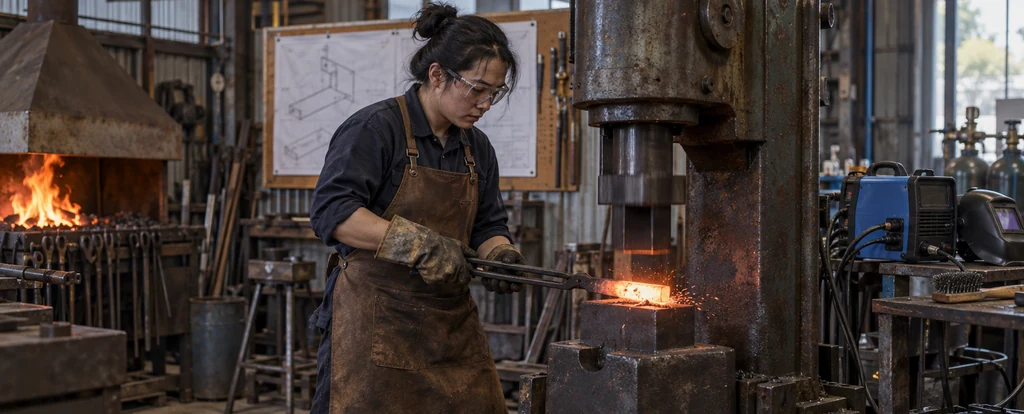
A blacksmith heats metal in a forge and shapes it by hand, making and repairing gates, tools, hardware and architectural ironwork.
- Median salary*
- $72,800
3.7%vs last year, before tax
- People employed
- 240
20.0%vs last year
- Projected growth
- +4.8%
to 2035
- AI exposure*
- Low
- automation risk
- Average hours
- 45/wk
+5h vs all jobs
- Shortage status
- In shortage
national
Blacksmiths work in small forges and workshops, heating metal until it softens and shaping it with hammers, a power hammer or a press. Much of the work is custom or small-batch: gates, balustrades, hinges, hand tools, farm repairs and heritage restoration. It differs from the fabrication and welding that happens in the same workshops, where metal is usually cut and joined cold from stock rather than forged.
How much do blacksmiths earn?
The median full-time salary for a blacksmith is $72,800 per annum, before tax, up $15,000 since 2018.
Award or enterprise agreement rates set the base for blacksmiths employed in a workshop, and overtime or penalty rates apply when a job runs past the usual day. Self-employed blacksmiths earn from commissions, so income moves with the type of work, the materials bill and how accurately each piece was quoted. Specialising in heritage restoration or architectural ironwork changes both what you can charge and how long each piece takes.
What does a blacksmith do day to day?
The list below is what fills most weeks; the exact mix shifts with seniority and whatever stage the current work is at.
- Heating bar and billet in a forge until the metal is soft enough to move
- Hammering, bending and twisting hot metal on the anvil to form a part
- Drawing out, upsetting and joining sections with a power hammer, press or forge weld
- Reading drawings and setting out dimensions for custom or repair work
- Grinding, wire brushing and applying finishes that stop the metal rusting
What skills do blacksmiths need?
Employers look for hand and power tool work, fabrication and finishing, reading plans and specifications, backed by Fusion 360 fluency and strong attention to detail.
Specialist skills
- Hand and power tool work
- Fabrication and finishing
- Reading plans and specifications
- Plant and equipment operation
- Worksite safety management
- Craft and handmade production
Software and tools
- Fusion 360
- AutoCAD
- MIG welder
- power hammer
- plasma cutter
General skills
- Attention to detail
- Problem solving
Is the job growing?
About 240 people work as blacksmiths in Australia, and employment is projected to grow 4.8% over the decade to 2035. That's modest growth: demand is steady rather than booming.
How do you become a blacksmith?
Here's the path most blacksmiths take, step by step.
- 1Try the work before you commit
Short blacksmithing courses and open forge days run through TAFE, heritage sites and state blacksmithing associations. They are a low-cost way to find out whether you enjoy the heat, the noise and the repetition of forging before you sign up to a trade.
- 2Start a Certificate III through an apprenticeship
The usual entry is a Certificate III in Engineering (Fabrication Trade) with forging or blacksmithing units, delivered through a paid apprenticeship that takes about four years. Not every provider offers the forging stream, so check what your local TAFE or private training provider runs, as options differ by state.
- 3Add a speciality
Bladesmithing, toolmaking, architectural ironwork and heritage restoration all need training beyond the trade certificate, and each has its own tools and techniques. Farriery is a separate trade again, built around travelling to horses rather than working at a forge.
- 4Decide between a workshop and your own forge
Because blacksmithing businesses are small, the pathway often leads to self-employment rather than a job in a large workshop. Setting up a forge takes workspace, tools, insurance and a customer base as much as it takes forging skill.
Ready to apply as a blacksmith?
Whether you're working toward becoming a blacksmith or already are one and want a hand with the next step (sharpening your resume for ATS screening, tightening your cover letter, or knowing what you'll actually be asked at interview), here are examples grounded in this specific role, not generic templates.
What jobs can a blacksmith move to?
Moving into Metal Machinist typically comes with the biggest pay rise, worth $62,700 a year more on average.
| Move to | Typical pay change | Overlap | Retraining |
|---|---|---|---|
| Metal Machinist Blacksmiths bring precision metal work and tool knowledge, moving into machining roles that require measuring, cutting and finishing metal parts. | +$62,700 | 85% | reskill |
| Fitter Blacksmiths bring metal trade skills and hand tool proficiency, moving into fitting work that assembles, aligns and maintains machinery. | +$18,200 | 74% | reskill |
| Metal Fabricator Blacksmiths bring hot metal shaping, joining and hand tool skills to fabrication work, moving into structural and custom metal production. | +$15,000 | 61% | reskill |
| Welder Blacksmiths bring forge welding and metal joining experience, moving into welding roles that need heat control and strong fabrication skills. | +$15,000 | 61% | reskill |
| Foundry Moulder Blacksmiths bring experience with molten metal, heat treatment and casting tools, moving into foundry work shaping moulds and poured components. | −$2,600 | 85% | reskill |
Moves are chosen from Jobs and Skills Australia's Data on Occupation Mobility, which follows income tax records between 2011-12 and 2020-21, together with entry requirements and skill overlap. A known move is one people were seen making in that data. Pay change compares median full-time pay for the two roles.
Who works as a blacksmith?
The typical blacksmith is 51 years old; 98% are men, 71% work full-time, and full-timers average 45 hours a week.
- 51
- Median age
- 2%
- Female share
- 71%
- Full-time
- +5h
- vs all-jobs avg
What's it like being a blacksmith?
Much of the day is spent standing at a forge or anvil, moving between the fire and the hammer while the metal is still soft. Between heats there is grinding, finishing, drawing and quoting, and a commission can run for weeks from first sketch to installation. The trade suits people who like working with their hands, are patient with repetition, and would rather finish a piece themselves than watch a machine do it.
What people like
- You see the finished piece. A gate, a set of hinges or a repaired tool leaves the workshop as a solid object you made, rather than a task ticked off a list.
- The metal gives immediate feedback. Steel only moves when it is hot enough and struck in the right place, so each heat tells you straight away whether your hammer control is improving.
- The work covers a wide range. Heritage ironwork, farm repairs, toolmaking and decorative pieces each call for different techniques, which keeps the bench varied.
- You can specialise. Bladesmithing, architectural ironwork and restoration all build on the same foundation, so there is room to go deeper in one direction once the basics are solid.
What people find hard
- Heat, noise and physical load. Summer days at a forge are hot, the workshop is loud, and the work is done standing and swinging hammers. Hearing and eye protection are worn most of the day.
- Small workshops, little company. Most blacksmiths work alone or in teams of two or three, so quiet days with no one else around are part of the job rather than an exception.
- Custom work is hard to price. Every one-off piece takes a different number of hours, and quoting too low means the extra time comes out of your own pocket.
- Skills take years to build. Hammer control and heat judgement come from repetition, and early work rarely matches the drawing. New smiths spend a long time on simpler jobs first.
Based on our synthesis of professional-body surveys and public accounts of the role, not first-person verified reviews.
Which industries employ blacksmiths?
Manufacturing employs the largest share of blacksmiths.
Top employing industries
- 1Manufacturing
Ranked by employment share; the source doesn't publish an exact percentage per industry.
| Certificate III/IV | 44% | |
|---|---|---|
| Year 12 or below | 38.6% | |
| Bachelor degree | 7.4% | |
| Diploma / Advanced Diploma | 4.5% | |
| Postgraduate | 1.2% |
Will AI replace blacksmiths?
Blacksmithing sits at the low end of AI exposure, because the core of the job is shaping hot metal by hand, and that depends on heat judgement and hammer control rather than data. CAD and design software have made drawing and quoting faster, and plasma cutting tables take over some repetitive cutting, but they change the preparation around the forge, not the forging.
Share of typical working time by exposure level
- Heating and forging metal by handJudging working temperature by the colour of the steel and shaping it on the anvil has no automated equivalent.40%low
- Welding, cutting and finishingForge welding, grinding and applying finishes need the smith to watch how the metal moves and adjust as they go.25%low
- Drawing and setting out workCAD speeds up drawings for a gate or balustrade, though the final dimensions are still checked against the actual metal in the workshop.20%moderate
- Quoting jobs and ordering materialsSoftware can help estimate steel and consumables, but pricing a one-off piece still turns on judgement about how many hours it will take.15%moderate
Common questions about becoming a blacksmith
Straight answers to the questions people ask most.
How much do blacksmiths earn?
Full-time blacksmiths earn a median of $72,800 per year before tax. That figure covers employed blacksmiths and leaves out the commission income many self-employed smiths rely on, so what you take home depends on the work you do and how you are paid.
How do you become a blacksmith?
The usual route is a Certificate III in Engineering (Fabrication Trade) with forging or blacksmithing units, completed through a paid apprenticeship of about four years. The most common qualification in the trade is a Certificate III/IV, held by about 44% of blacksmiths. Finding an employer to take you on is often the harder part, so short courses and association forge days are a useful way to meet working smiths first.
Are blacksmiths in demand?
Blacksmiths are currently in shortage nationally, and employment is projected to grow 4.8% over the decade to 2035. The trade is small, at about 240 people, so most openings come through specialist workshops, heritage projects or setting up your own forge.
Will AI replace blacksmiths?
Not directly, because forging depends on reading hot metal by eye and by feel, which machines do not do. Design software has made drawing and quoting quicker, and plasma or laser cutting handles some repetitive cutting, but the shaping still happens at the anvil. The change sits in the paperwork around the job rather than in the forge.
What jobs can a blacksmith move into?
Welding and metal fabrication are the closest moves, since heat control and metal joining carry straight over, and a welder earns $15,000 more than a blacksmith. Fitting and machining use the same measuring, cutting and finishing skills, and a metal machinist earns $62,700 more. Many blacksmiths also stay in the trade by running their own forge, which is often where earnings grow.
What are the working conditions like?
Expect heat, noise, sparks and a lot of standing, with eye and hearing protection worn for most of the day. Most blacksmiths work in very small workshops or alone, and full-time hours average about 45 a week, with longer days when a commission is due.
Related roles
Not sure this is you? Take the career quiz and get a ranked shortlist of roles that fit how you like to work.