Home Manufacturing & Production
Boat Builder
Boat builders construct, fit out and repair vessels in fibreglass, aluminium, timber and composite materials, and their work keeps commercial fleets and recreational craft seaworthy.
- Median salary*
- $72,800
4.0%vs last year, before tax
- People employed
- 2,600
0.0%vs last year
- Projected growth
- +3.6%
to 2035
- AI exposure*
- Low
- automation risk
- Average hours
- 42/wk
+2h vs all jobs
- Shortage status
- In shortage
national
Boat builders work in boatyards, workshops and marinas, building new craft and repairing or refitting existing ones. Hull construction, structural fit-out and the installation of engines, steering and on board systems are the core of the trade, which separates it from shipwright work on larger vessel refits and structural repairs. Most builders work in small to medium marine businesses, where one person may follow a vessel from a bare hull through to its launch.
How much do boat builders earn?
The median full-time salary for a boat builder is $72,800 per annum, before tax, up $15,200 since 2018.
Pay depends heavily on the employer, because production yards, custom builders and small repair businesses all set rates differently, and overtime through refit season adds to a base wage. Builders who can run a job, work confidently in composites or specialise in systems tend to earn more, and moving into a supervisory or boatyard management role is a further step. Those who set up their own repair or fit-out business set their own rates, though the work arrives unevenly.
What does a boat builder do day to day?
The list below is what fills most weeks; the exact mix shifts with seniority and whatever stage the current work is at.
- Reading plans, lofting hull lines and setting out templates for a new build
- Cutting and shaping fibreglass, aluminium, timber and composite panels
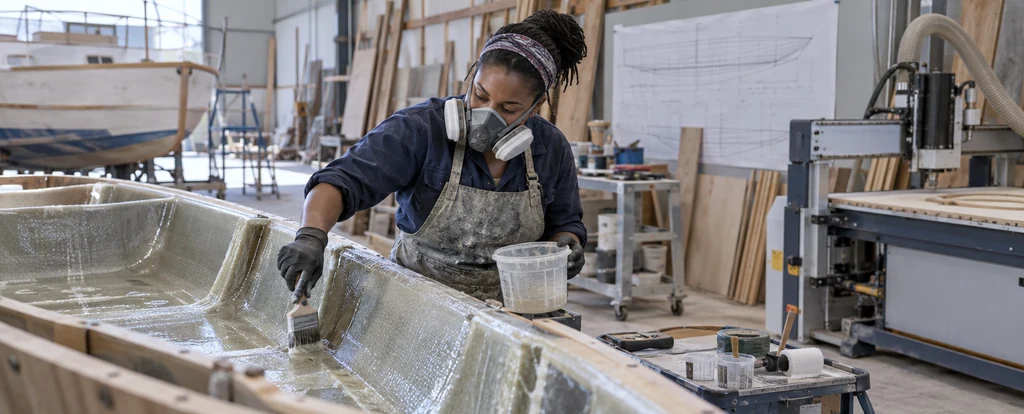
- Laminating hulls, decks and superstructures by hand, often in a mould
- Installing engines, steering, plumbing and electrical systems during fit-out
- Fairing, sanding and repairing hulls, then finishing them before a launch or antifoul
What skills do boat builders need?
Employers look for hand and power tool work, fabrication and finishing, reading plans and specifications, backed by AutoCAD fluency and strong attention to detail.
Specialist skills
- Hand and power tool work
- Fabrication and finishing
- Reading plans and specifications
- Craft and handmade production
- Installation and maintenance
Software and tools
- AutoCAD
- Rhino 3D
- CNC router
- Fibreglass layup equipment
General skills
- Attention to detail
- Problem solving
Is the job growing?
About 2,600 people work as boat builders in Australia, and employment is projected to grow 3.6% over the decade to 2035. That's modest growth: demand is steady rather than booming.
How do you become a boat builder?
Here's the path most boat builders take, step by step.
- 1Try the work before you commit
A pre-apprenticeship or Certificate II in marine craft construction, or a few weeks of work experience in a boatyard, will show you whether you like the materials and the pace, and it gives you something concrete to offer an employer.
- 2Start a Certificate III in Marine Craft Construction apprenticeship
The trade qualification is usually a four-year apprenticeship, combining paid work in a yard with block release at TAFE or a marine training provider. You need an employer to take you on, so apply directly to boatyards and marine businesses as well as through apprenticeship networks.
- 3Work out which materials and tasks you are best at
Timber, composites, aluminium and systems fit-out each carry their own skills. Employers hire on what you can already do, so a boat builder who can laminate, spray gelcoat or wire a helm station is more useful than one who has only worked on a single stage.
- 4Add qualifications if you want larger vessels
Moving into shipwright work usually takes further study, such as a diploma in marine craft construction, and the same applies if you aim for marine surveying or boatyard management later on.
- 5Enter from another trade
Carpenters, cabinetmakers, welders and metal fabricators can move across with additional training, often as a mature-age apprentice. The hand skills carry over, while the materials and the standards expected on the water are what take time to learn.
Ready to apply as a boat builder?
Whether you're working toward becoming a boat builder or already are one and want a hand with the next step (sharpening your resume for ATS screening, tightening your cover letter, or knowing what you'll actually be asked at interview), here are examples grounded in this specific role, not generic templates.
What jobs can a boat builder move to?
Moving into Rigger typically comes with the biggest pay rise, worth $20,800 a year more on average.
| Move to | Typical pay change | Overlap | Retraining |
|---|---|---|---|
| Rigger Boat builders' structural assembly and lifting experience transfers to rigging work, which requires additional certification for slinging, scaffolding and load handling.Known move | +$20,800 | 33% | reskill |
| Metal Fabricator Boat builders' welding, cutting and metal fitting skills carry into fabricating structural components, though the trade requires a separate apprenticeship.Known move | +$15,000 | 48% | requalify |
| Shipwright Boat builders bring hull construction and fit-out skills, and shipwright work adds larger vessel structural and refit expertise through further study.Known move | +$7,800 | 85% | reskill |
Moves are chosen from Jobs and Skills Australia's Data on Occupation Mobility, which follows income tax records between 2011-12 and 2020-21, together with entry requirements and skill overlap. A known move is one people were seen making in that data. Pay change compares median full-time pay for the two roles.
Who works as a boat builder?
The typical boat builder is 40 years old; 98% are men, 84% work full-time, and full-timers average 42 hours a week.
- 40
- Median age
- 2%
- Female share
- 84%
- Full-time
- +2h
- vs all-jobs avg
What's it like being a boat builder?
The work is physical and practical, split between a workshop and the yard, and the rhythm follows the boating season: new builds run over months while refits arrive in a rush before summer. Boat builders spend long stretches on their feet among dust and resin, and much of the job is judged by hand and eye rather than by a gauge. It suits someone who likes making things properly and can stay patient through the slow, repetitive stages that sit between the interesting ones.
What people like
- Seeing a hull take shape. A new vessel moves from lofted lines to a finished craft over months, and the launch is the point where the whole job is on show.
- Variety across materials and jobs. One week might be a timber repair on an older cruiser, the next a composite deck moulding or a helm refit, so the trade rarely settles into one task.
- Small teams and hands-on work. Many boat builders work in yards of a few people where you know the whole vessel and the person next to you, rather than one station on a long production line.
- Practical problem solving. Repairing damage when the original drawings are gone, or fitting a new system into a space never designed for it, is a real part of the job.
What people find hard
- Dust, resin and protective gear. Fibreglass work means respirators, gloves and coveralls, and resin and gelcoat fumes are part of the day, which gets hot in summer.
- Work bunched before the season. Refits pile up ahead of summer and the start of the boating season, so the weeks before a launch can run long.
- Cramped and heavy work. Inside a hull the space is tight, and lifting and holding panels, engines and ballast in awkward positions takes a toll on the body.
- Quiet stretches between contracts. Small yards depend on a flow of orders, and a slow period for new builds or repairs can mean shorter hours for everyone.
Based on our synthesis of professional-body surveys and public accounts of the role, not first-person verified reviews.
Which industries employ boat builders?
Manufacturing employs the largest share of boat builders.
Top employing industries
- 1Manufacturing
Ranked by employment share; the source doesn't publish an exact percentage per industry.
| Certificate III/IV | 50.7% | |
|---|---|---|
| Year 12 or below | 33.9% | |
| Diploma / Advanced Diploma | 5% | |
| Bachelor degree | 4.6% | |
| Postgraduate | 0.9% |
Will AI replace boat builders?
Boatbuilding has low exposure to AI, because most of the work is physical: laying up laminate, fitting systems into confined spaces and fairing a hull by hand and eye. CAD software and CNC routers are used in boatyards to cut frames, bulkheads and panels from a digital model, which has changed how parts are marked out but not who builds the vessel. The bigger shift sits in the office, where digital modelling has reduced the full-size lofting once done on the workshop floor.
Share of typical working time by exposure level
- Laminating hulls, decks and superstructuresHand layup, vacuum bagging and gelcoat work are still done by hand, and judging whether a laminate has wet out properly is a feel and eye skill.30%low
- Fitting engines, steering and on board systemsRunning cables, aligning a shaft or fitting a fuel system means working inside the vessel, where access and judgement matter more than any tool.25%low
- Fairing, finishing and hull repairsMatching a repair to an existing hull and sanding a surface fair is judged by hand, although moisture meters and thermal cameras now help locate damage first.25%low
- Reading plans, lofting and setting out partsDesign software and CNC routers now cut frames, bulkheads and panels from a digital model, so parts arrive shaped rather than marked out and cut by hand.20%moderate
Common questions about becoming a boat builder
Straight answers to the questions people ask most.
How much does a boat builder earn?
Boat builders earn a median of $72,800 per year before tax. Pay moves with the sector you work in, overtime during refit season, and whether you take on supervisory work or run your own repair business.
How do you become a boat builder?
The usual route is a Certificate III in Marine Craft Construction (MEM30719) apprenticeship, which takes about four years and is paid while you train. You need an employer to take you on, so apply directly to boatyards and marine businesses, or start with a pre-apprenticeship to build your hand skills first.
Are boat builders in demand?
Boat builders are currently in shortage nationally, and employment is projected to grow 3.6% over the decade to 2035. With about 2,600 people in the trade, most work sits in boatyards and marine businesses, so where you live matters as much as the national picture.
Will AI replace boat builders?
Boatbuilding has low exposure to AI because most of the job is physical: laying up laminate, fitting systems into tight spaces and fairing a hull by hand. CAD software and CNC routers have changed how parts are designed and cut, but they do not change who assembles the vessel. The main shift is in the office, where digital modelling has reduced the full-size lofting work once done on the workshop floor.
What jobs can a boat builder move into?
Shipwright work builds on the same hull construction and fit-out skills and pays $7,800 more. Metal fabrication pays $15,000 more and applies the same welding and cutting to structural components, though it needs a separate apprenticeship. Many people in the trade set up their own repair or fit-out businesses, which is often where earnings grow.
Do you need a licence to work as a boat builder?
There is no trade licence for boatbuilding in Australia, so employers look for a Certificate III in Marine Craft Construction and evidence of what you can do with your hands. Depending on the yard, you may also need a White Card, a forklift licence or a marine licence to move vessels around the site.
Related roles
Not sure this is you? Take the career quiz and get a ranked shortlist of roles that fit how you like to work.