Electronics Technician
Electronics technicians install, test and repair the electronic systems behind communications, control and medical equipment.
- Median salary*
- $77,000
4.2%vs last year, before tax
- People employed
- 15,000
0.7%vs last year
- Projected growth
- +6.2%
to 2035
- AI exposure*
- Moderate
- automation risk
- Average hours
- 42/wk
+2h vs all jobs
- Shortage status
- Not in shortage
national
Electronics technicians often work away from a bench, installing and calibrating equipment in plant rooms, on production floors, on communications sites and in hospitals. The role sits close to electrical trades and to computer hardware work, but the focus is the electronic circuit itself, from the sensor or power supply through to the control board. Most people enter through an apprenticeship in electronics and communications, and what registration you need depends on your state and on whether the work touches fixed wiring or telecommunications cabling.
How much do electronics technicians earn?
The median full-time salary for an electronics technician is $77,000 per annum, before tax, up $16,200 since 2018.
Pay is set by the award or enterprise agreement covering your employer, so a manufacturer, a mine site and a small service business can pay quite differently for the same work. Shift work, on-call rosters and remote site allowances add to the base rate, and the registration or licence you hold can open up work that pays more.
What does an electronics technician do day to day?
The list below is what fills most weeks; the exact mix shifts with seniority and whatever stage the current work is at.
- Installing, configuring and testing electronic systems, instruments and control equipment
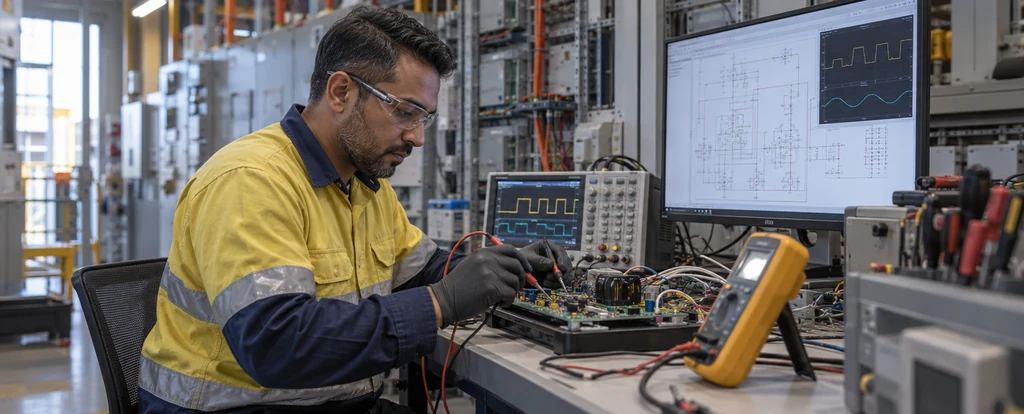
- Fault finding down to component level using multimeters, oscilloscopes and circuit diagrams
- Calibrating and maintaining test and measurement instruments to specification
- Repairing or replacing failed boards, sensors, power supplies and wiring
- Recording maintenance work and writing service and compliance reports
What skills do electronics technicians need?
Employers look for installation and maintenance, plant and equipment operation, worksite safety management, backed by Digital multimeters fluency and strong problem solving.
Specialist skills
- Installation and maintenance
- Plant and equipment operation
- Worksite safety management
- Software testing and QA
- Reading plans and specifications
Software and tools
- Digital multimeters
- Oscilloscopes
- Soldering and rework stations
- Altium Designer
- Circuit simulation software
General skills
- Problem solving
- Attention to detail
- Digital literacy
Is the job growing?
About 15,000 people work as electronics technicians in Australia, and employment is projected to grow 6.2% over the decade to 2035. That's modest growth: demand is steady rather than booming.
How do you become an electronics technician?
Here's the path most electronics technicians take, step by step.
- 1Start a Certificate III in Electronics and Communications
Most people do this as a paid apprenticeship over about three to four years, combining TAFE study with supervised work. It is the qualification employers ask for, and 35% of the current workforce holds a Certificate III/IV.
- 2Build bench and site experience during the apprenticeship
The trade is learned on real equipment: wiring, soldering, testing and fault finding alongside a qualified technician. Ask to rotate through different equipment types, because employers look for breadth as well as a completed qualification.
- 3Add the registration your work requires
Telecommunications cabling needs ACMA registration as a cabler, and work connected to fixed electrical wiring needs a restricted electrical licence. The rules differ between states, so check your own before taking on that part of a job.
- 4Specialise or extend your qualifications
A Diploma of Electronics and Communications Engineering (UEE50520) suits people moving into design support, commissioning or team leadership. Manufacturer training in medical, defence or process control equipment is another common way to narrow into better-paid work.
Ready to apply as an electronics technician?
Whether you're working toward becoming an electronics technician or already are one and want a hand with the next step (sharpening your resume for ATS screening, tightening your cover letter, or knowing what you'll actually be asked at interview), here are examples grounded in this specific role, not generic templates.
What jobs can an electronics technician move to?
Moving into Systems Administrator typically comes with the biggest pay rise, worth $51,000 a year more on average.
| Move to | Typical pay change | Overlap | Retraining |
|---|---|---|---|
| Systems Administrator A hardware and fault diagnosis background helps in server and system support, though substantial retraining in networks and operating systems is needed.Known move | +$51,000 | 6% | reskill |
| Instrumentation Technician Calibration, testing and control loop experience with electronic equipment suits instrument work, with further training in process control needed. | +$21,800 | 67% | reskill |
| Telecommunications Technician Signal, cabling and testing knowledge carries into installing and maintaining communications networks, though a telecommunications apprenticeship is required.Known move | +$14,000 | 50% | requalify |
| IT Support Officer Diagnostic and repair skills with electronic hardware carry into supporting computer systems, though formal IT study is needed for software and networks.Known move | +$10,700 | 7% | reskill |
| Computer Hardware Technician Bench repair and circuit fault finding transfer directly to servicing computers and peripherals, with a certificate rounding out the hardware specialism.Known move | −$1,600 | 31% | reskill |
Moves are chosen from Jobs and Skills Australia's Data on Occupation Mobility, which follows income tax records between 2011-12 and 2020-21, together with entry requirements and skill overlap. A known move is one people were seen making in that data. Pay change compares median full-time pay for the two roles.
Who works as an electronics technician?
The typical electronics technician is 40 years old; 95% are men, 73% work full-time, and full-timers average 42 hours a week.
- 40
- Median age
- 5%
- Female share
- 73%
- Full-time
- +2h
- vs all-jobs avg
What's it like being an electronics technician?
The work swings between planned maintenance, where you know the equipment and the schedule, and breakdowns, where a line or a system is down and the pressure is on. Technicians spend a fair amount of the week travelling to sites, reading diagrams and working through a fault methodically rather than guessing. It suits people who like tangible problems, don't mind working alone sometimes, and take satisfaction in a piece of equipment going back into service.
What people like
- Faults you can chase to the end. A diagnosis that ends at a failed component or a dry joint gives you a clear answer, and the repair either works or it doesn't.
- Variety in where you work. The same skills apply on a hospital imaging system, a production line sensor and a communications rack, so the settings change even when the method doesn't.
- Room to specialise. Instrumentation, medical equipment, defence systems and telecommunications all build on the trade, and each has its own training and equipment.
- Working with your hands and your head. The job combines physical work with circuit theory, oscilloscope traces and software settings, which keeps it from becoming routine.
What people find hard
- Travel between sites. Service work means driving, sometimes long distances, and regional or remote placements are common in mining, utilities and communications.
- Intermittent faults and waiting on parts. A fault that appears once a week is hard to pin down, and a machine can sit idle for days while a replacement board is ordered.
- Licensing can stop a job mid-repair. If the work crosses into fixed wiring or cabling you aren't registered for, you have to hand it to someone who is, which can be frustrating on site.
Based on our synthesis of professional-body surveys and public accounts of the role, not first-person verified reviews.
Which industries employ electronics technicians?
Construction employs the largest share of electronics technicians, followed by Other Services.
Top employing industries
- 1Construction
- 2Other Services
- 3Professional, Scientific and Technical Services
Ranked by employment share; the source doesn't publish an exact percentage per industry.
| Certificate III/IV | 35.2% | |
|---|---|---|
| Year 12 or below | 27.1% | |
| Diploma / Advanced Diploma | 14.6% | |
| Bachelor degree | 13.7% | |
| Postgraduate | 3.5% |
Will AI replace electronics technicians?
AI and automation reach the testing, design and paperwork parts of this job more than the equipment itself. Simulation tools and automated test rigs cut the time spent on routine verification, and diagnostic software can point to likely faults, but a technician still has to take a meter to a live board, trace a signal and make the repair on site. That mix puts the overall exposure at moderate.
Share of typical working time by exposure level
- Fault finding and component level repairDiagnostic software narrows the search, but confirming a failed capacitor or dry joint on a working board is still a hands-on job with a meter and a soldering iron.30%low
- Installing and commissioning equipment on siteRunning cable, mounting sensors and configuring a control panel in a plant room cannot be done remotely, and no two sites are laid out the same way.30%low
- Calibration and testing against specificationAutomated test equipment and logging software now capture readings and flag drift, so the technician spends more time interpreting results than recording them.25%moderate
- Maintenance records and compliance reportingService reports, calibration certificates and asset histories are increasingly drafted from system data, and the technician reviews rather than writes them from scratch.15%high
Common questions about becoming an electronics technician
Straight answers to the questions people ask most.
How much do electronics technicians earn?
Electronics technicians earn a median $77,000 per year before tax. What you take home depends on your employer's award or enterprise agreement, the registrations you hold, and whether the role includes shift work, on-call or site allowances.
How do you become an electronics technician?
The standard route is a Certificate III in Electronics and Communications (UEE30920), usually completed as a paid apprenticeship with TAFE study built in. Registering as a cabler and getting a restricted electrical licence, where your state requires it, widens the work you can take on.
Are electronics technicians in demand?
Electronics technicians are currently not in shortage, and employment is projected to grow 6.2% over the decade to 2035. Openings cluster in construction, manufacturing and technical services, and employers generally want the completed trade qualification rather than a partially finished one.
Will AI replace electronics technicians?
AI and automation have a moderate reach into this job, mainly on the testing, documentation and design side. Automated test equipment and circuit simulation shorten routine verification, and diagnostic software can suggest likely faults, but tracing a signal on a live board, calibrating an instrument and repairing equipment on site still need hands and judgement.
What can electronics technicians move into?
Instrumentation technician is a close step across, sharing calibration, testing and control loop work, and it pays $21,800 more. IT support officer and computer hardware technician are also common moves, since diagnostic and bench repair skills carry over, though both need some formal IT study to handle software and networks. Some experienced technicians go out on their own doing equipment service and repair, which is often where earnings grow.
Do electronics technicians need a licence?
Not for the trade itself, but specific tasks need registration: telecommunications cabling requires ACMA cabler registration, and work on equipment connected to fixed wiring needs a restricted electrical licence. The requirements vary by state and by the type of work, so check before you quote on a job.
Related roles
- IT Support Officer
- Computer Hardware Technician
- Instrumentation Technician
- Telecommunications Technician
- Systems Administrator
- Computer Hardware Technician
Not sure this is you? Take the career quiz and get a ranked shortlist of roles that fit how you like to work.