Instrumentation Technician
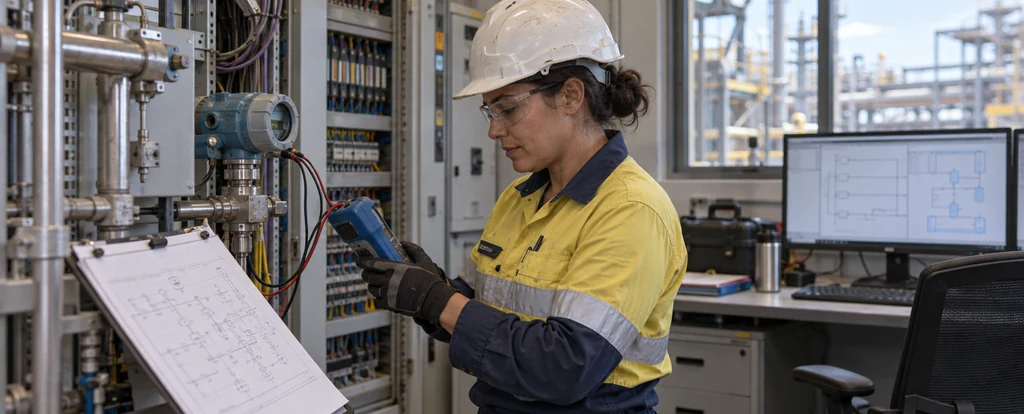
Instrumentation technicians install, calibrate and repair the instruments that measure and control industrial processes.
- Median salary*
- $98,800
4.4%vs last year, before tax
- People employed
- 1,400
0.0%vs last year
- Projected growth
- +6.2%
to 2035
- AI exposure*
- Moderate
- automation risk
- Average hours
- 46/wk
+6h vs all jobs
- Shortage status
- Not in shortage
national
They keep pressure and flow transmitters, control valves, analysers and the loops that connect them working accurately, because a reading that drifts can stop a production line or send a treatment process out of spec. The work happens on site in manufacturing plants, mines, water and waste utilities, and gas or chemical facilities, often alongside electricians but on measurement and control rather than power circuits. It sits between the trade and the engineering technician, combining hands-on calibration with reading loop drawings and control system data.
How much do instrumentation technicians earn?
The median full-time salary for an instrumentation technician is $98,800 per annum, before tax, up $20,900 since 2018.
Where you work moves pay more than the job title does: instrumentation technicians in mining and oil and gas are usually on site allowances, roster arrangements and overtime that lift total earnings well above manufacturing and utilities rates. Hazardous area competency and control system skills are worth paying for, and shut-down or contract work often carries a premium for irregular hours. The full-time average of 46 hours a week reflects how common overtime is in this trade.
What does an instrumentation technician do day to day?
The list below is what fills most weeks; the exact mix shifts with seniority and whatever stage the current work is at.
- Calibrating pressure, temperature, flow and level instruments against reference standards
- Installing and commissioning transmitters, control valves and analysers
- Tracing faults through control loops, PLC inputs and SCADA readings
- Reading piping and instrumentation diagrams and loop drawings before starting a job
- Running scheduled maintenance, loop checks and hazardous area inspections
What skills do instrumentation technicians need?
Employers look for installation and maintenance, reading plans and specifications, worksite safety management, backed by Fluke 754 documenting process calibrator fluency and strong problem solving.
Specialist skills
- Installation and maintenance
- Reading plans and specifications
- Worksite safety management
- Plant and equipment operation
- Process improvement
Software and tools
- Fluke 754 documenting process calibrator
- HART communicator
- Emerson AMS Trex
- Rockwell Automation Studio 5000
- Siemens TIA Portal
General skills
- Problem solving
- Attention to detail
Is the job growing?
About 1,400 people work as instrumentation technicians in Australia, and employment is projected to grow 6.2% over the decade to 2035. That's modest growth: demand is steady rather than booming.
How do you become an instrumentation technician?
Here's the path most instrumentation technicians take, step by step.
- 1Start with a Certificate III in Instrumentation and Control
Most people enter through an apprenticeship or traineeship, which takes about three to four years and combines paid site work with TAFE study in measurement, control loops and process systems.
- 2Or cross over from an electrical or electronics trade
Electricians and electronics technicians often move in later, completing instrumentation units on top of a Certificate III in Electrotechnology. If your work involves fixed electrical wiring, you need the electrician's licence for your state or territory, because licensing rules differ.
- 3Add hazardous area competency for the sectors that need it
Oil and gas, chemical and some mining sites require electrical equipment in hazardous areas training, which employers check before they will let you work on classified plant.
- 4Consider a diploma for technical and supervisory roles
A diploma in engineering or instrumentation opens up commissioning, design support and team leader positions, and it is the usual step if you want to move away from hands-on maintenance.
Ready to apply as an instrumentation technician?
Whether you're working toward becoming an instrumentation technician or already are one and want a hand with the next step (sharpening your resume for ATS screening, tightening your cover letter, or knowing what you'll actually be asked at interview), here are examples grounded in this specific role, not generic templates.
What jobs can an instrumentation technician move to?
Moving into Electrician typically comes with the biggest pay rise, worth $15,100 a year more on average.
| Move to | Typical pay change | Overlap | Retraining |
|---|---|---|---|
| Electrician Instrumentation technicians can become electricians, though a separate electrical apprenticeship and licence are required.Known move | +$15,100 | 42% | requalify |
| Electronic Engineering Technician Instrumentation technicians move into electronic engineering technician roles, applying measurement and control skills with further study in electronics engineering.Known move | +$12,600 | 19% | reskill |
| Automation Technician Instrumentation technicians can move into automation technician roles, applying control and measurement skills after a short course. | +$0 | 52% | short course |
| Electrical Engineering Technician Instrumentation technicians can become electrical engineering technicians, using their electrical and control knowledge with additional diploma study.Known move | −$7,300 | 38% | reskill |
Moves are chosen from Jobs and Skills Australia's Data on Occupation Mobility, which follows income tax records between 2011-12 and 2020-21, together with entry requirements and skill overlap. A known move is one people were seen making in that data. Pay change compares median full-time pay for the two roles.
Who works as an instrumentation technician?
The typical instrumentation technician is 34 years old; 92% are men, 91% work full-time, and full-timers average 46 hours a week.
- 34
- Median age
- 8%
- Female share
- 91%
- Full-time
- +6h
- vs all-jobs avg
What's it like being an instrumentation technician?
The job runs on the plant's schedule: planned calibrations and loop checks during shut-downs, and fault calls whenever a reading drifts or an instrument fails. Technicians spend much of the week on the plant floor, in confined spaces, at height or in hazardous areas, and the records that prove each instrument is accurate have to stand up to audit. The people who enjoy it tend to like the detective work of tracing a fault to its cause and the variety that comes with moving between industries.
What people like
- Faults you can chase down. A drifting reading or a loop that will not hold usually comes back to one cause, and finding it is the part of the job technicians tend to like most.
- Your work shows up immediately. When an instrument is wrong, a production line or a treatment process stops, so a good fix is visible and the operators notice it.
- Skills that carry between industries. Control loops and measurement work much the same in a mine, a brewery or a water treatment plant, so you can change sectors without starting over.
- Mostly hands-on, not meetings. Much of the week is spent with a documenting calibrator and a work permit rather than at a desk.
What people find hard
- Callouts at any hour. Process plants run around the clock, so a failed transmitter can mean a night or weekend callout.
- Awkward places to work. Instruments sit on towers, inside tanks and in noisy or hazardous areas, so confined space and working at height training is often part of the job.
- Documentation that has to be exact. Every calibration and inspection is recorded and the certificates are audited, so paperwork takes real time each week.
- Travel and rosters. Remote mining and oil and gas sites often mean fly-in fly-out or long swings away from home.
Based on our synthesis of professional-body surveys and public accounts of the role, not first-person verified reviews.
Which industries employ instrumentation technicians?
Public Administration and Safety employs the largest share of instrumentation technicians, followed by Manufacturing.
Top employing industries
- 1Public Administration and Safety
- 2Manufacturing
- 3Mining
Ranked by employment share; the source doesn't publish an exact percentage per industry.
| Certificate III/IV | 54% | |
|---|---|---|
| Diploma / Advanced Diploma | 22.3% | |
| Year 12 or below | 10.8% | |
| Bachelor degree | 8.1% | |
| Postgraduate | 3.2% |
Will AI replace instrumentation technicians?
Instrumentation work is moderately exposed to AI. Control systems already trend instrument data and predict when a transmitter will drift, and calibration software captures results and writes the certificates, which removes most of the routine record-keeping. What it has not replaced is being on the plant to isolate a loop, test it against a reference standard and work out why a reading does not match the process.
Share of typical working time by exposure level
- Calibrating transmitters and control valvesThis needs a technician on the plant with a documenting calibrator, working around process conditions, isolation and hazardous areas.30%low
- Fault finding on control loopsDiagnostic tools and control system alarms can point to a suspect transmitter or wiring fault, but confirming it usually means isolating the loop and testing on site.25%moderate
- Installing and commissioning new instrumentsDigital commissioning tools speed up loop checks, though mounting instruments, running cable and verifying the loop against the process still happen on site.25%moderate
- Calibration records and compliance documentationCalibration management software now captures results, generates certificates and flags instruments that are due, which removes most of the manual paperwork.20%high
Moves least exposed to AI
These career moves from instrumentation technician work are rated low for AI exposure:
- Electrician
Solid skill overlap (42%), requalify to get there, and a low automation-risk profile.
Common questions about becoming an instrumentation technician
Straight answers to the questions people ask most.
How much do instrumentation technicians earn?
Full-time instrumentation technicians earn a median of $98,800 per year before tax. Pay moves with the sector you work in, your hazardous area and control system qualifications, and how much overtime or site work you take on. Treat the median as a benchmark rather than a fixed rate, because rosters and allowances change total earnings a lot.
How do you become an instrumentation technician?
Most people start with a Certificate III in Instrumentation and Control (UEE31225), usually through an apprenticeship or traineeship that combines paid site work with TAFE study. Electricians and electronics technicians often cross over later, adding instrumentation units and hazardous area training to their trade qualification. A diploma helps if you want to move into commissioning, design support or supervisory work.
Are instrumentation technicians in demand?
Instrumentation technicians are currently not in shortage. Employment is projected to grow 6.2% over the decade to 2035. Because the occupation is small, the number of openings in any year depends as much on retirements and people moving between industries as on the growth figure itself.
Will AI replace instrumentation technicians?
AI affects the paperwork and the analysis more than the hands-on work. Calibration management software now records results and flags instruments due for testing, and control systems trend data to warn when a transmitter is drifting, which saves time on routine checks. Fault-finding, calibration and installation still need someone on the plant with the right instruments, isolation and permits.
What can instrumentation technicians move into?
Moving to an automation technician role is the shortest step, since the control and measurement skills overlap and a short course covers most of the gap, and the pay is about the same. Electronic engineering technician pays $12,600 more and suits technicians who want more electronics testing and design work, while electrical engineering technician is a sideways move on $7,300 less with a different focus. Becoming an electrician pays $15,100 more but needs a full apprenticeship and licence, so some experienced technicians instead build a calibration or instrument service contracting business, which is often where earnings grow.
Do you need a licence to work as an instrumentation technician?
The instrumentation work itself does not need a national licence, but any fixed electrical wiring must be done by a licensed electrician, and those rules are set by each state and territory. Hazardous area work also requires specific competency training that employers check before you start. If your role includes electrical work, you will need the electrician's licence for that jurisdiction as well.
Related roles
- Electronic Engineering Technician
- Electrical Engineering Technician
- Electrician
- Automation Technician
- Electrician
- Electronics Technician
Not sure this is you? Take the career quiz and get a ranked shortlist of roles that fit how you like to work.