Telecommunications Technician
Telecommunications technicians install, test and repair the networks that carry phone, internet and mobile signals, from customer premises out to towers and exchanges.
- Median salary*
- $91,000
4.1%vs last year, before tax
- People employed
- 10,100
0.0%vs last year
- Projected growth
- +3.8%
to 2035
- AI exposure*
- Moderate
- automation risk
- Average hours
- 42/wk
+2h vs all jobs
- Shortage status
- In shortage
national
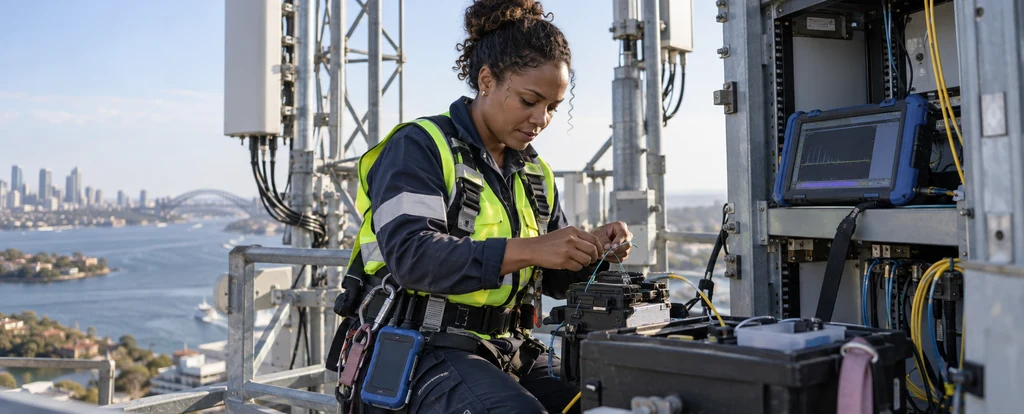
Telecommunications technicians build and maintain the physical side of fixed line, mobile and broadband networks. They work on customer premises, in exchanges, and on towers and cable routes, usually in small teams, and the job sits closer to cabling, splicing and testing than to the design and coordination a field engineer handles. Carriers, network contractors and infrastructure builders all hire them, and customer premises cabling requires registration as a cabling provider.
How much do telecommunications technicians earn?
The median full-time salary for a telecommunications technician is $91,000 per annum, before tax, up $19,100 since 2018.
Pay follows the telecommunications industry award or a company enterprise agreement, so a technician at a carrier and one at a contractor can be on different rates for similar work. Overtime, on-call rosters and penalty rates for after-hours fault restoration add to the base, and outage work is where those hours build up. The cabling registration you hold and any specialist skills, such as fibre splicing or working at heights, also affect what employers offer.
What does a telecommunications technician do day to day?
The list below is what fills most weeks; the exact mix shifts with seniority and whatever stage the current work is at.
- Installing and terminating copper, coaxial and optical fibre cabling
- Splicing and testing fibre links with fusion splicers and OTDRs
- Erecting and maintaining antennas, towers and transmission equipment
- Diagnosing faults in fixed line, mobile and broadband networks
- Commissioning customer premises equipment and checking network performance
What skills do telecommunications technicians need?
Employers look for installation and maintenance, networks and systems administration, worksite safety management, backed by Fusion splicer fluency and strong problem solving.
Specialist skills
- Installation and maintenance
- Networks and systems administration
- Worksite safety management
- Plant and equipment operation
Software and tools
- Fusion splicer
- OTDR
- Spectrum analyser
- Cable certifier
- Network analyser
General skills
- Problem solving
- Attention to detail
- Customer service
Is the job growing?
About 10,100 people work as telecommunications technicians in Australia, and employment is projected to grow 3.8% over the decade to 2035. That's modest growth: demand is steady rather than booming.
How do you become a telecommunications technician?
Here's the path most telecommunications technicians take, step by step.
- 1Complete a Certificate III in Telecommunications Technology
Most technicians enter through an Australian Apprenticeship, which combines the certificate with paid on-the-job training over about three to four years with a carrier, contractor or network builder.
- 2Get registered as a cabling provider
Registration is required before you can legally install or maintain customer premises cabling, and it is arranged through an ACMA-accredited registrar.
- 3Add the licences and qualifications for specialised work
Fibre splicing, structured cabling, working at heights and rigging each need their own training, and a high risk work licence is required for some of it.
- 4Choose a specialisation or study further
A diploma in telecommunications engineering or network technology opens up technologist and field engineering roles, while staying on the tools leads towards leading hand and supervisor positions.
Ready to apply as a telecommunications technician?
Whether you're working toward becoming a telecommunications technician or already are one and want a hand with the next step (sharpening your resume for ATS screening, tightening your cover letter, or knowing what you'll actually be asked at interview), here are examples grounded in this specific role, not generic templates.
What jobs can a telecommunications technician move to?
Moving into Telecommunications Field Engineer typically comes with the biggest pay rise, worth $10,400 a year more on average.
| Move to | Typical pay change | Overlap | Retraining |
|---|---|---|---|
| Telecommunications Field Engineer Telecommunications technicians move into field engineering, applying hands-on network installation and fault-finding experience while taking on design and coordination responsibilities.Known move | +$10,400 | 88% | reskill |
| Telecommunications Technologist Telecommunications technicians progress to technologist roles, building on network operations experience while studying for the diploma needed for planning and systems support.Known move | +$5,200 | 50% | reskill |
| Radiocommunications Technician Telecommunications technicians specialise in radiocommunications, applying antenna and network knowledge while completing the radiocommunications apprenticeship for radio frequency work.Known move | +$0 | 58% | requalify |
| Telecommunications Cable Jointer Telecommunications technicians can specialise as cable jointers, applying cable installation and fault-finding skills to splicing and maintaining network cables.Known move | +$0 | 55% | short course |
| Electronics Technician Telecommunications technicians move into electronics technician roles, using installation and fault-finding skills while completing the electronics apprenticeship for circuit-level work.Known move | −$14,000 | 50% | requalify |
Moves are chosen from Jobs and Skills Australia's Data on Occupation Mobility, which follows income tax records between 2011-12 and 2020-21, together with entry requirements and skill overlap. A known move is one people were seen making in that data. Pay change compares median full-time pay for the two roles.
Who works as a telecommunications technician?
The typical telecommunications technician is 40 years old; 94% are men, 77% work full-time, and full-timers average 42 hours a week.
- 40
- Median age
- 6%
- Female share
- 77%
- Full-time
- +2h
- vs all-jobs avg
What's it like being a telecommunications technician?
The week mixes planned installation work with unplanned faults, so a schedule can be set in the morning and rebuilt after the first callout. Travel between sites is constant, some of it outdoors, at height or well outside the city, which suits people who would rather move around than sit at a desk. Progress is easy to see, because a link either passes its test or it doesn't.
What people like
- Faults get finished. A fault comes in, you trace it through the cable or the equipment, and a test result tells you when the job is done.
- Hands-on with real infrastructure. You can point to the fibre, the antenna or the exchange equipment that carries a suburb's traffic.
- Skills that travel across employers. Cabling, splicing and testing experience is used by carriers, contractors and infrastructure builders, so you are not tied to one company.
- A clear trade pathway. The apprenticeship, certificate and cabling registration give you a defined way in and a route to add specialities later.
What people find hard
- Weather and heights. Tower, pole and rooftop work happens in heat, cold and wind, and some of it needs a high risk work licence for rigging or an elevated work platform.
- On-call and after-hours callouts. Fault restoration runs around the clock, so rosters include nights, weekends and public holidays.
- Time lost to travel. Long drives between sites, remote exchanges and rough access tracks eat into the working day.
- Working in other people's premises. You are in homes and businesses, fitting around customers, pets and tight roof spaces, and they would usually rather you were not there.
Based on our synthesis of professional-body surveys and public accounts of the role, not first-person verified reviews.
Which industries employ telecommunications technicians?
Information Media and Telecommunications employs the largest share of telecommunications technicians, followed by Construction.
Top employing industries
- 1Information Media and Telecommunications
- 2Construction
- 3Other Services
Ranked by employment share; the source doesn't publish an exact percentage per industry.
| Certificate III/IV | 42.9% | |
|---|---|---|
| Year 12 or below | 20.6% | |
| Diploma / Advanced Diploma | 14.9% | |
| Bachelor degree | 13.1% | |
| Postgraduate | 5% |
Will AI replace telecommunications technicians?
The job is moderately exposed to AI and automation. Network monitoring, automated testing and fault detection increasingly run through software, which narrows down where a problem is before anyone drives out to site. The physical work of preparing cable, splicing fibre and proving a link by hand is much harder to automate, so the trade keeps its hands-on core.
Share of typical working time by exposure level
- Splicing and terminating fibre and copperA fusion splicer lines up and fuses the glass, but cleaning, cleaving and checking the splice with an OTDR still relies on the person holding the cable.30%low
- Installing and commissioning equipment on siteMounting antennas, running cable through a roof space or connecting equipment in an exchange is physical, access-dependent work that software cannot do.30%low
- Fault finding on live networksMonitoring systems often flag the faulty segment before you arrive, though intermittent faults and damaged cable ends still have to be traced on site.25%moderate
- Test results, cable records and job notesTest gear and network inventory systems now export results and as-built cable records automatically, so far less is written up by hand.15%high
Moves least exposed to AI
These career moves from telecommunications technician work are rated low for AI exposure:
- Telecommunications Field Engineer
High skill overlap (88%), reskill to get there, and a low automation-risk profile.
- Radiocommunications Technician
Solid skill overlap (58%), requalify to get there, and a low automation-risk profile.
- Telecommunications Cable Jointer
Solid skill overlap (55%), short course to get there, and a low automation-risk profile.
Common questions about becoming a telecommunications technician
Straight answers to the questions people ask most.
How much do telecommunications technicians earn?
Telecommunications technicians earn $91,000 per year before tax in full-time work. That is a median, so what you are offered depends on your enterprise agreement, your overtime and on-call load, and whether you work for a carrier or a contractor.
How do you become a telecommunications technician?
Most people start with an Australian Apprenticeship in telecommunications technology, which combines a Certificate III with paid on-the-job training over about three to four years. Customer premises cabling also requires registration as a cabling provider, and specialist work such as fibre splicing or tower rigging needs extra licences and endorsements.
Are telecommunications technicians in demand?
Telecommunications technicians are currently in shortage nationally, and employment is projected to grow 3.8% over the decade to 2035. Most openings come from the installation, upgrade and fault maintenance work that carriers and contractors always need done, so it is worth talking to employers and group training organisations about apprenticeship intakes.
Will AI or automation replace telecommunications technicians?
The work is moderately exposed. Network monitoring, fault detection and documentation increasingly run through software, which narrows down where a problem is before anyone drives out to site. The physical side, including splicing fibre, installing equipment and tracing faults on site, still needs someone on the tools.
What can a telecommunications technician move into?
The usual next step is a telecommunications field engineer role, where hands-on network experience carries into design and coordination and pay is $10,400 more. A diploma opens up technologist work in planning and systems support, and radiocommunications is the specialist route, where pay is about the same. Many experienced technicians also set up their own cabling or contracting business, which is often where earnings grow.
Do you need a licence to work as a telecommunications technician?
To work on customer premises cabling you need registration as a cabling provider, arranged through an ACMA-accredited registrar. Tower, pole and rigging work can require a high risk work licence, and construction sites ask for a White Card. Requirements vary by state and territory, so check the rules where you will be working.
Related roles
- Telecommunications Field Engineer
- Telecommunications Technologist
- Electronics Technician
- Radiocommunications Technician
- Telecommunications Cable Jointer
- Data Cabler
Not sure this is you? Take the career quiz and get a ranked shortlist of roles that fit how you like to work.