Radiocommunications Technician
Radiocommunications technicians install and maintain the two-way radio and wireless systems that emergency services, transport operators and industry depend on.
- Median salary*
- $91,000
4.4%vs last year, before tax
- People employed
- 720
2.9%vs last year
- Projected growth
- +13.7%
to 2035
- AI exposure*
- Low
- automation risk
- Average hours
- 42/wk
+2h vs all jobs
- Shortage status
- Not in shortage
national
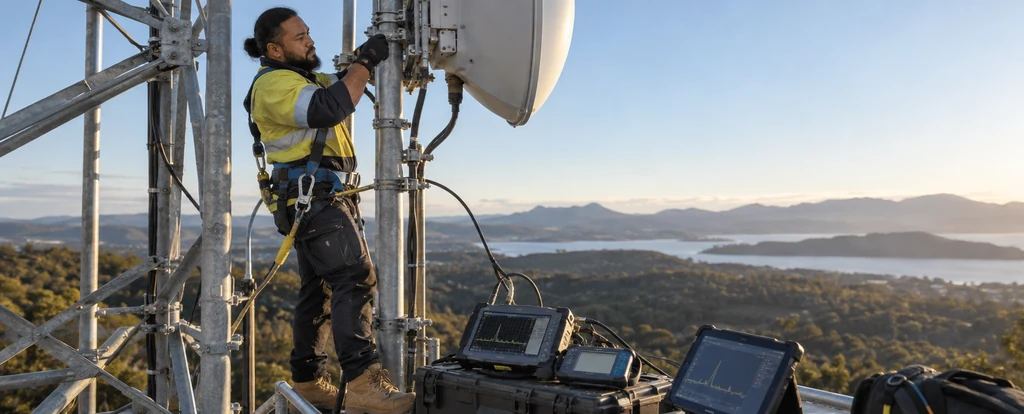
Radiocommunications technicians install, test and repair radio equipment such as base stations, antennas, repeaters and mobile radios, often on towers, rooftops and remote sites where coverage is thin. They work for telecommunications carriers, broadcasters, emergency services, defence contractors and mining operations, and the job sits closer to radio engineering than to the broader cabling and network work of a telecommunications technician. About 720 people work in the occupation, so you are more likely to be the radio specialist on a site than one of a large crew.
How much do radiocommunications technicians earn?
The median full-time salary for a radiocommunications technician is $91,000 per annum, before tax, up $19,200 since 2018.
What you earn depends heavily on who you work for, because mining, defence and emergency services networks tend to pay above routine maintenance contracts, and remote or fly-in fly-out placements come with allowances on top. Overtime and on-call rostering for network faults add to the base rate, and extra qualifications in areas such as microwave links or tower work put you in line for the better-paid jobs. Enterprise agreements in the larger carriers and government agencies set most rates.
What does a radiocommunications technician do day to day?
The list below is what fills most weeks; the exact mix shifts with seniority and whatever stage the current work is at.
- Installing base stations, antennas and feeder cables, often on masts and remote hilltop sites
- Programming and configuring two-way radio systems, repeaters and channel plans
- Testing transmitters and receivers with spectrum analysers, RF power meters and antenna analysers
- Tracking down faults in radio networks, interference and coverage black spots
- Running site surveys and coverage tests, then writing up the results for the network owner
What skills do radiocommunications technicians need?
Employers look for installation and maintenance, plant and equipment operation, worksite safety management, backed by Spectrum analyser fluency and strong problem solving.
Specialist skills
- Installation and maintenance
- Plant and equipment operation
- Worksite safety management
- Technical support and troubleshooting
Software and tools
- Spectrum analyser
- RF power meter
- Antenna analyser
- Motorola CPS
- Multimeter
General skills
- Problem solving
- Attention to detail
- Written communication
Is the job growing?
About 720 people work as radiocommunications technicians in Australia, and employment is projected to grow 13.7% over the decade to 2035. That's healthy, above-average growth, and the role should stay in solid demand.
How do you become a radiocommunications technician?
Here's the path most radiocommunications technicians take, step by step.
- 1Finish Year 12 with maths and physics where you can
The theory behind radio frequency work comes more easily with a grounding in maths and physics, though it is not a hard requirement and plenty of people enter straight through the trade pathway.
- 2Start a Certificate III in electronics and communications
This is the standard trade qualification and is usually done as an apprenticeship or traineeship with a carrier, a radio network contractor, a defence supplier or a government agency. It takes about three to four years and you are paid while you train.
- 3Add a Certificate IV in electronics and communications
About 45% of people in the role hold a Certificate III or IV, and the higher qualification is what opens up network planning, system design and supervisory work.
- 4Get the site and safety training employers expect
A White Card is needed to work on construction sites, and tower work usually requires working at heights and tower rescue training. Employers often arrange these once you are on the job, but holding them already makes you easier to place.
- 5Specialise in a radio system or vendor
Networks run on a handful of standards such as P25, DMR and TETRA, and carriers, emergency services and mining companies look for technicians who already know theirs. Vendor training on Motorola or similar equipment is worth asking an employer to fund.
Ready to apply as a radiocommunications technician?
Whether you're working toward becoming a radiocommunications technician or already are one and want a hand with the next step (sharpening your resume for ATS screening, tightening your cover letter, or knowing what you'll actually be asked at interview), here are examples grounded in this specific role, not generic templates.
What jobs can a radiocommunications technician move to?
Moving into Electronic Engineering Technician typically comes with the biggest pay rise, worth $20,400 a year more on average.
| Move to | Typical pay change | Overlap | Retraining |
|---|---|---|---|
| Electronic Engineering Technician Radio and electronics skills provide a foundation, but a substantial course is needed to work as an electronic engineering technician.Known move | +$20,400 | 25% | reskill |
| Telecommunications Field Engineer Brings practical radio systems knowledge, though further study in engineering is needed to become a telecommunications field engineer. | +$10,400 | 67% | reskill |
| Telecommunications Technologist Brings hands-on radio and wireless installation experience, but needs further study to work as a telecommunications technologist.Known move | +$5,200 | 38% | reskill |
| Telecommunications Technician Radio installation and maintenance skills carry across, but the move is treated as requiring full requalification.Known move | +$0 | 58% | requalify |
| Telecommunications Cable Jointer Radio and wireless experience helps in jointing cables, with a short course needed for the specific cable jointing ticket.Known move | +$0 | 55% | short course |
Moves are chosen from Jobs and Skills Australia's Data on Occupation Mobility, which follows income tax records between 2011-12 and 2020-21, together with entry requirements and skill overlap. A known move is one people were seen making in that data. Pay change compares median full-time pay for the two roles.
Who works as a radiocommunications technician?
The typical radiocommunications technician is 45 years old; 97% are men, 86% work full-time, and full-timers average 42 hours a week.
- 45
- Median age
- 3%
- Female share
- 86%
- Full-time
- +2h
- vs all-jobs avg
What's it like being a radiocommunications technician?
The work swings between planned installation projects and reactive fault calls, so a quiet week can turn into a night tracing interference on a network that has to stay on air. Much of it happens outdoors and off the beaten track, on towers, rooftops and remote sites, which suits people who like hands-on electronics and do not mind the travel. The trade-off is that the skills are narrow and specialist, and you are usually the person a site calls when the radio link drops.
What people like
- Faults you can actually fix. Tracing a coverage problem back to a corroded connector or a misaligned antenna, then leaving with the network working again, is the satisfying part of the job.
- Knowledge that few others on site have. Radio frequency work is specialist, so crews and clients tend to treat you as the person who understands why a link is failing and what to do about it.
- A changing set of sites and systems. One week you might be on a mine site, the next on an ambulance network or a ferry terminal, so the work rarely settles into the same four walls.
- Hands-on work away from a desk. The job involves climbing, measuring and testing real equipment, and the results of a good day are visible in whether the network reaches where it should.
What people find hard
- Travel and time away from home. Remote sites mean long drives and nights in accommodation, and fault call-outs can come at the end of a day you have already worked.
- Weather and heights. Antenna work happens on masts and rooftops in heat, wind and rain, and it cannot always be rescheduled to a better day.
- Faults that only show up under load. Intermittent interference can take several visits to pin down, because the problem may only appear during a busy period or in particular conditions.
- A small field with fewer employers. The occupation is small and the work is concentrated among carriers, contractors and agencies, so changing jobs can mean relocating or waiting for the right opening.
Based on our synthesis of professional-body surveys and public accounts of the role, not first-person verified reviews.
Which industries employ radiocommunications technicians?
Information Media and Telecommunications employs the largest share of radiocommunications technicians, followed by Public Administration and Safety.
Top employing industries
- 1Information Media and Telecommunications
- 2Public Administration and Safety
- 3Professional, Scientific and Technical Services
Ranked by employment share; the source doesn't publish an exact percentage per industry.
| Certificate III/IV | 44.8% | |
|---|---|---|
| Diploma / Advanced Diploma | 22.1% | |
| Year 12 or below | 15.5% | |
| Bachelor degree | 10.2% | |
| Postgraduate | 4.2% |
Will AI replace radiocommunications technicians?
This is a low-exposure job overall. Radio equipment is increasingly software-defined and remotely monitored, which changes how faults are found and how settings are loaded, but installing antennas, climbing masts and repairing hardware still has to be done by hand on site. The tools speed up diagnosis rather than take over the work.
Share of typical working time by exposure level
- On-site installation and repairsBolting up antennas, replacing feeder cables and swapping out radios on towers and rooftops is physical work that has to happen where the equipment sits.40%low
- Fault-finding on live networksRemote monitoring can flag a failing transmitter before anyone drives out, which narrows the search but does not confirm the cause or repair it.25%moderate
- Site surveys and coverage testingDrive testing and coverage prediction software speed up the measurement, but interference, terrain and building effects still need a technician on site to interpret.20%moderate
- Frequency planning and radio configurationSoftware-defined radios and channel-planning tools can generate and load configurations, so less of this is done by hand than it used to be.15%high
Common questions about becoming a radiocommunications technician
Straight answers to the questions people ask most.
How much do radiocommunications technicians earn?
The median for full-time radiocommunications technicians is $91,000 per annum, before tax. What you actually take home depends on the sector, with mining, defence and emergency services networks paying above routine maintenance contracts, and remote, on-call or fly-in fly-out work adding allowances.
How do you become a radiocommunications technician?
Most people start with a Certificate III in electronics and communications (UEE30920), often through an apprenticeship or traineeship with a carrier, contractor or government agency. A Certificate IV then opens up network planning and design work, and site, heights and tower rescue training covers the safety requirements.
Are radiocommunications technicians in demand?
Radiocommunications technicians are currently not in shortage, and employment is projected to grow 13.7% over the decade to 2035. Because the workforce is small, openings tend to come up with specific employers, so it helps to know which carriers, contractors and agencies run radio networks in your region before you start applying.
Will AI and automation replace radiocommunications technicians?
This is a low-exposure job. Radio equipment is increasingly software-defined and monitored remotely, which changes how faults are spotted and settings are loaded, but installing antennas, climbing towers and repairing hardware still happens on site by hand. Diagnostic tools narrow the search; someone still has to confirm the cause and fix it.
How is this different from a telecommunications technician?
Radiocommunications technicians specialise in radio, working on base stations, antennas, repeaters and coverage, while telecommunications technicians cover a wider mix of cabling, broadband and network work. The two roles share trade skills and qualifications, and technicians move between them.
What can radiocommunications technicians move into?
Radio skills carry across to other telecommunications roles. Moving to telecommunications field engineer pays $10,400 more and builds on the same systems knowledge, though it usually needs further study in engineering, while electronic engineering technician work pays $20,400 more and leans more on the electronics side. Some technicians retrain as telecommunications cable jointers, where pay is about the same and a short course covers the jointing qualification.
Related roles
- Telecommunications Technologist
- Telecommunications Technician
- Telecommunications Field Engineer
- Telecommunications Cable Jointer
- Electronic Engineering Technician
- Telecommunications Technician
Not sure this is you? Take the career quiz and get a ranked shortlist of roles that fit how you like to work.