Telecommunications Technologist
Telecommunications technologists install, test and repair the fibre, copper and radio equipment that carries voice, data and mobile services.
- Median salary*
- $96,200
3.6%vs last year, before tax
- People employed
- 700
0.0%vs last year
- Projected growth
- +13.7%
to 2035
- AI exposure*
- Moderate
- automation risk
- Average hours
- 40/wk
matches all-jobs average
- Shortage status
- Not in shortage
national
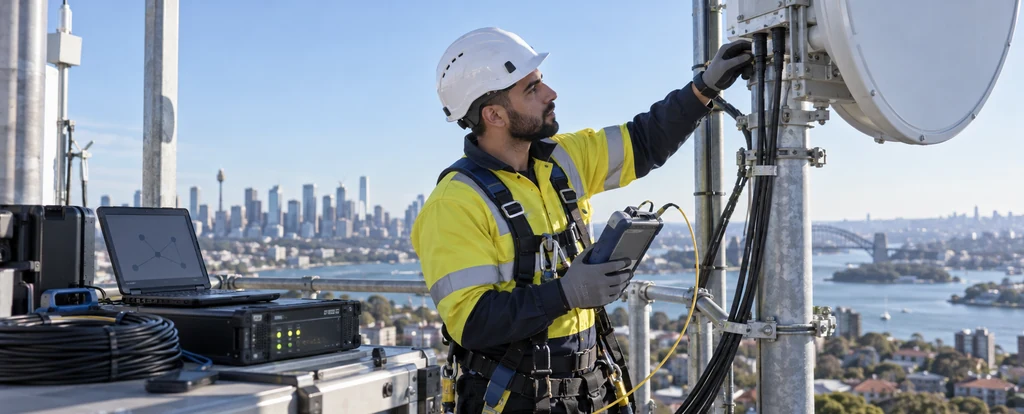
They work for carriers, nbn delivery partners, network contractors and large organisations that run their own infrastructure, splitting their time between field sites, exchanges and data centres. The role sits between the technician who installs and terminates cabling and the engineer who designs the network, so a technologist is usually the one working out why a link or service is failing and bringing it back up. Many hold a diploma or certificate rather than a degree, which is the main practical difference from a telecommunications engineer.
How much do telecommunications technologists earn?
The median full-time salary for a telecommunications technologist is $96,200 per annum, before tax, up $20,500 since 2018.
Who you work for moves pay as much as the job itself: carriers and large network owners generally pay under enterprise agreements with defined classifications, while contractors pay a premium for scarce skills such as optical transmission or radio access work. Shift rosters, on-call availability and overnight cutovers usually attract loadings on top of base pay, and qualifications like ACMA cabling registration, working at heights or vendor certifications open higher-paid roles. Remote and regional postings often come with allowances.
What does a telecommunications technologist do day to day?
The list below is what fills most weeks; the exact mix shifts with seniority and whatever stage the current work is at.
- Installing and commissioning fibre, copper, radio and transmission equipment
- Testing and fault-finding network links and customer services
- Configuring routers, switches and network management systems
- Reading network designs and technical specifications to plan the work
- Keeping asset records, test results and site documentation up to date
What skills do telecommunications technologists need?
Employers look for networks and systems administration, installation and maintenance, software testing and QA, backed by OTDR test equipment fluency and strong problem solving.
Specialist skills
- Networks and systems administration
- Installation and maintenance
- Software testing and QA
- Worksite safety management
- Field inspection and testing
Software and tools
- OTDR test equipment
- spectrum analysers
- Cisco IOS
- network management systems
- GIS mapping software
General skills
- Problem solving
- Attention to detail
- Written communication
Is the job growing?
About 700 people work as telecommunications technologists in Australia, and employment is projected to grow 13.7% over the decade to 2035. That's healthy, above-average growth, and the role should stay in solid demand.
How do you become a telecommunications technologist?
Here's the path most telecommunications technologists take, step by step.
- 1Start with a certificate or diploma in telecommunications
A Certificate III or IV in telecommunications engineering technology covers cabling, testing and basic network principles, and the diploma goes further into transmission, radio and network design. TAFE and some private providers offer both, often with evening or online options if you are already working.
- 2Get field experience with a carrier or contractor
Most technologists learn the practical side on the job, splicing fibre, testing links and following faults through to a fix. Employers generally provide the test equipment and send you for the safety training each site requires.
- 3Sort out your cabling registration and site licences
Cabling work in Australia requires registration with the Australian Communications and Media Authority, and the open registration covers the structured cabling most technologists handle. Sites commonly also ask for a White Card, working at heights and confined space training, and first aid.
- 4Finish the diploma or advanced diploma while you work
The diploma is the qualification most experienced technologists end up holding, and studying part time lets you apply it to real networks as you go. It is also what opens internal moves into design, planning and specialist transmission work.
- 5Add vendor certifications for the systems you use
Cisco, Nokia and Juniper certifications, or vendor training on radio access equipment, are how many technologists specialise. They are not needed to start, but they carry weight when employers are choosing between applicants for a network operations or commissioning role.
Ready to apply as a telecommunications technologist?
Whether you're working toward becoming a telecommunications technologist or already are one and want a hand with the next step (sharpening your resume for ATS screening, tightening your cover letter, or knowing what you'll actually be asked at interview), here are examples grounded in this specific role, not generic templates.
What jobs can a telecommunications technologist move to?
Moving into Telecommunications Engineer typically comes with the biggest pay rise, worth $49,200 a year more on average.
| Move to | Typical pay change | Overlap | Retraining |
|---|---|---|---|
| Telecommunications Engineer Telecommunications technologists bring hands-on network operations experience, but becoming an engineer requires a full engineering degree.Known move | +$49,200 | 20% | requalify |
| Electronic Engineering Technician Electronics technicians use overlapping circuit and signal knowledge, though the move needs further study in electronics engineering.Known move | +$15,200 | 38% | reskill |
| Telecommunications Network Planner Technologists understand network performance and fault patterns, which supports planning and design work with further study.Known move | +$7,800 | 21% | reskill |
| Telecommunications Field Engineer Field engineers build on the same network skills, adding onsite commissioning and customer-facing fault resolution.Known move | +$5,200 | 57% | short course |
Moves are chosen from Jobs and Skills Australia's Data on Occupation Mobility, which follows income tax records between 2011-12 and 2020-21, together with entry requirements and skill overlap. A known move is one people were seen making in that data. Pay change compares median full-time pay for the two roles.
Who works as a telecommunications technologist?
The typical telecommunications technologist is 47 years old; 89% are men, 90% work full-time, and full-timers average 40 hours a week.
- 47
- Median age
- 11%
- Female share
- 90%
- Full-time
- +0h
- vs all-jobs avg
What's it like being a telecommunications technologist?
The job moves between three settings: a field site where you are terminating or testing equipment, an exchange or data centre where you are working on transmission gear, and a screen where you are watching alarms and configuration. Faults set the rhythm, since a link down or a service degrading interrupts whatever project work was planned for the day, and much of the planned work happens overnight or on weekends to avoid disrupting customers. It suits people who like troubleshooting something physical and logical at once and do not mind being on their feet in the weather.
What people like
- Diagnosing faults others have given up on. A failing link can come down to a dirty connector, a misconfigured port or a damaged splice, and working through the possibilities with test gear until you find it is the part of the job many technologists enjoy most.
- A mix of hands-on and technical work. You might spend the morning on a rooftop with a spectrum analyser and the afternoon on network management software, which keeps the role from settling into either pure field work or pure desk work.
- You can see the service come back. When a business or a suburb is back online, the result of your work is immediate and concrete, which is different from roles where the outcome is a document.
- The skills carry across networks. Testing, fault-finding and commissioning experience applies to fibre, mobile and enterprise networks alike, so you are not locked into one employer or one technology.
What people find hard
- On-call and after-hours work. Networks are upgraded and repaired when traffic is low, so night cutovers and weekend callouts are part of the job in most operations and field roles.
- Weather and travel. A lot of the equipment sits on poles, rooftops and remote sites, and the work goes ahead in heat, rain and long drives that eat into the day.
- Access delays and documentation. Waiting on a site escort, a permit or another crew's work can hold up a job for hours, and every test result and asset change still has to be recorded properly.
- Pressure to restore quickly. When a service is down, other people's businesses and phone calls are waiting on you, and how fast you restore it is often how the work is measured.
Based on our synthesis of professional-body surveys and public accounts of the role, not first-person verified reviews.
Which industries employ telecommunications technologists?
Information Media and Telecommunications employs the largest share of telecommunications technologists, followed by Public Administration and Safety.
Top employing industries
- 1Information Media and Telecommunications
- 2Public Administration and Safety
- 3Professional, Scientific and Technical Services
Ranked by employment share; the source doesn't publish an exact percentage per industry.
| Diploma / Advanced Diploma | 33.6% | |
|---|---|---|
| Certificate III/IV | 24.4% | |
| Bachelor degree | 18.2% | |
| Year 12 or below | 12% | |
| Postgraduate | 6.7% |
Will AI replace telecommunications technologists?
AI and automation touch this job moderately, mostly on the monitoring, provisioning and reporting side rather than the physical work. Software-defined networking and management platforms now handle routine configuration changes and correlate thousands of alarms into a short list of likely faults, which changes how you diagnose but not who replaces a failed card or splices a damaged cable. The field work, the testing and the site conditions keep a solid share of the job in human hands.
Share of typical working time by exposure level
- Installing and commissioning network equipmentRacking transmission gear, terminating fibre and aligning radio links still needs hands on site, and robots do not work on rooftops or in cable pits.30%low
- Testing and fault-finding links and servicesAlarm correlation tools often point to the fault before you arrive, and an OTDR trace confirms it, but locating the damaged section and repairing it is manual work.25%moderate
- Recording test results and asset documentationTest results, splice records and asset changes are increasingly captured into network management and GIS systems automatically, so the reporting role is shifting to checking and correcting what the system records.25%high
- Configuring routers, switches and management systemsSoftware-defined networking and automated provisioning push routine configuration and policy changes without a person logging into each device, leaving the exceptions and troubleshooting.20%high
Moves least exposed to AI
These career moves from telecommunications technologist work are rated low for AI exposure:
- Telecommunications Field Engineer
Solid skill overlap (57%), short course to get there, and a low automation-risk profile.
Common questions about becoming a telecommunications technologist
Straight answers to the questions people ask most.
How much do telecommunications technologists earn?
The median is $96,200 per year before tax. Pay depends heavily on the employer, since carriers and large network owners generally pay under enterprise agreements while contractors pay more for specialist skills such as optical transmission or radio access work. Shift rosters, on-call availability and overnight cutovers usually add loadings on top.
How do you become a telecommunications technologist?
Most people start with a Certificate III or IV in telecommunications engineering technology and build field experience with a carrier, nbn delivery partner or network contractor. Registration with the Australian Communications and Media Authority is required for cabling work, and the diploma is the qualification most experienced technologists hold.
Are telecommunications technologists in demand?
Telecommunications technologists are currently not in shortage, and employment is projected to grow 13.7% over the decade to 2035. The occupation is small, with about 700 people working in it, so openings tend to come from retirements and from the ongoing build and upgrade of fibre and mobile networks.
Will AI replace telecommunications technologists?
Automation reaches the monitoring, provisioning and reporting side of the job more than the physical work. Software-defined networks and automated alarm correlation handle routine configuration changes and point to likely faults, but someone still has to travel to site, test the link with an OTDR and replace the hardware.
What can a telecommunications technologist move into?
Field engineering is a common next step, adding onsite commissioning and customer-facing fault resolution to the same network skills, and it pays $5,200 more. Network planning is another, using your knowledge of fault patterns and performance, and pays $7,800 more. Becoming a telecommunications engineer pays $49,200 more, but it requires completing a full engineering degree.
Do you need a degree to work as a telecommunications technologist?
No, and most people in the role hold a diploma or certificate rather than a degree. That is enough for installation, commissioning and network operations work, while a degree is what the engineering roles above this one ask for.
Related roles
- Telecommunications Engineer
- Telecommunications Network Planner
- Telecommunications Field Engineer
- Electronic Engineering Technician
- Telecommunications Technician
- IT Support Officer
Not sure this is you? Take the career quiz and get a ranked shortlist of roles that fit how you like to work.