Telecommunications Field Engineer
Telecommunications field engineers install, maintain and repair the equipment behind phone, internet and mobile services, working mostly on site rather than at a desk.
- Median salary*
- $101,400
4.4%vs last year, before tax
- People employed
- 850
6.3%vs last year
- Projected growth
- +13.7%
to 2035
- AI exposure*
- Low
- automation risk
- Average hours
- 40/wk
matches all-jobs average
- Shortage status
- Not in shortage
national
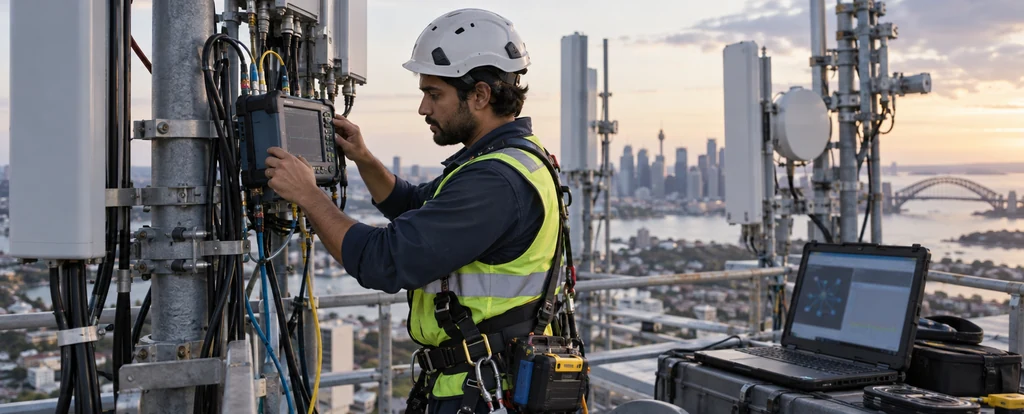
Most of the job happens at mobile base sites, telephone exchanges, pits and customer premises, where field engineers commission new equipment and get failed links working again. The role sits between the technician who installs and repairs the network and the engineer who designs it: a field engineer fault-finds on live equipment and often plans the job and reports back on what was found. Employers are mainly carriers, network infrastructure contractors and large organisations that run their own networks, and the work is often done to a deadline because customers are offline until the fault is cleared.
How much do telecommunications field engineers earn?
The median full-time salary for a telecommunications field engineer is $101,400 per annum, before tax, up $21,500 since 2018.
Who you work for moves pay more than the job title does: carriers and large contractors tend to pay above the award, while smaller subcontractors often do not. On-call rosters, after-hours fault callouts and travel to remote sites usually bring penalty rates or allowances on top of base pay. Extra licences, such as a high risk work licence for tower work or registration under the Australian Communications and Media Authority cabling scheme, can also move you up a band.
What does a telecommunications field engineer do day to day?
The list below is what fills most weeks; the exact mix shifts with seniority and whatever stage the current work is at.
- Installing and commissioning equipment such as antennas, transmission gear and customer connections
- Splicing fibre and testing links with an OTDR or spectrum analyser to confirm the signal is within spec
- Tracing faults across copper, fibre and wireless links, then restoring service and recording what caused it
- Reading network diagrams and as-built plans to work out how a site was actually built
- Working to safety and industry standards on towers, in exchanges and at customer premises, where a missed step can take out a link for everyone on it
What skills do telecommunications field engineers need?
Employers look for networks and systems administration, installation and maintenance, plant and equipment operation, backed by OTDR fluency and strong problem solving.
Specialist skills
- Networks and systems administration
- Installation and maintenance
- Plant and equipment operation
- Worksite safety management
Software and tools
- OTDR
- Spectrum analyser
- Fusion splicer
- Cable tester
- Network management software
General skills
- Problem solving
- Attention to detail
- Written communication
Is the job growing?
About 850 people work as telecommunications field engineers in Australia, and employment is projected to grow 13.7% over the decade to 2035. That's healthy, above-average growth, and the role should stay in solid demand.
How do you become a telecommunications field engineer?
Here's the path most telecommunications field engineers take, step by step.
- 1Start with a Certificate III in Telecommunications Technology
TAFEs and registered training organisations offer it, and it is commonly done as an apprenticeship or traineeship with a carrier or contractor, which means you are paid while you learn and finish in about three to four years.
- 2Get your cabling registration and site licences
Working on customer cabling requires registration under the ACMA scheme, which the Certificate III supports, and construction sites generally require a White Card. Tower work calls for a high risk work licence and height safety training.
- 3Learn fault-finding on live networks
Early on you work under an experienced field engineer or supervisor, and the skill that takes longest to build is reading a fault quickly from test results and what you can see at the site.
- 4Add a diploma or degree for the design side
A Diploma of Telecommunications Network Engineering suits work closer to network design and planning, while a Bachelor of Engineering is what the move into a telecommunications engineer role requires.
Ready to apply as a telecommunications field engineer?
Whether you're working toward becoming a telecommunications field engineer or already are one and want a hand with the next step (sharpening your resume for ATS screening, tightening your cover letter, or knowing what you'll actually be asked at interview), here are examples grounded in this specific role, not generic templates.
What jobs can a telecommunications field engineer move to?
Moving into Telecommunications Engineer typically comes with the biggest pay rise, worth $44,000 a year more on average.
| Move to | Typical pay change | Overlap | Retraining |
|---|---|---|---|
| Telecommunications Engineer Field engineers bring hands-on network deployment and fault-finding experience, but moving into engineering design requires a degree.Known move | +$44,000 | 22% | requalify |
| Telecommunications Technologist Field engineers bring practical network knowledge, and a short course in technology design supports the move into a technologist role.Known move | −$5,200 | 57% | short course |
Moves are chosen from Jobs and Skills Australia's Data on Occupation Mobility, which follows income tax records between 2011-12 and 2020-21, together with entry requirements and skill overlap. A known move is one people were seen making in that data. Pay change compares median full-time pay for the two roles.
Who works as a telecommunications field engineer?
The typical telecommunications field engineer is 43 years old; 95% are men, 91% work full-time, and full-timers average 40 hours a week.
- 43
- Median age
- 5%
- Female share
- 91%
- Full-time
- +0h
- vs all-jobs avg
What's it like being a telecommunications field engineer?
The week is a mix of booked jobs and whatever breaks, so field engineers plan their run in the morning and often have it rearranged by a fault call by lunchtime. The pressure comes from the network being live: customers are offline until the link is back, and a lot of the technical judgement happens alone at the site with test gear. It suits people who like practical problem solving, are comfortable working at heights and in all weather, and would rather be moving between sites than sitting at one desk.
What people like
- Faults you can find and fix. A test result points to a break or a misaligned antenna, and the job ends with a link back up and customers who noticed it was down.
- A different site every day. A week might cover a rooftop, a suburban pit and a regional tower, which suits people who do not want to work in one place.
- The equipment gives you an answer. Networks respond to measurement rather than opinion, so diagnosis rewards method and patience.
- Skills that carry across. Fibre splicing, RF testing and IP networking also turn up in broadcasting, mining, defence and data centres, so the experience travels.
What people find hard
- Weather and after-hours callouts. Outages do not wait for business hours, so night works and wet days on a tower are part of the roster.
- Time on the road. Regional and remote sites can mean long drives and nights away, and the travel usually sits on top of a full day of work.
- Waiting on access and permits. A job can stall on a building manager, a site induction or a road permit while the customer is still offline.
- Repetitive planned maintenance. Inspections and record-keeping take up a fair share of the calendar, and they are less interesting than a live fault.
Based on our synthesis of professional-body surveys and public accounts of the role, not first-person verified reviews.
Which industries employ telecommunications field engineers?
Information Media and Telecommunications employs the largest share of telecommunications field engineers, followed by Construction.
Top employing industries
- 1Information Media and Telecommunications
- 2Construction
Ranked by employment share; the source doesn't publish an exact percentage per industry.
| Certificate III/IV | 37.2% | |
|---|---|---|
| Diploma / Advanced Diploma | 17.3% | |
| Bachelor degree | 16% | |
| Year 12 or below | 14.9% | |
| Postgraduate | 9.4% |
Will AI replace telecommunications field engineers?
This is a low-exposure role because so much of the work happens with your hands on equipment in the field: climbing structures, splicing fibre, swapping cards and testing what is physically there. Remote monitoring, automated test gear and network management software now do more of the fault detection and configuration than they used to, which changes how a fault is found rather than removing the need to go and fix it.
Share of typical working time by exposure level
- Installing and maintaining site hardwareMounting antennas, pulling and splicing fibre and replacing failed cards is physical work at height, in pits and in exchanges.35%low
- Job records, permits and compliance reportingWork notes, timesheets and safety records are captured on a tablet in the field and increasingly pre-filled from the test data the equipment produces.25%high
- Diagnosing faults from test resultsSoftware flags the likely cause from alarm and performance data, but confirming a break in a cable or a misaligned antenna still means going to the site with an OTDR.20%moderate
- Configuring and commissioning new equipmentStandard configurations are pushed remotely by network management systems, and the field engineer checks that the equipment behaves as expected once it is live.20%moderate
Common questions about becoming a telecommunications field engineer
Straight answers to the questions people ask most.
How much do telecommunications field engineers earn?
Median pay is $101,400 per year before tax for full-time work. Take-home pay varies with overtime, on-call allowances and who you work for, so a contractor role with regular callouts can pay more than the median while base rates at a small subcontractor can sit below it.
How do you become a telecommunications field engineer?
The usual entry is a Certificate III in Telecommunications Technology (ICT30524), often completed as an apprenticeship or traineeship with a carrier or contractor, plus registration under the ACMA cabling scheme. Employers then expect a few years of supervised fault-finding before you work on live networks on your own.
Are telecommunications field engineers in demand?
Telecommunications field engineers are currently not in shortage, and employment is projected to grow 13.7% over the decade to 2035 over the decade to 2035. With about 850 people in the occupation, the work sits with a relatively small number of carriers and network contractors, so it pays to watch who is building or upgrading in your area.
Will AI replace telecommunications field engineers?
AI and automation reach only part of this job. Network management software and remote monitoring now flag many faults and push standard configurations automatically, but climbing, splicing, replacing hardware and testing what is actually on site keeps the role hands-on.
What can telecommunications field engineers move into?
Moving into network design as a telecommunications engineer is one route, though it requires a degree, and median pay there is $44,000 more. A move to telecommunications technologist takes a short course and median pay for that role is $5,200 less. Telecommunications technicians often step up into field engineering, where median pay is $10,400 more.
Do telecommunications field engineers work shifts or on call?
Many work an ordinary day shift with a rotating on-call roster for faults outside business hours. Planned maintenance on live networks is often scheduled at night to avoid cutting off customers, so late finishes happen even without an outage.
Related roles
- Telecommunications Engineer
- Telecommunications Technologist
- Telecommunications Technician
- Telecommunications Technologist
- Radiocommunications Technician
- Calibration Technician
Not sure this is you? Take the career quiz and get a ranked shortlist of roles that fit how you like to work.