Railway Signal Electrician
Railway signal electricians install and maintain the electrical systems that control train movements, keeping passenger and freight services safe and on time.
- Median salary*
- $111,800
3.7%vs last year, before tax
- People employed*
- 2,500
0.0%vs last year
- Projected growth*
- +5%
to 2035
- AI exposure*
- Low
- automation risk
- Average hours*
- 40/wk
matches all-jobs average
- Shortage status*
- In shortage
national
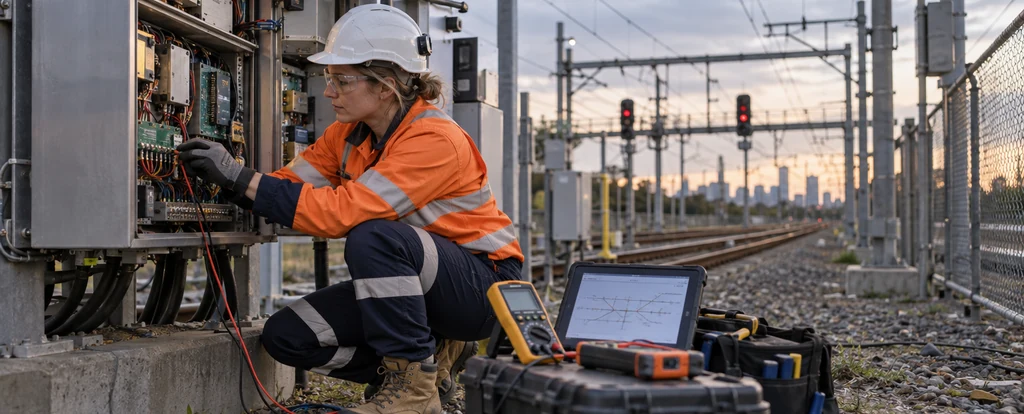
Railway signal electricians install, test and repair the equipment that tells trains where they can safely travel, including trackside signals, points, train detection circuits and the relay rooms and control centres behind them. They work for rail operators, freight businesses and signalling contractors, and much of the work happens during track closures at night or over a weekend, when no trains are running. It sits close to general electrical work in its wiring and testing, but the systems, the standards and the safety rules are specific to the rail network.
How much do railway signal electricians earn?
The median full-time salary for a railway signal electrician is $111,800 per annum, before tax, up $23,100 since 2018.
Pay is set mainly by the enterprise agreement you work under, so a state rail operator, a freight business and a private signalling contractor can offer different rates for similar work. Shift work, night possessions and weekend callouts usually attract penalty rates, and adding higher signalling competencies or moving into a team leader role lifts the base rate. Signalling is a small trade, so rates also reflect how hard it is for an employer to replace someone with your network experience.
What does a railway signal electrician do day to day?
The list below is what fills most weeks; the exact mix shifts with seniority and whatever stage the current work is at.
- Installing and wiring trackside signalling equipment such as signals, points and train stops
- Testing and commissioning new signalling circuits and interlocking systems
- Diagnosing faults in relay, electronic and computer-based signalling systems, often against the clock inside a track closure
- Maintaining and repairing level crossing warning systems and train detection equipment
- Reading and interpreting signalling diagrams, wiring schedules and rail safety standards
What skills do railway signal electricians need?
Employers look for installation and maintenance, reading plans and specifications, worksite safety management, backed by Multimeter fluency and strong safety and compliance awareness.
Specialist skills
- Installation and maintenance
- Reading plans and specifications
- Worksite safety management
- Plant and equipment operation
Software and tools
- Multimeter
- Oscilloscope
- Westrace interlocking
- CBTC diagnostic software
- Insulation tester
General skills
- Safety and compliance awareness
- Problem solving
- Attention to detail
Is the job growing?
About 2,500 people work as railway signal electricians in Australia, and employment is projected to grow 5% over the decade to 2035. That's modest growth: demand is steady rather than booming.
How do you become a railway signal electrician?
Here's the path most railway signal electricians take, step by step.
- 1Complete an electrical apprenticeship
A Certificate III in Electrotechnology Electrician (UEE30820) takes about four years and is paid, and covers wiring, testing, fault-finding and electrical safety. It is the base qualification most rail employers expect before they will train you on signalling systems.
- 2Get your electrical licence
You need the electrical licence issued by your state or territory regulator before working unsupervised on electrical equipment. Licensing rules differ between states, so check the requirements where you intend to work.
- 3Add rail signalling training
A Certificate IV in Electrical Rail Signalling covers interlockings, train detection and trackside equipment, and many employers put new starters through it on the job. It is the qualification that separates signalling work from general electrical maintenance.
- 4Complete rail safety worker competency
National rail safety regulation requires safeworking training and a competency that is assessed and renewed periodically for the network you work on. Without it you cannot take responsibility for equipment that trains depend on.
- 5Entering from another electrical trade
A licensed electrician or electrical fitter can move across by completing the signalling qualification and safeworking competency, while an electrical trades assistant usually needs the full apprenticeship first.
Ready to apply as a railway signal electrician?
Whether you're working toward becoming a railway signal electrician or already are one and want a hand with the next step (sharpening your resume for ATS screening, tightening your cover letter, or knowing what you'll actually be asked at interview), here are examples grounded in this specific role, not generic templates.
What jobs can a railway signal electrician move to?
Moving into Powerline Worker typically comes with the biggest pay rise, worth $30,200 a year more on average.
| Move to | Typical pay change | Overlap | Retraining |
|---|---|---|---|
| Powerline Worker A railway signal electrician brings electrical safety and fault-finding skills, but needs training for overhead line work. | +$30,200 | 67% | reskill |
| Electrician A railway signal electrician brings specialised wiring and testing skills, but needs broad electrical installation training to work as an electrician. | +$2,100 | 46% | reskill |
| Cable Jointer A railway signal electrician brings fault-finding, cable termination and testing skills, but needs extra training for cable jointing. | −$10,400 | 83% | reskill |
| Electrical Fitter A railway signal electrician brings relay, wiring and maintenance skills, and needs retraining in machinery fitting and installation. | −$20,800 | 67% | reskill |
Moves are chosen from Jobs and Skills Australia's Data on Occupation Mobility, which follows income tax records between 2011-12 and 2020-21, together with entry requirements and skill overlap. A known move is one people were seen making in that data. Pay change compares median full-time pay for the two roles.
Who works as a railway signal electrician?
The typical railway signal electrician is 40 years old; 95% are men, 94% work full-time, and full-timers average 40 hours a week.
- 40
- Median age
- 5%
- Female share
- 94%
- Full-time
- +0h
- vs all-jobs avg
What's it like being a railway signal electrician?
The job follows the railway timetable rather than a standard week: installation, testing and heavy maintenance happen during track closures at night or over a weekend, and the rest of the time goes on inspections, fault response and records. Because a wrong connection can put trains at risk, work is checked against procedures and reviewed by another competent person, which suits people who prefer precise, methodical tasks. The trade is small and specialised, so signal electricians tend to stay in it and build knowledge of one or two networks over a career.
What people like
- Faults with visible consequences. When a signal comes back to life, the block reopens and trains start moving again, so the result of the work shows up within minutes rather than at the end of a project.
- Trackside and workshop time. A week can take in a relay room, a level crossing, a control centre and an open track corridor, so the days are not spent in one place.
- A small trade with long memories. Because few people hold these skills, experienced hands are known across a network and much of the knowledge about older relay equipment sits with people rather than in documents.
- Conditions set by agreement. Most signal electricians work under an enterprise agreement, with penalty rates for night and weekend possessions built into the roster rather than negotiated case by case.
What people find hard
- Nights and weekends in track closures. Most installation and heavy testing happens when the trains have stopped, so late shifts and weekend work are part of the pattern rather than an occasional extra.
- Paperwork and competency renewals. Permits, safe work method statements, test records and periodic rail safety competency renewals take up a real share of the week.
- Waiting on project schedules. Commissioning dates shift when construction runs late, which can leave a crew ready to test with nothing to test.
- Weather and distance. Regional lines and yards mean hot, cold and wet conditions, plus travel away from home on some projects.
Based on our synthesis of professional-body surveys and public accounts of the role, not first-person verified reviews.
Which industries employ railway signal electricians?
Rail passenger transport employs the largest share of railway signal electricians, followed by Rail freight transport.
Top employing industries
- 1Rail passenger transport
- 2Rail freight transport
- 3Heavy and civil engineering construction
- 4Electrical services
- 5Government administration
Ranked by employment share; the source doesn't publish an exact percentage per industry.
| Certificate III/IV | 34% | |
|---|---|---|
| Diploma / Advanced Diploma | 26% | |
| Bachelor degree | 20% | |
| Year 12 or below | 20% |
Will AI replace railway signal electricians?
The job is only lightly exposed to AI. Signalling has gone digital, so interlockings, train detection and CBTC systems log faults that diagnostic software helps interpret, which shortens the search for where a problem started. The repair, testing and verification still happen trackside with tools in hand, under rail safety rules that require each circuit to be tested and signed off before trains run.
Share of typical working time by exposure level
- Fault-finding on signalling systemsFault logs from an interlocking point to a suspect circuit, but tracing it with a multimeter or insulation tester ends at the terminal.35%low
- Trackside installation and wiringRunning cables, terminating conductors and fitting signals and points motors is manual work in live rail corridors that no software performs.30%low
- Testing and commissioning new installationsTest equipment and computer-based interlockings can run part of the sequence automatically, and the results still get checked against the signalling diagram.20%moderate
- Inspection records and maintenance reportingWriting up inspections, defect reports and competency records is the part of the job most easily drafted or templated by software.15%high
Common questions about becoming a railway signal electrician
Straight answers to the questions people ask most.
How much does a railway signal electrician earn?
The median is $111,800 per annum, before tax, for full-time railway signal electricians. That median covers workers across rail operators, freight businesses and signalling contractors, so your own pay depends on your enterprise agreement, shift loadings and how many signalling competencies you hold.
How do you become a railway signal electrician?
The usual route is a four-year electrical apprenticeship leading to a Certificate III in Electrotechnology Electrician (UEE30820) and a state or territory electrical licence, then signalling-specific training such as a Certificate IV in Electrical Rail Signalling. Most people also complete their employer's safeworking and rail safety worker competency before working unsupervised on the network.
Do you need to be a licensed electrician to work as a railway signal electrician?
In most cases yes. Employers generally expect a Certificate III in Electrotechnology Electrician and a current electrical licence before they will put you on signalling systems, and then add the signalling qualification and safeworking competency on top. Electrical trades assistants do move across, but they usually need to complete the apprenticeship first.
Are railway signal electricians in demand?
Railway signal electricians are currently in shortage nationally, and employment in the role is projected to grow 5% over the decade to 2035. Employers are rail operators, freight businesses and signalling contractors, so openings follow their maintenance programs and major project schedules rather than being spread across every electrical employer.
Will AI and automation replace railway signal electricians?
AI and automation change the equipment more than the job of maintaining it. Diagnostic software and computer-based interlockings log and narrow down faults, and test sequences can partly run themselves, but installation, testing and verification still need a licensed person trackside. Inspection records and defect reporting are the parts of the role most easily drafted by software.
What can a railway signal electrician move into?
Most moves stay inside the rail electrical trades. Cable jointing is a close fit because fault-finding, cable termination and testing carry across, and it pays $10,400 less; powerline work pays $30,200 more and draws on the same electrical safety habits, though it needs training for overhead lines. General electrical work is an option too, paying $2,100 more, but it needs broad installation experience.
Related roles
Not sure this is you? Take the career quiz and get a ranked shortlist of roles that fit how you like to work.