Cable Jointer
Cable jointers join, seal and terminate power cables so electricity can travel through a network without failing at the connection.
- Median salary*
- $101,400
3.9%vs last year, before tax
- People employed
- 580
3.3%vs last year
- Projected growth
- +5.2%
to 2035
- AI exposure*
- Low
- automation risk
- Average hours
- 44/wk
+4h vs all jobs
- Shortage status
- In shortage
national
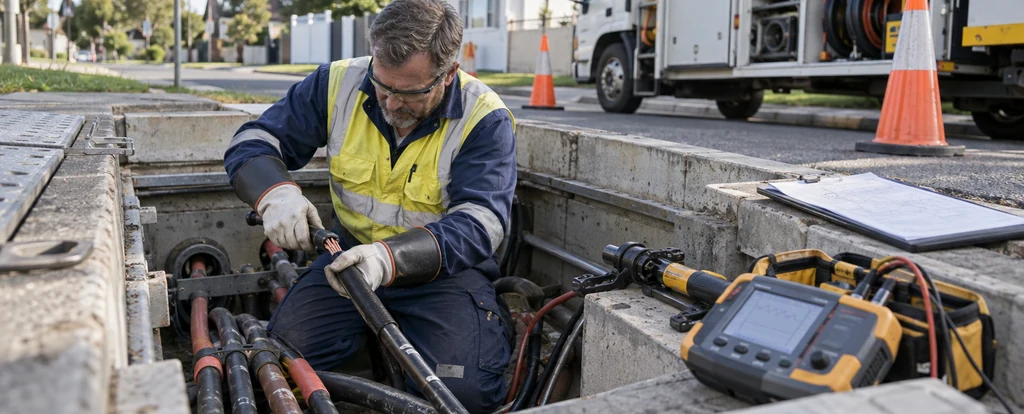
Most cable jointers work for electricity network operators or the contractors that build and maintain those networks, and the cables they handle run underground, overhead and into substations. It is a narrower job than powerline work: where a powerline worker looks after the overhead lines, a cable jointer takes responsibility for the cable itself, its insulation, its joints and its terminations. The work is often outdoors in trenches, cable pits or substations, and preparing and completing a single high voltage joint can take several hours.
How much do cable jointers earn?
The median full-time salary for a cable jointer is $101,400 per annum, before tax, up $21,000 since 2018.
Pay is set mainly by the enterprise agreement you work under, so jointers at network operators and large contractors are paid on a classification scale that rises with the voltages you are authorised to work on. Overtime, standby, night and weekend outage work add loadings on top of the base rate, and camp or remote projects often come with an allowance. Contracting through labour hire can pay more per hour, usually without the same security or training support.
What does a cable jointer do day to day?
The list below is what fills most weeks; the exact mix shifts with seniority and whatever stage the current work is at.
- Preparing cable ends by stripping back insulation, screens and bedding to expose the conductor
- Joining and terminating low voltage, high voltage and extra high voltage cables with crimps, heat shrink and cast resin
- Testing completed joints and terminations with insulation resistance and high voltage test sets
- Locating cable faults with time domain reflectometers and fault locators, then repairing the damaged section
- Reading network plans and following switching and safe work procedures so the cable can be returned to service
What skills do cable jointers need?
Employers look for installation and maintenance, worksite safety management, reading plans and specifications, backed by Hydraulic crimping tools fluency and strong safety and compliance awareness.
Specialist skills
- Installation and maintenance
- Worksite safety management
- Reading plans and specifications
- Plant and equipment operation
- Hand and power tool work
Software and tools
- Hydraulic crimping tools
- Cable fault locators and time domain reflectometers
- Insulation resistance and high voltage test sets
- Cable pulling winches
- Network asset and GIS mapping software
General skills
- Safety and compliance awareness
- Problem solving
- Attention to detail
Is the job growing?
About 580 people work as cable jointers in Australia, and employment is projected to grow 5.2% over the decade to 2035. That's modest growth: demand is steady rather than booming.
How do you become a cable jointer?
Here's the path most cable jointers take, step by step.
- 1Start with an electrical trade or a power systems traineeship
Most cable jointers come through a Certificate III in Electrotechnology (Electrician) apprenticeship, while others enter through a power systems traineeship with a network operator. Both are paid and take about four years.
- 2Add the cable jointing qualification
The specific qualification is a Certificate III in ESI Power Systems (Distribution Cable Jointing), delivered through TAFE or an employer's registered training organisation while you work on a crew.
- 3Build up your authorisations
Network operators authorise jointers for low voltage first, then high voltage and extra high voltage as you gain supervised experience and pass assessments. The voltages you are authorised for decide which jobs you can be put on.
- 4Keep your licence and safety training current
Electrical worker licensing and registration are handled by state regulators, so requirements differ depending on where you work, and refreshers such as CPR, pole top rescue, confined space and switching are renewed on a set cycle.
Ready to apply as a cable jointer?
Whether you're working toward becoming a cable jointer or already are one and want a hand with the next step (sharpening your resume for ATS screening, tightening your cover letter, or knowing what you'll actually be asked at interview), here are examples grounded in this specific role, not generic templates.
What jobs can a cable jointer move to?
None of the roles cable jointers typically move into pay more than the role itself. Telecommunications Cable Jointer is the closest match. If a bigger salary is the goal, moving up into a senior or principal position within the role is usually the faster route than moving sideways.
| Move to | Typical pay change | Overlap | Retraining |
|---|---|---|---|
| Telecommunications Cable Jointer Cable jointers bring cable jointing and termination skills to telecommunications work, with a short course covering fibre and low voltage networks.Known move | −$10,400 | 70% | short course |
| Data Cabler Structured cabling and termination skills carry across, with a short course bridging to low voltage cabling and testing work.Known move | −$20,800 | 67% | short course |
Moves are chosen from Jobs and Skills Australia's Data on Occupation Mobility, which follows income tax records between 2011-12 and 2020-21, together with entry requirements and skill overlap. A known move is one people were seen making in that data. Pay change compares median full-time pay for the two roles.
Who works as a cable jointer?
The typical cable jointer is 38 years old; 98% are men, 94% work full-time, and full-timers average 44 hours a week.
- 38
- Median age
- 2%
- Female share
- 94%
- Full-time
- +4h
- vs all-jobs avg
What's it like being a cable jointer?
The work runs on planned outages and faults, so a week can swing between a long, careful job in a trench and a call-out in the rain when a cable fails. It suits people who like finishing something to a clear standard and can stay methodical when a joint has to be exactly right, because a bad joint fails later and takes supply with it. The trade-off is weather, cramped places and shift or standby rosters.
What people like
- Work that is either right or wrong. A joint goes back into service and either holds or fails, which suits people who like a clear standard and a finished result at the end of the day.
- A range of cable types and voltages. You might work on a low voltage service cable and extra high voltage cable in the same year, using different jointing methods for each.
- Small crews and a known patch. Jointing crews are small, so you get to know the network area you cover, the substations on it and the people you work with.
- Steady work with the network owner. Much of the work comes from ongoing maintenance and capital programs rather than one-off projects, which makes for continuous employment.
What people find hard
- Trenches, pits and bad weather. A lot of the work happens below ground or inside a substation, in heat, rain or cold, and cable pits are cramped and sometimes wet.
- Outages scheduled for when customers won't notice. Network operators often schedule planned outages at night or on weekends to limit disruption, so those hours are part of the job.
- Faults that don't wait. A cable failure can put you on standby or call you out after hours, and the fault has to be found and repaired before supply is restored.
- Mistakes show up later. A poorly prepared joint can pass its immediate tests and fail years later, so the work demands care even when you are hurrying to restore supply.
Based on our synthesis of professional-body surveys and public accounts of the role, not first-person verified reviews.
Which industries employ cable jointers?
Electricity, Gas, Water and Waste Services employs the largest share of cable jointers, followed by Construction.
Top employing industries
- 1Electricity, Gas, Water and Waste Services
- 2Construction
Ranked by employment share; the source doesn't publish an exact percentage per industry.
| Certificate III/IV | 74.6% | |
|---|---|---|
| Year 12 or below | 16.8% | |
| Diploma / Advanced Diploma | 4.2% | |
| Bachelor degree | 2.4% | |
| Postgraduate | 0.5% |
Will AI replace cable jointers?
Cable jointing rates as low exposure to AI because the core of the job is physical work on cables in trenches, pits and substations. Software already helps with the work around it, locating faults from test results, mapping cables in GIS and scheduling outages and crews, but it does not prepare a cable end or complete a joint. That split is likely to hold, with the tools getting better at telling you where to dig rather than doing the work once you are there.
Share of typical working time by exposure level
- Jointing and terminating cablesCompleting a joint on low, high or extra high voltage cable is skilled handwork, and hydraulic crimping with resin or heat shrink systems still needs a jointer to place and finish it.35%low
- Preparing cable ends and conductorsStripping insulation, screens and bedding without nicking the conductor is done by hand and judged by eye and feel.25%low
- Fault location and testingTime domain reflectometers and test sets are increasingly automated in how they interpret results, which speeds up finding a fault but leaves the repair to the jointer.25%moderate
- Recording work and planning outagesAsset records, switching sheets and mapping updates are the parts most likely to be generated or checked automatically, freeing time for the field work.15%high
Common questions about becoming a cable jointer
Straight answers to the questions people ask most.
How much does a cable jointer earn?
Cable jointers working full time earn a median of $101,400 per year before tax. What you actually take home depends on the enterprise agreement you are on, the voltages you are authorised to work on and how much outage and emergency work you do.
How do you become a cable jointer?
The usual route is an electrical apprenticeship or a power systems traineeship with a network operator, followed by the cable jointing qualification and employer authorisations for each voltage level. Electrical worker licensing sits with state regulators, so check what your state requires before you commit.
Are cable jointers in demand?
Cable jointers are currently in shortage nationally, and employment is projected to grow 5.2% over the decade to 2035. About 580 people work in the trade nationally, so the openings that appear depend on the maintenance and construction programs of the network operators and contractors in your state.
Will AI replace cable jointers?
Software reaches the planning, testing and record-keeping around the job more than the jointing itself, which keeps the role's exposure low. Fault location software and automated test sets can point to a problem faster, but someone still has to expose, prepare and complete the cable.
What can a cable jointer move into?
Most moves stay inside the electricity supply industry. Powerline workers bring overhead line experience and reskill through a course in underground jointing and termination, for $40,600 less in pay. Jointing skills also carry across to telecommunications cable jointing, for $10,400 less, and data cabling, for $20,800 less, each with a short bridging course.
What is the difference between a cable jointer and a powerline worker?
A powerline worker installs and maintains the overhead lines, poles and structures, while a cable jointer works on the cable itself, joining, terminating and repairing it. The two trades overlap in the electricity supply industry and people move between them, but the jointing techniques are specific to cable work.
Related roles
- Telecommunications Cable Jointer
- Data Cabler
- Electrical Trades Assistant
- Powerline Worker
- Conveyor Belt Splicer
- Wind Turbine Technician
Not sure this is you? Take the career quiz and get a ranked shortlist of roles that fit how you like to work.