Flooring Installer
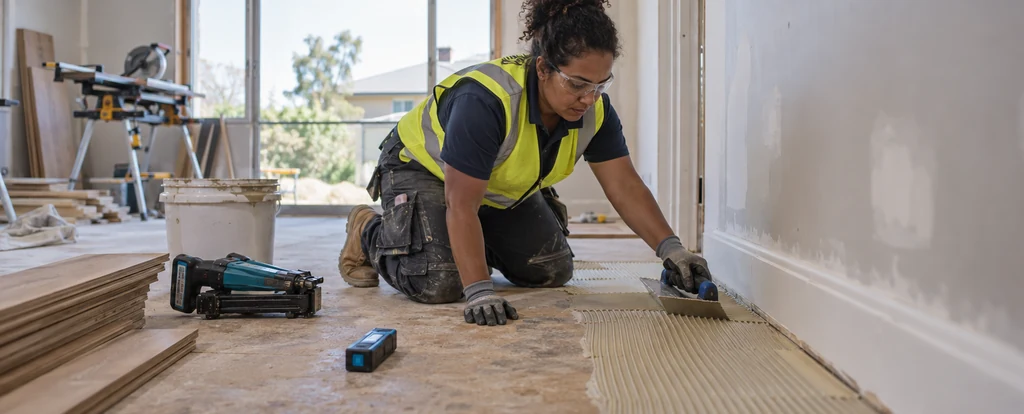
Flooring installers lay the carpet, timber, laminate and vinyl that finishes a room, working from a subfloor they have usually prepared themselves.
- Median salary*
- $70,200
4.5%vs last year, before tax
- People employed
- 11,500
0.9%vs last year
- Projected growth
- +7.6%
to 2035
- AI exposure*
- Low
- automation risk
- Average hours
- 43/wk
+3h vs all jobs
- Shortage status
- In shortage
national
Flooring installers work in new homes, renovations and commercial fit-outs, laying coverings over subfloors they have measured, checked and levelled. The trade splits by material: carpet and resilient layers work with rolls and sheet goods, while timber installers sand and finish what they lay. It is one of the last trades on site before handover, so the pressure to be quick and neat lands at the end of a build when other trades are waiting.
How much do flooring installers earn?
The median full-time salary for a flooring installer is $70,200 per annum, before tax, up $14,900 since 2018.
Installers on wages are usually covered by a construction industry award, where the rate depends on your classification level and how much of your work is commercial rather than residential. Subcontractors are paid per job and carry their own tools, vehicle and insurance, which the quoted price has to cover, so a job that runs over costs you rather than the builder. Sanding and finishing skills, and a second covering specialisation, are the usual ways to earn more without changing trades.
What does a flooring installer do day to day?
The list below is what fills most weeks; the exact mix shifts with seniority and whatever stage the current work is at.
- Measuring rooms and checking subfloors for moisture, flatness and level
- Cutting and laying carpet, timber, laminate and vinyl around walls, doorways and fittings
- Spreading adhesives and fitting underlay before the covering goes down
- Sanding, sealing and polishing timber floors
- Fitting trims, skirting and transition strips where one surface meets another
What skills do flooring installers need?
Employers look for hand and power tool work, reading plans and specifications, installation and maintenance, backed by Laser distance measurers fluency and strong attention to detail.
Specialist skills
- Hand and power tool work
- Reading plans and specifications
- Installation and maintenance
- Worksite safety management
- Craft and handmade production
- Quoting and estimating
Software and tools
- Laser distance measurers
- Moisture meters
- Floor sanders
- Nail guns
- MeasureSquare
General skills
- Attention to detail
- Physical stamina and dexterity
Is the job growing?
About 11,500 people work as flooring installers in Australia, and employment is projected to grow 7.6% over the decade to 2035. That's modest growth: demand is steady rather than booming.
How do you become a flooring installer?
Here's the path most flooring installers take, step by step.
- 1Get your White Card first
General construction induction training is a short course and is required before you set foot on a construction site anywhere in Australia. It is quick to complete and makes you employable as a labourer while you look for an apprenticeship.
- 2Start a flooring apprenticeship
The standard entry is a Certificate III in Flooring Technology (MSF30822) through an Australian Apprenticeship, usually three years of paid on-the-job training with a registered training organisation component. You cover subfloor preparation, adhesives and at least one covering type in depth, and finish with a trade qualification.
- 3Choose the coverings you want to specialise in
Carpet and resilient sheet goods use different tools and techniques from timber and laminate, and sanding and finishing is a skill of its own. Many installers add a second specialisation after they qualify because it keeps work coming in between fit-out seasons.
- 4Coming from another trade
Builder's labourers and tilers often move across because they already read plans, prepare surfaces and know how a site runs. You still need the flooring qualification, but some training organisations recognise prior experience and shorten the training.
- 5Decide between wages and subcontracting
Most installers start on wages with a flooring company, then move to subcontract work quoting per job. Subcontracting pays more on paper, but you supply the tools, the ute and the insurance, so your quoting has to be accurate.
Ready to apply as a flooring installer?
Whether you're working toward becoming a flooring installer or already are one and want a hand with the next step (sharpening your resume for ATS screening, tightening your cover letter, or knowing what you'll actually be asked at interview), here are examples grounded in this specific role, not generic templates.
What jobs can a flooring installer move to?
Moving into Concreter typically comes with the biggest pay rise, worth $44,700 a year more on average.
| Move to | Typical pay change | Overlap | Retraining |
|---|---|---|---|
| Concreter Flooring installers bring floor preparation and levelling experience, but need concreting training to place and finish concrete.Known move | +$44,700 | 41% | reskill |
| Carpenter Flooring installers bring subfloor preparation and finishing skills, but need carpentry training to build and install structural timber.Known move | +$21,300 | 50% | reskill |
| Tiler Flooring installers bring surface preparation, cutting and levelling skills, but need tiling training for wall and floor tiles.Known move | −$8,800 | 54% | reskill |
Moves are chosen from Jobs and Skills Australia's Data on Occupation Mobility, which follows income tax records between 2011-12 and 2020-21, together with entry requirements and skill overlap. A known move is one people were seen making in that data. Pay change compares median full-time pay for the two roles.
Who works as a flooring installer?
The typical flooring installer is 42 years old; 93% are men, 71% work full-time, and full-timers average 43 hours a week.
- 42
- Median age
- 7%
- Female share
- 71%
- Full-time
- +3h
- vs all-jobs avg
What's it like being a flooring installer?
The work is physical and it moves: a domestic carpet job one day, a commercial vinyl fit-out the next, and rarely the same address twice in a week. Full-time installers average 43 hours a week, much of it spent kneeling, lifting and working to someone else's schedule because flooring goes in late, once the wet trades, plasterers and painters are done. What holds people in the trade is that the result is finished and visible by the end of each job.
What people like
- You see the finished result. A room looks transformed at the end of the day, and the floor is the surface everyone notices first when they walk in.
- The work changes with every job. Different sites, different materials and different problems to solve, with no two rooms quite the same shape.
- Hand skills that keep improving. Scribing a neat join around a door frame or getting a timber floor dead flat is a skill you can feel getting better, and it is what separates a good installer from a quick one.
- A clear path to working for yourself. Once you have the qualification and a set of tools, subcontracting and then running your own small operation is a normal step rather than a leap.
What people find hard
- Hard on the knees and back. Kneeling and crouching for most of the day, plus lifting rolls of carpet and boxes of planks, takes a toll over a career.
- You often fix problems you did not cause. A slab that is out of level or a floor that is still damp can stop the job, and the delay lands on you even though the subfloor was someone else's work.
- Quoted jobs can run long. Subcontractors are usually paid for the job rather than the hours, so an awkward room or a hidden layer of old adhesive comes out of your own time.
- Dust, adhesives and fumes. Sanding and stripping old flooring throws up dust, and solvent-based adhesives need ventilation and the right mask.
Based on our synthesis of professional-body surveys and public accounts of the role, not first-person verified reviews.
Which industries employ flooring installers?
Construction employs the largest share of flooring installers.
Top employing industries
- 1Construction
Ranked by employment share; the source doesn't publish an exact percentage per industry.
| Year 12 or below | 48.6% | |
|---|---|---|
| Certificate III/IV | 40% | |
| Diploma / Advanced Diploma | 4% | |
| Bachelor degree | 3.5% | |
| Postgraduate | 0.6% |
Will AI replace flooring installers?
Flooring installation is a low-exposure trade, because the job happens with your hands on a site that is never quite square, level or dry. Estimating software, laser distance measurers and moisture meters have taken over much of the measuring and quoting, and that is genuinely useful, but none of it fits a sheet of vinyl around a kitchen island or decides whether a slab is dry enough to lay over. Technology has changed the paperwork around the trade far more than the trade itself.
Share of typical working time by exposure level
- Cutting and laying coveringsMachine-cut planks and factory-finished boards save time, but scribing around pipes, door frames and awkward corners is done by hand with a knife and a template.40%low
- Preparing and levelling subfloorsMoisture meters and grinders help, but deciding whether a slab is flat and dry enough to lay over is a judgement made on site with a straight edge and experience.30%low
- Measuring up and quoting a jobTools like MeasureSquare and laser measurers work out areas and waste from a floor plan in minutes, though you still walk the rooms to check the plan matches the building.15%moderate
- Quotes, invoices and schedulingQuoting and accounting apps handle the paperwork that used to eat evenings, which matters most if you are subcontracting and running your own bookings.15%high
Common questions about becoming a flooring installer
Straight answers to the questions people ask most.
How much do flooring installers earn?
Full-time flooring installers earn a median of $70,200 per year before tax. What you take home depends on your classification under the relevant construction award, whether you are on wages or paid per square metre, and how much commercial fit-out work you do compared with residential jobs.
How do you become a flooring installer?
Most people start with a Certificate III in Flooring Technology (MSF30822) as an apprentice, which takes about three years and is paid work rather than full-time study. A White Card is needed before you can work on a construction site, and it is usually the first thing employers ask about.
Are flooring installers in demand?
Flooring installers are currently in shortage nationally, and employment is projected to grow 7.6% over the decade to 2035. For someone deciding whether to train, that points to work waiting once you are qualified rather than a trade you have to fight your way into.
Will AI replace flooring installers?
Not in the near term, because the core of the job is physical fitting on a site that will not hold still. Measuring and estimating software already handles takeoffs and quotes, and that paperwork is the most exposed part of the work, but laying, scribing and finishing are done by hand.
What can flooring installers move into?
Carpenters earn $21,300 more and concreters $44,700 more compared with flooring installers, and both moves make sense because you already prepare and level surfaces, though each needs further training rather than a straight swap. Going out on your own as a subcontractor is the more common progression, and it is often where earnings grow. Setting up on your own means handling quotes, materials and scheduling as well as the install itself.
Do you need a licence to install flooring?
Flooring installation is not licensed in most states, but a White Card is required for any construction site work. If you strip out old sheet vinyl or underlay in an older building, you may run into asbestos, which has its own removal and licensing rules in every state.
Related roles
Not sure this is you? Take the career quiz and get a ranked shortlist of roles that fit how you like to work.