Concrete Pump Operator
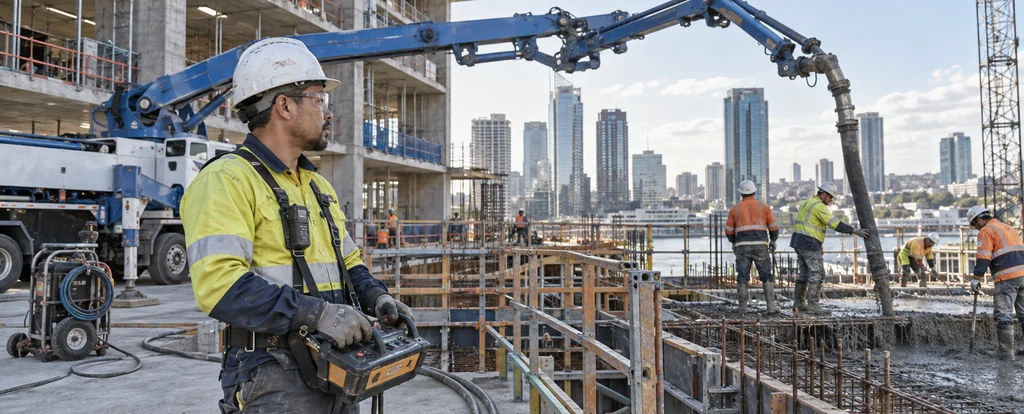
Concrete pump operators run the boom or line pump that moves concrete from the truck to exactly where it is needed on site.
- Median salary*
- $91,000
3.9%vs last year, before tax
- People employed
- 2,200
0.0%vs last year
- Projected growth
- +6.9%
to 2035
- AI exposure*
- Low
- automation risk
- Average hours
- 47/wk
+7h vs all jobs
- Shortage status
- Not in shortage
national
Concrete pump operators set up and run truck-mounted boom pumps or trailer and line pumps, delivering concrete to footings, slabs, formwork and places a chute cannot reach. Most work is on commercial and civil sites, and the operator sits between the concrete supplier and the concreting crew, controlling flow and pressure while the pour is under way. The job differs from concreting: a concreter places and finishes the concrete, while the pump operator gets it there safely and at the pace the crew needs.
How much do concrete pump operators earn?
The median full-time salary for a concrete pump operator is $91,000 per annum, before tax, up $18,900 since 2018.
Pay is usually set by the award or a site enterprise agreement, so rates move with the project you are on and the hours you work, and long or night pours attract penalty rates. Operators who hold a heavy vehicle licence and run a truck-mounted boom tend to earn more than those on trailer pumps, and large civil or remote projects often carry a site allowance.
What does a concrete pump operator do day to day?
The list below is what fills most weeks; the exact mix shifts with seniority and whatever stage the current work is at.
- Positioning and setting up boom or line pumps at the worksite
- Operating boom and pump controls to place concrete exactly where the crew needs it
- Directing concrete trucks and the placing crew over two-way radio during a pour
- Watching flow, pressure and slump so the line does not block or blow
- Cleaning out the pump, hoses and pipeline after each pour and checking them before the next
What skills do concrete pump operators need?
Employers look for plant and equipment operation, worksite safety management, operations management, backed by Boom pump control system fluency and strong attention to detail.
Specialist skills
- Plant and equipment operation
- Worksite safety management
- Operations management
- Installation and maintenance
Software and tools
- Boom pump control system
- Remote control pendant
- Two-way radio
- Pump line and clamp system
- High-pressure water cleaner
General skills
- Attention to detail
- Problem solving
- Time and deadline management
Is the job growing?
About 2,200 people work as concrete pump operators in Australia, and employment is projected to grow 6.9% over the decade to 2035. That's modest growth: demand is steady rather than booming.
How do you become a concrete pump operator?
Here's the path most concrete pump operators take, step by step.
- 1Get a White Card
The general construction induction card is required before you set foot on a site in any state, and most employers will not take an application without one. It is a short course, usually done in a day.
- 2Build site experience and a heavy vehicle licence
Many operators start as a labourer or an offsider, handling hoses, clamps and the pump line, and use that time to get an HR or HC licence. Truck-mounted booms cannot be driven to site without the right licence class.
- 3Learn pump operation on the job
Training is mostly done with an employer, moving from the line to the remote control under supervision, and it takes a range of pours before you are running a job on your own. Some employers also send operators through short courses or units with a registered training organisation.
- 4Check state licensing and plant requirements
Requirements for plant and high risk work differ between states, so confirm with your state regulator what applies to the pump type you will operate before you take a job. A mobile phone and a hard hat will not cover it.
Ready to apply as a concrete pump operator?
Whether you're working toward becoming a concrete pump operator or already are one and want a hand with the next step (sharpening your resume for ATS screening, tightening your cover letter, or knowing what you'll actually be asked at interview), here are examples grounded in this specific role, not generic templates.
What jobs can a concrete pump operator move to?
Moving into Concreter typically comes with the biggest pay rise, worth $23,900 a year more on average.
| Move to | Typical pay change | Overlap | Retraining |
|---|---|---|---|
| Concreter Concrete pump operators bring concrete placement and site safety skills, so moving into concreting needs a reskill.Known move | +$23,900 | 32% | reskill |
| Bulldozer Operator Heavy plant control and precision placement carry over, so moving to bulldozer operation needs only a short course. | +$15,600 | 58% | short course |
| Truck Driver Operating truck-mounted pumps builds heavy vehicle and site experience, so moving to truck driving needs a reskill for licensing.Known move | +$10,900 | 13% | reskill |
| Backhoe Operator Both roles control heavy plant on civil sites, so a concrete pump operator can move to backhoe operating with minimal retraining. | +$7,800 | 78% | minimal |
| Machine Operator Plant control and site safety transfer to machine operating, though a reskill is needed for factory production work.Known move | −$10,200 | 36% | reskill |
Moves are chosen from Jobs and Skills Australia's Data on Occupation Mobility, which follows income tax records between 2011-12 and 2020-21, together with entry requirements and skill overlap. A known move is one people were seen making in that data. Pay change compares median full-time pay for the two roles.
Who works as a concrete pump operator?
The typical concrete pump operator is 36 years old; 99% are men, 81% work full-time, and full-timers average 47 hours a week.
- 36
- Median age
- 1%
- Female share
- 81%
- Full-time
- +7h
- vs all-jobs avg
What's it like being a concrete pump operator?
The job has a stop-start rhythm: early starts, waiting on trucks and site access, then a concentrated burst of work while the concrete is flowing. Pours cannot pause for long, so the operator keeps the line moving while crews, weather and delivery schedules change around them. It suits people who like machinery, are comfortable outdoors and do not mind their hours shifting with the job.
What people like
- You see the finished result. A pour takes shape under your control, from the first load into the footings to the last square metre of slab, and you know the job is right before you pack up.
- The controls reward skill. Placing concrete through a window or into tight formwork with a remote pendant takes timing and feel, and an experienced operator is a person the site relies on during the pour.
- A different site every few days. Pumps move between jobs, so the work does not sit in one place, and each site brings different access, ground and crews to deal with.
- Small crews and clear roles. You work closely with the concreting crew and the truck drivers, and the radio talk is direct and practical rather than corporate.
What people find hard
- Waiting around between pours. Trucks get held up in traffic, the site is not ready or the concrete is late, and the pump and operator sit idle until the schedule catches up.
- Long days and early starts. Pours often begin before daylight, and finishing depends on the last truck rather than the clock, with weekend and night work on bigger projects.
- Weather stops the job. Rain can wash out a pour and extreme heat changes how the concrete behaves, so days are lost and the work reshuffles around conditions nobody controls.
- The cost of something going wrong. A burst hose or a misplaced boom can put concrete where it should not be, and cleaning that up holds up the whole site and reflects on you.
Based on our synthesis of professional-body surveys and public accounts of the role, not first-person verified reviews.
Which industries employ concrete pump operators?
Construction employs the largest share of concrete pump operators.
Top employing industries
- 1Construction
Ranked by employment share; the source doesn't publish an exact percentage per industry.
| Year 12 or below | 63.4% | |
|---|---|---|
| Certificate III/IV | 29% | |
| Diploma / Advanced Diploma | 2.9% | |
| Bachelor degree | 1% | |
| Postgraduate | 0.2% |
Will AI replace concrete pump operators?
Concrete pumping is a low-exposure job because the work happens in real time, outdoors, with a hose or boom in a position that changes with every site. Truck telematics, electronic delivery dockets and automated boom functions are changing dispatch, paperwork and how smoothly the boom moves, but not who places the concrete. Someone still has to level the truck, set up the outriggers, watch the formwork and adjust the flow as the pour develops.
Share of typical working time by exposure level
- Running the boom during a pourBoom controls are increasingly assisted and smoother to operate, but placing concrete into formwork or through a window is still done by eye and feel on the remote.30%moderate
- Setting up and levelling the pumpReading the ground, positioning the truck for boom reach and setting outriggers on a soft or sloping site is judged on the spot from what is in front of you.25%low
- Talking the crew and trucks through the pourRadio coordination with the concreting crew and the agitator drivers shifts constantly as the pour, the weather and the deliveries change.25%low
- Cleaning out and checking the pump and pipelineFlushing the line, checking clamps and hoses and spotting wear or leaks is hands-on maintenance that no system does for you yet.20%low
Common questions about becoming a concrete pump operator
Straight answers to the questions people ask most.
How much do concrete pump operators earn?
Full-time concrete pump operators earn a median of $91,000 per year before tax. That figure is a midpoint across full-time workers, so it varies with the project, the agreement on site, overtime and penalty rates, and the type of pump you run.
How do you become a concrete pump operator?
Most people start on site as a labourer or offsider and learn pump operation on the job. You need a White Card, a heavy vehicle licence for truck-mounted booms, and, depending on your state, specific licences or qualifications for the plant you operate.
Are concrete pump operators in demand?
Concrete pump operators are currently not in shortage, and employment is projected to grow 6.9% over the decade to 2035. The occupation is small, so openings in any year depend more on construction activity where you live than on the national picture, and demand follows the commercial and civil project pipeline.
Will AI replace concrete pump operators?
No, and the exposure is low, because placing concrete is a physical job done in real time, in the weather, at a spot that changes with every pour. Telematics on the truck, electronic delivery dockets and increasingly automated boom functions are changing scheduling and record keeping, but someone still has to set up the pump, read the pour and work the controls by eye.
What are the career moves from concrete pumping?
Concrete pumping skills transfer to other concrete and plant work: concreters work alongside pump crews and earn $23,900 more, backhoe operating needs only a short course because both jobs control heavy plant to precise lines, and truck driving suits operators who already hold a heavy vehicle licence. Many operators eventually buy their own pump and truck and run it as a small business, which is often where earnings grow.
What hours do concrete pump operators work?
Hours follow the pour, which usually means an early start well before the concrete arrives and a finish that depends on the last truck. Weekend and night pours are common on commercial and civil projects, and travel to sites outside your area adds to the day.
Related roles
Not sure this is you? Take the career quiz and get a ranked shortlist of roles that fit how you like to work.