Insulation Installer
Insulation installers fit batts, rolls and loose-fill product into ceilings, walls and underfloors so buildings hold their heat and use less energy.
- Median salary*
- $68,600
4.4%vs last year, before tax
- People employed
- 4,400
0.0%vs last year
- Projected growth
- +6.5%
to 2035
- AI exposure*
- Low
- automation risk
- Average hours
- 43/wk
+3h vs all jobs
- Shortage status
- Not in shortage
national
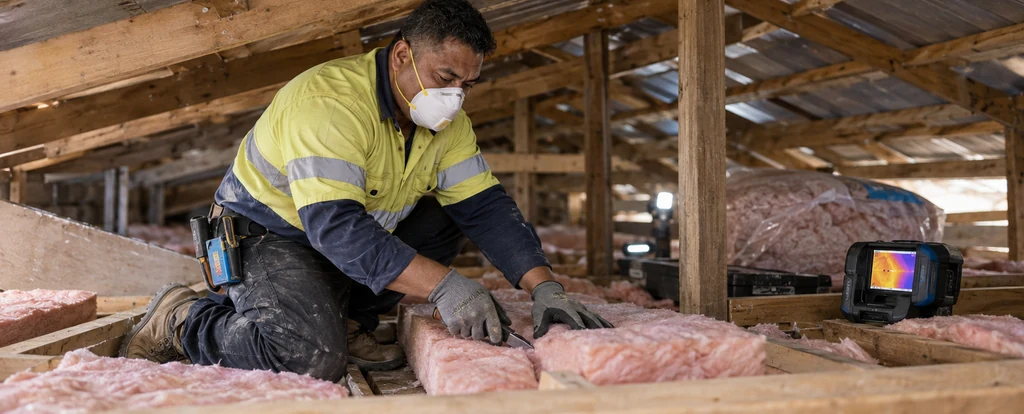
Insulation installers work on new builds and on existing homes, fitting product into ceiling spaces, wall frames and underfloors before the plaster goes on or as part of an energy efficiency retrofit. It's a narrow corner of construction: most installers work in small teams for specialist insulation contractors, and much of the job happens in roof voids and subfloors where measuring and fitting are awkward. It's often confused with lagging, which insulates pipes and ducts rather than the building itself.
How much do insulation installers earn?
The median full-time salary for an insulation installer is $68,600 per annum, before tax, up $14,500 since 2018.
How you're engaged matters more than anything else: installers employed by a specialist contractor usually work under an award or enterprise agreement with penalty rates, while subcontractors are often paid per square metre, so a fast, well-organised day earns more. Sector shifts the picture too, with commercial and new-build work generally steadier than one-off residential retrofits. Energy efficiency schemes that fund a lot of retrofit work set their own installer rates, which can hold pay flat on those jobs.
What does an insulation installer do day to day?
The list below is what fills most weeks; the exact mix shifts with seniority and whatever stage the current work is at.
- Measuring and cutting batts and rolls to fit around noggings, pipes and cabling
- Fitting insulation into ceiling spaces, wall frames and underfloors, working from plans or around what's already there
- Blowing loose-fill insulation across a ceiling with a machine and checking the depth is even
- Sealing gaps and draughts around windows, doors and service penetrations so the insulation performs as intended
- Pulling out old, damp or compressed insulation before fitting new product, and stopping if there's any sign of asbestos
What skills do insulation installers need?
Employers look for installation and maintenance, hand and power tool work, worksite safety management, backed by Insulation blowing machine fluency and strong physical stamina and dexterity.
Specialist skills
- Installation and maintenance
- Hand and power tool work
- Worksite safety management
- Building codes and standards
Software and tools
- Insulation blowing machine
- Utility knife
- Staple gun
- Thermal imaging camera
- Respirator and PPE
General skills
- Physical stamina and dexterity
- Attention to detail
Is the job growing?
About 4,400 people work as insulation installers in Australia, and employment is projected to grow 6.5% over the decade to 2035. That's modest growth: demand is steady rather than booming.
How do you become an insulation installer?
Here's the path most insulation installers take, step by step.
- 1Get your White Card
General construction induction training is required before you can work on a building site in any state or territory, and most employers ask for the card before anything else.
- 2Learn the trade on the job
Most installers start as an offsider, carrying batts and cutting in, and pick up product types, coverage rates and safe roof-space work from an experienced installer over months rather than years. There's no apprenticeship for insulation specifically, and about 49% of people in the role have Year 12 or below, which reflects how much is learned on site.
- 3Add formal training where it counts
A Certificate III in wall and ceiling lining (CPC31220) includes insulation units, and the energy efficiency schemes that fund retrofit work generally require installers to be accredited with the scheme before they can be paid for those jobs.
- 4Sort out asbestos awareness before you remove anything
Anyone working in the construction industry needs asbestos awareness training, and removing asbestos-containing material has to be done by a licensed removalist. The rules differ by state, so check what applies where you work.
- 5Go out on your own when you're ready
Many installers end up subcontracting, which means an ABN, public liability insurance and scheme accreditation for rebate jobs, plus the quoting and scheduling that an employer used to handle.
Ready to apply as an insulation installer?
Whether you're working toward becoming an insulation installer or already are one and want a hand with the next step (sharpening your resume for ATS screening, tightening your cover letter, or knowing what you'll actually be asked at interview), here are examples grounded in this specific role, not generic templates.
What jobs can an insulation installer move to?
Moving into Carpenter typically comes with the biggest pay rise, worth $22,900 a year more on average.
| Move to | Typical pay change | Overlap | Retraining |
|---|---|---|---|
| Carpenter Insulation installers bring building site knowledge and material fitting skills to carpentry, though a full apprenticeship is needed to qualify.Known move | +$22,900 | 43% | requalify |
| Site Supervisor Insulation installers bring practical building experience to site supervision, with further training in coordination and safety.Known move | +$17,200 | 30% | reskill |
| Machine Operator Insulation installers bring practical tool use and material handling to machine operating roles, with reskilling required for plant operation.Known move | +$12,200 | 16% | reskill |
| Lagger Insulation installers bring insulation knowledge and fitting skills to lagging, with additional training for pipe and duct insulation.Known move | +$9,400 | 43% | reskill |
| Home Improvement Installer Insulation installers bring installation and finishing skills to home improvement work, with a short course covering product specifics.Known move | −$1,000 | 53% | short course |
Moves are chosen from Jobs and Skills Australia's Data on Occupation Mobility, which follows income tax records between 2011-12 and 2020-21, together with entry requirements and skill overlap. A known move is one people were seen making in that data. Pay change compares median full-time pay for the two roles.
Who works as an insulation installer?
The typical insulation installer is 36 years old; 96% are men, 69% work full-time, and full-timers average 43 hours a week.
- 36
- Median age
- 4%
- Female share
- 69%
- Full-time
- +3h
- vs all-jobs avg
What's it like being an insulation installer?
The work is physical and moves between sites, so a day might take in three houses at different stages and a lot of time on your knees, on your back or up a ladder. Installers tend to like it because the result is visible and the job ends when the house does, and because they work in pairs or alone rather than in a crowd. The trade-off is the conditions and the schedule, since tight spaces, dust and a builder's timeline don't move for anyone.
What people like
- You can see the job finished. A house takes a day or two, not a year, and a thermal camera or an energy rating shows whether the work did what it should.
- Small crews and little supervision. Most installers work in a pair or on their own, driving between jobs and deciding how to tackle a space once they're in it.
- Different sites through the week. New builds, older homes, extensions and commercial fit-outs all come up, so the week doesn't sit in one place.
- A short route in. There's no long qualification standing between you and paid work, and the skills you pick up transfer to other building trades.
What people find hard
- Roof spaces in summer. Ceiling voids get extremely hot, and the combination of heat, dust and a respirator is the hardest part of the job for many installers.
- Old insulation hides surprises. Pulling out old product can turn up asbestos, rodent droppings, mould or wiring that shouldn't be there, and the job stops until it's sorted.
- The builder's schedule sets your day. Insulation has to go in after the frame and before the plaster, so work bunches up around that stage and a delayed build means a wasted trip.
- Subcontracting shifts the risk to you. When you're paid per square metre or per job, a quiet fortnight, a long drive or a return visit to fix a gap comes out of your own time.
Based on our synthesis of professional-body surveys and public accounts of the role, not first-person verified reviews.
Which industries employ insulation installers?
Construction employs the largest share of insulation installers.
Top employing industries
- 1Construction
Ranked by employment share; the source doesn't publish an exact percentage per industry.
| Year 12 or below | 48.8% | |
|---|---|---|
| Certificate III/IV | 26.8% | |
| Diploma / Advanced Diploma | 6.4% | |
| Bachelor degree | 5.4% | |
| Postgraduate | 1.2% |
Will AI replace insulation installers?
AI and automation reach very little of this work, because it comes down to fitting material into irregular spaces no machine can easily get to. The technology that has arrived, such as blowing machines, thermal imaging cameras and energy rating software, changes how a job is quoted and checked more than it changes who does the fitting. Fitting a batt around a bearer or a pipe in a subfloor still takes a person with a knife.
Share of typical working time by exposure level
- Fitting batts and rolls into ceilings and wallsBatts go in by hand and need to sit tight without being compressed, and no machine reaches the corners of a pitched roof.30%low
- Measuring and cutting batts and rollsEvery cut follows the shape of the space around cables, noggings and pipes, which is why installers measure on site rather than from the plans.25%low
- Quoting jobs and ordering materialsSoftware can read a floor plan and estimate bags of product, though site access, old insulation and uneven ceilings still need a look before you put a price on it.25%moderate
- Blowing loose-fill insulation into a ceilingA machine does the blowing, but the installer sets the rate, drags the hose and checks the depth is even across the whole ceiling.20%low
Common questions about becoming an insulation installer
Straight answers to the questions people ask most.
How much do insulation installers earn?
Full-time insulation installers earn a median of $68,600 per year before tax. Subcontractors paid per square metre can earn more in a busy week and less in a quiet one, and scheme-funded retrofit work usually sits at a set rate.
How do you become an insulation installer?
Get a White Card first, since you can't work on a construction site without one, then learn the job as an offsider alongside an experienced installer. There's no apprenticeship for insulation itself, but a Certificate III in wall and ceiling lining (CPC31220) covers insulation units and scheme accreditation opens up rebate work.
Are insulation installers in demand?
Insulation installers are currently not in shortage, and employment is projected to grow 6.5% over the decade to 2035. A good share of the work follows government energy efficiency programs, so the pipeline of retrofit funding tends to matter as much as the overall employment figure when you're looking for jobs.
Could AI or automation take over insulation installation?
Very little of the hands-on work. Cutting batts around cabling and blowing loose-fill into a ceiling happen in spaces no machine fits, and what's behind a wall is something you find out by being there. Software has changed the quoting and assessment side, where thermal imaging and energy rating tools help work out what a house needs.
What can an insulation installer move into?
Lagging builds on the same insulation materials and fitting skills, and pay there is $9,400 more. Carpentry pays $22,900 more but needs a full apprenticeship to qualify, so it suits someone willing to start again as an apprentice. Many installers instead build their own subcontracting business, which is often where earnings grow.
Is insulation installation hard on your body?
It can be. Roof voids are low, hot and dusty, and a lot of the day is spent crouching, crawling and lifting batts overhead, so fitness and knee protection matter more than raw strength. Installers who stay in the trade usually work in pairs, rotate between jobs and are strict about respirators.
Related roles
Not sure this is you? Take the career quiz and get a ranked shortlist of roles that fit how you like to work.