Mail Sorter
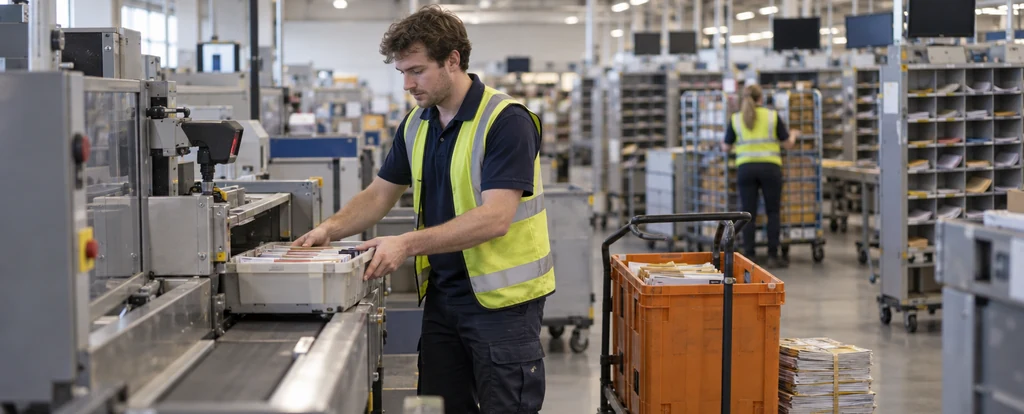
Mail sorters check the address and code on every letter or parcel passing through a depot so it ends up on the right delivery run.
- Median salary*
- $49,300
4.0%vs last year, before tax
- People employed
- 11,400
0.0%vs last year
- Projected growth
- −1.6%
to 2035
- AI exposure*
- High
- automation risk
- Average hours
- 41/wk
+1h vs all jobs
- Shortage status*
- Not in shortage
national
Mail sorters work in postal depots and distribution centres, most often for Australia Post or its licensed contractors, sorting incoming mail before it goes out on individual delivery rounds. The job sits earlier in the chain than a postal delivery officer, who carries mail to the door: a sorter gets each item onto the correct truck or trolley in the first place. Shifts often start before dawn so the day's mail is ready when the delivery vans are loaded.
How much do mail sorters earn?
The median full-time salary for a mail sorter is $49,300 per annum, before tax, up $10,300 since 2018.
What you take home depends more on the shift and the employer than on the job title. Larger depots sort around the clock, so penalty rates for early morning, night and weekend work make up a large part of most pay packets, while casual and labour hire roles usually trade paid leave for a loading. Australia Post and its licensed contractors pay under enterprise agreements, so it is worth asking which agreement covers a vacancy before comparing offers.
What does a mail sorter do day to day?
The list below is what fills most weeks; the exact mix shifts with seniority and whatever stage the current work is at.
- Sorting mail by postcode and delivery route using automated machines and manual racks
- Keying destination codes into sorting machines and clearing jams or misreads
- Scanning barcodes on parcels and checking them against the day's sorting schedule
- Bundling, labelling and loading sorted mail onto carts and trolleys for dispatch
- Reporting equipment faults and keeping the sorting floor clear during fast-moving shifts
What skills do mail sorters need?
Employers look for operations management, data analysis, backed by postal sorting machines fluency and strong attention to detail.
Specialist skills
- Operations management
- Data analysis
Software and tools
- postal sorting machines
- barcode scanners
- mail carts and trolleys
- labelling systems
- postal management software
General skills
- Attention to detail
- Time and deadline management
- Problem solving
Is the job growing?
About 11,400 people work as mail sorters in Australia, and employment is projected to decline 1.6% over the decade to 2035. That's a real decline, worth weighing carefully before training into the role.
How do you become a mail sorter?
Here's the path most mail sorters take, step by step.
- 1Finish Year 12 or a Certificate II
There is no formal qualification for the job, and Year 12 or below is the level most people in the role hold (54% of the current workforce). Employers look for reliable attendance, basic computer skills and the ability to read addresses and codes quickly.
- 2Apply to a postal operator or a depot labour hire firm
Most vacancies are advertised on the careers site of Australia Post or one of its licensed contractors, or through labour hire agencies that supply depot staff. Casual and part-time shifts are the usual way in, with extra intake around peak periods such as Christmas.
- 3Complete depot induction and on-the-job training
Training covers sorting machine operation, barcode scanning, manual handling and workplace safety, and it is paid. It usually runs over a few days to a couple of weeks alongside an experienced sorter before you work a line on your own.
- 4Add a logistics or warehouse qualification to move up
A Certificate II in Transport and Logistics or a Certificate III in Supply Chain Operations (TLI30325) can open up team leader, dispatch and machine operator roles. These are available through TAFE and sometimes as a traineeship with the employer.
Ready to apply as a mail sorter?
Whether you're working toward becoming a mail sorter or already are one and want a hand with the next step (sharpening your resume for ATS screening, tightening your cover letter, or knowing what you'll actually be asked at interview), here are examples grounded in this specific role, not generic templates.
What jobs can a mail sorter move to?
Moving into Process Worker typically comes with the biggest pay rise, worth $29,700 a year more on average.
| Move to | Typical pay change | Overlap | Retraining |
|---|---|---|---|
| Process Worker Mail sorters bring sorting and checking routines to process work, where machine feeding and production line duties are picked up on the job.Known move | +$29,700 | 31% | reskill |
| Postal Delivery Officer Mail sorters already read addresses and codes, so moving to postal delivery officer adds delivery rounds and customer contact on top of sorting knowledge.Known move | +$10,500 | 33% | reskill |
| Administration Officer Mail sorters bring coding, checking and clerical accuracy to administration officer work, with a short course covering office systems.Known move | +$8,900 | 50% | short course |
Moves are chosen from Jobs and Skills Australia's Data on Occupation Mobility, which follows income tax records between 2011-12 and 2020-21, together with entry requirements and skill overlap. A known move is one people were seen making in that data. Pay change compares median full-time pay for the two roles.
Who works as a mail sorter?
The typical mail sorter is 50 years old; 51% are women, 68% work full-time, and full-timers average 41 hours a week.
- 50
- Median age
- 51%
- Female share
- 68%
- Full-time
- +1h
- vs all-jobs avg
What's it like being a mail sorter?
The work follows the mail, so the rhythm is set by volume: a heavy early window, a lull, then the next run of trucks or vans. It suits people who like a clear routine, don't mind repetition and would rather finish early than work late. The pressure comes from the clock rather than from customers, because the delivery rounds cannot leave until the sorting is done.
What people like
- The day finishes early. Most depots sort through the night and early morning so delivery rounds can start on time, which means many shifts end by early afternoon.
- You leave the work at the depot. There is no caseload to carry home and no client calls to return, and when the shift ends the mail on the floor belongs to the next crew.
- Steady physical work indoors. The job keeps you on your feet around racks, trolleys and machines in a warehouse or depot, out of the weather, with a routine you can learn quickly.
- A foot in the door. Sorting experience counts towards postal delivery, process work and administration roles, and internal moves are common in the larger depots.
What people find hard
- Repetition is the job. The same movements repeat for a whole shift, and the variety comes from the mail rather than from the tasks themselves.
- Early starts and rotating rosters. Nights, weekends and public holidays are part of the schedule at larger depots, which is hard on sleep and on time with family.
- The machine sets the pace. Volume arrives in waves and the line keeps running, so a jam or a backlog has to be cleared before anyone can slow down.
- Automation is shrinking the manual side. Machines now handle most standard letters and barcoded parcels, so the work that remains leans towards tending equipment and handling exceptions rather than sorting by hand.
Based on our synthesis of professional-body surveys and public accounts of the role, not first-person verified reviews.
Which industries employ mail sorters?
Transport, Postal and Warehousing employs the largest share of mail sorters.
Top employing industries
- 1Transport, Postal and Warehousing
Ranked by employment share; the source doesn't publish an exact percentage per industry.
| Year 12 or below | 53.8% | |
|---|---|---|
| Bachelor degree | 14.2% | |
| Certificate III/IV | 12.4% | |
| Diploma / Advanced Diploma | 9.7% | |
| Postgraduate | 4.2% |
Will AI replace mail sorters?
Mail sorting sits at the high end of automation exposure, because recognising an address and sending an item to the right destination is precisely what automated sorting equipment does, and machines already handle the bulk of standard letters and barcoded parcels. What is left for people is the mail the machines reject, the oversized and fragile items, and restarting the line when something jams. That is why the role keeps leaning towards machine tending, exception handling and dispatch coordination rather than sorting by hand.
Share of typical working time by exposure level
- Keying destination codes and fixing misreads on sorting machinesOptical character recognition reads most printed addresses and barcodes on its own, so the operator deals with the residue: smudged labels, handwritten addresses and parcels the machine has rejected.30%high
- Scanning parcels and checking them against the day's sorting scheduleScanners capture tracking data automatically and scheduling software allocates volume to runs, leaving the sorter to confirm exceptions and reconcile counts before dispatch.25%high
- Sorting oversized and non-machineable items by handOdd shapes, fragile parcels and badly addressed mail still go into route racks by hand, which needs someone to read the label and judge where it belongs.25%low
- Clearing jams, reporting faults and keeping the line movingWhen a machine stops, someone has to find the item caught in the rollers, remove it safely and decide whether the line can restart or needs an engineer.20%low
Common questions about becoming a mail sorter
Straight answers to the questions people ask most.
How much do mail sorters earn?
Mail sorters earn $49,300 per year before tax at the median, which is for full-time work. Shift penalties, weekend work and casual loadings push actual take-home pay above or below that depending on the roster you work.
How do you become a mail sorter?
Apply directly to a postal operator such as Australia Post or to a labour hire firm that supplies depot staff, because there is no required qualification. Employers look for reliable attendance, basic computer skills and comfort with shift work, and machine and safety training happens on site once you start.
Are mail sorting jobs in demand?
Mail sorters are currently not in shortage, and employment is projected to decline 1.6% over the decade to 2035. Sorting work is concentrated in larger depots and distribution centres, so it is worth checking what is hiring at the sites within travelling distance of you.
Will AI and automation replace mail sorters?
Sorting is one of the more exposed jobs to automation, because reading an address or barcode and routing an item is exactly what sorting machines are built to do. People are still needed for mail the machines cannot read, for oversized and fragile items, and for clearing jams and keeping the line running. The mix of work keeps shifting towards machine tending and dispatch coordination rather than manual sorting.
What can a mail sorter move into?
Postal delivery officer draws on the address and route knowledge sorters already use, and the pay difference is $10,500 more. Process worker takes the machine feeding and production line side further, while administration officer suits sorters who prefer clerical tasks, with a short course covering office systems.
Do mail sorters work part time or casual?
Depots run casual, part-time and full-time shifts, and casual work is a common way into the job, especially around peak periods. Full-time sorters average 41 hours a week, and about 68% of people in the role work full time.
Related roles
- Postal Delivery Officer
- Process Worker
- Administration Officer
- Postal Delivery Officer
- Process Worker
- Administration Officer
Not sure this is you? Take the career quiz and get a ranked shortlist of roles that fit how you like to work.