Home Manufacturing & Production
Paper Machine Operator
Paper machine operators run the mill machinery that turns wood pulp into large rolls of paper, holding moisture, thickness and speed steady across a process that runs continuously.
- Median salary*
- $75,400
3.6%vs last year, before tax
- People employed
- 3,900
0.0%vs last year
- Projected growth*
- −5%
to 2035
- AI exposure*
- Moderate
- automation risk
- Average hours*
- 40/wk
matches all-jobs average
- Shortage status*
- Not in shortage
national
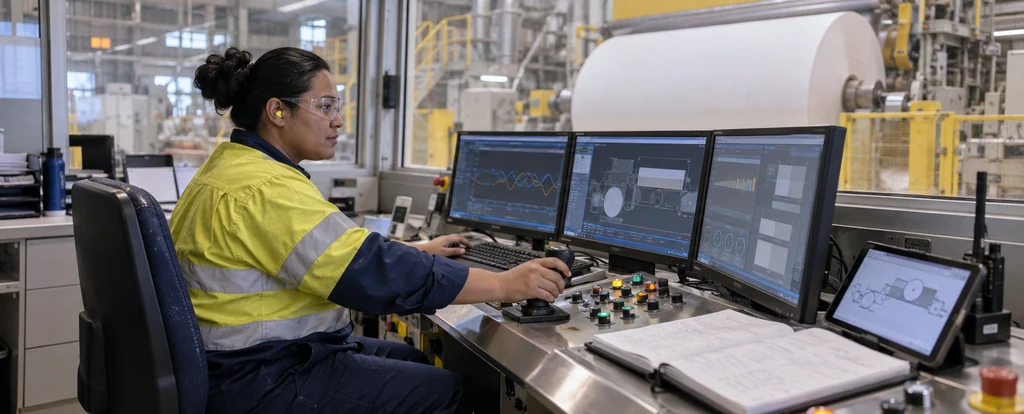
Paper machine operators work on the machine itself, a line that runs from stock preparation through presses and dryers to the reel, usually inside a mill that operates around the clock. The role is more continuous than most machine operating jobs: the sheet is always moving, and the operator keeps it within specification rather than starting each batch. Most work in mills making packaging, printing or tissue paper, as part of a shift crew of a few people.
How much do paper machine operators earn?
The median full-time salary for a paper machine operator is $75,400 per annum, before tax, up $16,000 since 2018.
Shift work is the biggest lever: rotating rosters and night work attract penalty rates, so two operators on the same grade can take home different amounts. Larger mills and sites covered by an enterprise agreement generally pay above the award, and operators who can handle grade changes and start-ups without supervision sit at the top of the range.
What does a paper machine operator do day to day?
The list below is what fills most weeks; the exact mix shifts with seniority and whatever stage the current work is at.
- Running the paper machine from the control room and the wet end, checking the sheet as it forms
- Monitoring stock consistency, moisture, temperature and reel tension through the distributed control system and the scanner
- Adjusting speed, steam pressure and slice settings when the sheet drifts off specification
- Cleaning felts, wires and press sections during wash-ups and short stops
- Recording production and quality data, and tagging faults for the maintenance crew
What skills do paper machine operators need?
Employers look for operations management, plant and equipment operation, process improvement, backed by Honeywell Experion DCS fluency and strong attention to detail.
Specialist skills
- Operations management
- Plant and equipment operation
- Process improvement
- Cleaning and grounds maintenance
Software and tools
- Honeywell Experion DCS
- Siemens SIMATIC PLC
- SCADA
- SAP Plant Maintenance
General skills
- Attention to detail
- Problem solving
- Safety and compliance awareness
Is the job growing?
About 3,900 people work as paper machine operators in Australia, and employment is projected to decline 5% over the decade to 2035. That's a real decline, worth weighing carefully before training into the role.
How do you become a paper machine operator?
Here's the path most paper machine operators take, step by step.
- 1Get into a mill in any role
Many operators start as a labourer, cleaner, storeperson or packaging line operator and apply internally when a trainee position opens. The work is paid from day one and gives you the site knowledge that counts at the interview.
- 2Take a traineeship in pulp and paper operations
A Certificate III in pulp and paper operations is the qualification mills recognise, usually delivered on the job through a trainee role over about two years of shift work. Some operators come in with a mechanical or electrical trade instead, which is equally accepted.
- 3Learn the machine stage by stage
Training typically starts at the dry end or as an extra hand and works back toward the wet end and the control room, as you show you can read the sheet and spot a problem before it reaches the reel.
- 4Add the site qualifications
A forklift licence, confined space entry and working at heights are commonly needed for wash-ups and maintenance support, and mills usually put new operators through them.
- 5Prove you can run the machine alone
Senior operator and leading hand roles go to people who can handle grade changes, start-ups and a sheet break unsupervised, and the step up usually comes with a higher classification and better pay.
Ready to apply as a paper machine operator?
Whether you're working toward becoming a paper machine operator or already are one and want a hand with the next step (sharpening your resume for ATS screening, tightening your cover letter, or knowing what you'll actually be asked at interview), here are examples grounded in this specific role, not generic templates.
What jobs can a paper machine operator move to?
Moving into Chemical Plant Operator typically comes with the biggest pay rise, worth $31,200 a year more on average.
| Move to | Typical pay change | Overlap | Retraining |
|---|---|---|---|
| Chemical Plant Operator Paper machine operators bring process monitoring and machine control skills to chemical plant operations, needing a short course in chemical handling. | +$31,200 | 75% | short course |
| Rubber Machine Operator Paper machine operators bring process control and machine monitoring skills to rubber machine operation, with a short course covering material differences. | −$5,200 | 58% | short course |
| Plastics Machine Operator Paper machine operators bring machine monitoring and production line skills to plastics machine operation, with little retraining needed. | −$10,400 | 75% | minimal |
| Textile Machine Operator Paper machine operators bring similar monitoring and mechanical skills to textile machine operation, making the move straightforward. | −$10,400 | 75% | minimal |
| Glass Production Operator Paper machine operators bring furnace and line monitoring skills to glass production, with a short course covering glass-specific processes. | −$10,400 | 58% | short course |
Moves are chosen from Jobs and Skills Australia's Data on Occupation Mobility, which follows income tax records between 2011-12 and 2020-21, together with entry requirements and skill overlap. A known move is one people were seen making in that data. Pay change compares median full-time pay for the two roles.
Who works as a paper machine operator?
The typical paper machine operator is 47 years old; 88% are men, 88% work full-time, and full-timers average 40 hours a week.
- 47
- Median age
- 12%
- Female share
- 88%
- Full-time
- +0h
- vs all-jobs avg
What's it like being a paper machine operator?
The machine sets the rhythm of the day, and it runs continuously, so shifts are long and the handover at the end of one matters. A good run is quiet and mostly about watching trends; a bad one means a sheet break, tonnes of waste and a hot, wet clean-up before production restarts. People who enjoy running a large process and reading its behaviour tend to settle into the work, while those who want daylight hours and variety usually move on.
What people like
- You run a whole line. The paper machine is one of the largest pieces of equipment on site, and the adjustments you make at the wet end show up in the finished reel.
- Faults have a cause you can find. A moisture or thickness fault comes from somewhere specific in the line, and tracking it down through the screens and the sheet is the part of the job many operators enjoy most.
- Work stays at the gate. The shift ends when the handover is done, with no paperwork or backlog following you home.
- A small crew that knows the machine. Shift teams are usually four or five people, so you quickly learn who covers which part of the line and how they work.
What people find hard
- Rotating shifts. Continuous mills run nights, weekends and public holidays, and rotating rosters are hard on sleep and on family routines.
- Heat, noise and paper dust. The machine area is hot and humid around the dryers, loud enough to need hearing protection, and dusty when the sheet breaks.
- A sheet break means heavy work. Rethreading the machine after a break is physical and wet, and every minute off the reel is lost production the crew has to make up.
- The work is tied to mill towns. Paper machines sit at a small number of sites around the country, so changing employers can mean relocating rather than just changing a commute.
Based on our synthesis of professional-body surveys and public accounts of the role, not first-person verified reviews.
Which industries employ paper machine operators?
Manufacturing employs the largest share of paper machine operators, followed by Wholesale Trade.
Top employing industries
- 1Manufacturing
- 2Wholesale Trade
- 3Construction
- 4Administrative and Support Services
Ranked by employment share; the source doesn't publish an exact percentage per industry.
| Certificate III/IV | 34% | |
|---|---|---|
| Diploma / Advanced Diploma | 26% | |
| Bachelor degree | 20% | |
| Year 12 or below | 20% |
Will AI replace paper machine operators?
Paper machine operators sit at a moderate level of exposure. Distributed control systems and online scanners already hold much of the loop steady and flag deviations, which changes the operator's job from turning valves by hand to reading trends and intervening when the sheet drifts. What keeps the exposure moderate is everything around the loop: diagnosing faults, running a grade change and cleaning up after a break still need hands on hot, wet equipment.
Share of typical working time by exposure level
- Watching the sheet and the control screens during a runThe control system keeps moisture and thickness close to target and raises alarms, so the operator mostly reads trends and decides whether a small drift needs correcting.30%moderate
- Wash-ups, felt changes and clearing a sheet breakRethreading the machine and cleaning press sections are physical jobs at high temperature, and nothing on the market does them for you.30%low
- Working out why the sheet has drifted and correcting itTracing a moisture fault back to a specific press, dryer section or stock line still relies on experience with that machine and what it does under different grades.20%low
- Logging production and quality resultsMost figures are captured automatically from the machine and the lab scanner, leaving the operator to check them and note what happened around the exceptions.20%high
Common questions about becoming a paper machine operator
Straight answers to the questions people ask most.
How much does a paper machine operator earn?
Paper machine operators earn $75,400 per annum, before tax, on the full-time median. That figure is a median across the workforce rather than a starting rate, and shift penalties can lift take-home pay well above it. The roster, the size of the mill and whether the site has an enterprise agreement explain most of the difference between one operator's pay and another's.
How do you become a paper machine operator?
Most people start inside a mill, in a labouring, cleaning, packaging or stores role, and move onto the machine when a trainee position opens. From there a Certificate III in pulp and paper operations, usually completed on the job through a traineeship, is the qualification employers recognise. A forklift licence and confined space or working at heights training are often required as well, and mills generally arrange them for new staff.
Are paper machine operators in demand?
Paper machine operators are currently not in shortage, and employment is projected to decline 5% over the decade to 2035. Most openings come from operators retiring or leaving the trade rather than from new machines being built, so vacancies appear as people move on. If you are entering, expect to look at a handful of mill locations and be ready to move to one of them.
Will AI and automation replace paper machine operators?
The job sits in the middle: control systems already hold much of the process steady, so routine monitoring and data logging are the most exposed parts of the work. Diagnosing a fault, changing grades and clearing a sheet break are hands-on and hard to automate with current equipment. Mills have tended to add automation gradually, with the same crews running more of the line from the control room.
What can paper machine operators move into?
Plastics machine operators work on comparable equipment with minimal retraining, and the skills transfer closely enough that a paper machine operator can usually step across within a few weeks; pay is $10,400 less. Chemical plant operators earn $31,200 more, with a short course covering chemical handling and process safety. Moving into textile or glass production is also common and needs only a short course.
What are the shifts like?
Most paper machines run continuously, so rosters include nights, weekends and public holidays. Mill sites set their own patterns and many use 12-hour shifts across a repeating cycle, with a run of shifts followed by several days off. Trading shifts with crewmates is usually possible once you know the roster.
Related roles
- Plastics Machine Operator
- Textile Machine Operator
- Chemical Plant Operator
- Rubber Machine Operator
- Glass Production Operator
- Packaging Operator
Not sure this is you? Take the career quiz and get a ranked shortlist of roles that fit how you like to work.