Radiation Therapist
Radiation therapists plan and deliver the daily doses of radiation that treat cancer, aiming the beam at the tumour while sparing the healthy tissue around it.
- Median salary*
- $98,800
3.7%vs last year, before tax
- People employed
- 2,200
4.8%vs last year
- Projected growth
- +33.1%
to 2035
- AI exposure*
- Moderate
- automation risk
- Average hours
- 39/wk
−1h vs all jobs
- Shortage status
- In shortage
national
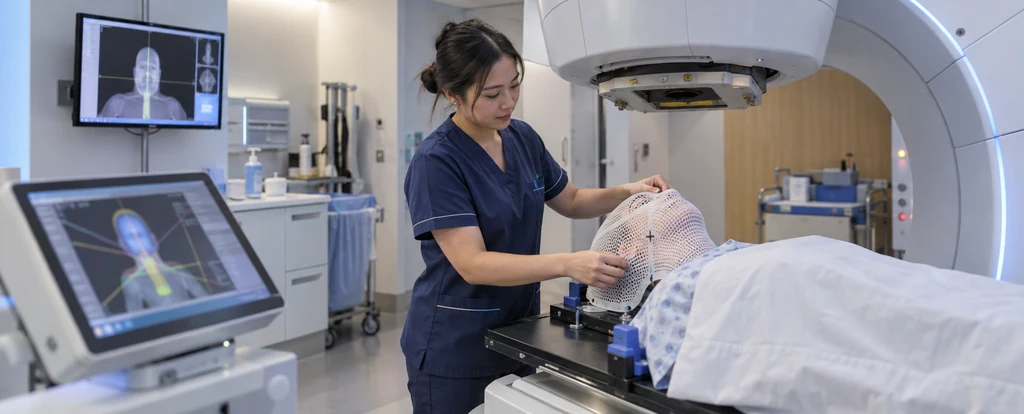
Most radiation therapists work in the radiation oncology department of a public or private hospital, alongside radiation oncologists, medical physicists and nurses. The role sits close to radiography, but a radiographer takes diagnostic images while a radiation therapist uses imaging to plan and deliver treatment. Patients usually come in daily for several weeks, so therapists get to know the people they are treating.
How much do radiation therapists earn?
The median full-time salary for a radiation therapist is $98,800 per annum, before tax, up $20,300 since 2018.
Public hospital radiation therapists are paid under state health enterprise agreements, so your classification level and the state you work in both shape your pay. Shift work, on-call and overtime add to the base rate, and private oncology centres often set their own. Experience moves you up the classification scale, and senior planning or team leader roles carry a higher grade again.
What does a radiation therapist do day to day?
The list below is what fills most weeks; the exact mix shifts with seniority and whatever stage the current work is at.
- Positioning patients on the treatment couch and running the linear accelerator for each daily dose
- Marking treatment areas during CT simulation and fitting the masks and supports that keep a patient still
- Planning and reviewing the treatment with the radiation oncologist and medical physicist
- Checking daily images to confirm the beam is hitting the right spot before treatment starts
- Watching for side effects such as skin reactions and fatigue, and answering questions through the course of treatment
What skills do radiation therapists need?
Employers look for patient care and support, care planning and coordination, clinical assessment and treatment, backed by Varian Eclipse fluency and strong written communication.
Specialist skills
- Patient care and support
- Care planning and coordination
- Clinical assessment and treatment
- Health education and advice
Software and tools
- Varian Eclipse
- ARIA Oncology Information System
- MOSAIQ
- RayStation
General skills
- Written communication
- Attention to detail
- Problem solving
Is the job growing?
About 2,200 people work as radiation therapists in Australia, and employment is projected to grow 33.1% over the decade to 2035. That's very strong growth. Few roles in Australia are expanding this fast, and it points to solid demand for years to come.
How do you become a radiation therapist?
Here's the path most radiation therapists take, step by step.
- 1Complete a degree in radiation therapy
The usual entry is a four-year Bachelor of Radiation Therapy, offered at a small number of universities. If you already hold a science or health degree, a two-year postgraduate master's is the common alternative.
- 2Finish the clinical placements built into the course
Placements in hospital radiation oncology departments are part of the qualification, and they are where you learn to run a treatment machine and work with real patients. Places are limited, so course entry can be competitive.
- 3Register with the Medical Radiation Practice Board of Australia
Registration through AHPRA is required before you can practise, and it is renewed each year. You will need to meet the board's English language and recency of practice requirements.
- 4Start as a new graduate in a hospital department
Most new graduates rotate through simulation, planning and treatment, with supervision that tapers off over the first year. Public departments advertise graduate positions each year, and private centres hire as vacancies come up.
Ready to apply as a radiation therapist?
Whether you're working toward becoming a radiation therapist or already are one and want a hand with the next step (sharpening your resume for ATS screening, tightening your cover letter, or knowing what you'll actually be asked at interview), here are examples grounded in this specific role, not generic templates.
What jobs can a radiation therapist move to?
Moving into Radiographer typically comes with the biggest pay rise, worth $23,900 a year more on average.
| Move to | Typical pay change | Overlap | Retraining |
|---|---|---|---|
| Radiographer Treatment planning and patient positioning skills carry across to general radiography, with a short course.Known move | +$23,900 | 47% | short course |
| Nuclear Medicine Technologist Radiation safety and patient care carry across to the nuclear medicine technologist role, needing minimal bridging training for imaging techniques. | +$7,800 | 63% | minimal |
Moves are chosen from Jobs and Skills Australia's Data on Occupation Mobility, which follows income tax records between 2011-12 and 2020-21, together with entry requirements and skill overlap. A known move is one people were seen making in that data. Pay change compares median full-time pay for the two roles.
Who works as a radiation therapist?
The typical radiation therapist is 35 years old; 75% are women, 71% work full-time, and full-timers average 39 hours a week.
- 35
- Median age
- 75%
- Female share
- 71%
- Full-time
- −1h
- vs all-jobs avg
What's it like being a radiation therapist?
The work runs to a schedule, with patients arriving daily for a course of treatment that can last several weeks, so much of the day is spent getting precise doses delivered on time. It suits people who like routine, technical detail and steady contact with the same patients, and who stay calm when someone is anxious or unwell. The department cannot easily run late, so the pace is set by the appointment list rather than by you.
What people like
- You follow the same patients through their treatment. A course runs for weeks, so you notice small changes in how someone is coping and can flag them early. That continuity is hard to find in most hospital roles.
- Precision you can see on the screen. The daily images tell you immediately whether the position is right, and a millimetre or two is a real difference. The feedback is quick and objective.
- Every course has an end point. Patients finish treatment and move on, which gives the work a rhythm and a sense of completion that open-ended care roles do not have.
- The techniques keep developing. Intensity-modulated and stereotactic treatments have changed what departments can offer, and planning software such as Varian Eclipse or RayStation is updated regularly. There is always something new to learn.
What people find hard
- Many of your patients are seriously unwell. Radiation therapy is mostly cancer treatment, and some patients decline during a course. That is part of the job, and departments generally build in support and debriefing.
- The list leaves little slack. If a machine goes down or a patient needs extra time, appointments stack up behind them. You cannot simply work through the backlog without pushing the day out.
- Shifts, extended hours and on-call. Many departments run extended hours and some treat on weekends, so rosters include early starts and later finishes. On-call arrangements vary by hospital.
- Departments are few and specialised. Radiation oncology services are concentrated in larger hospitals, so vacancies in a particular city can be limited and moving elsewhere may be part of the picture.
Based on our synthesis of professional-body surveys and public accounts of the role, not first-person verified reviews.
Which industries employ radiation therapists?
Health Care and Social Assistance employs the largest share of radiation therapists.
Top employing industries
- 1Health Care and Social Assistance
Ranked by employment share; the source doesn't publish an exact percentage per industry.
| Bachelor degree | 69.7% | |
|---|---|---|
| Postgraduate | 23.2% | |
| Diploma / Advanced Diploma | 5.8% | |
| Year 12 or below | 0.3% | |
| Certificate III/IV | 0% |
Will AI replace radiation therapists?
Radiation therapy sits in the middle. Planning software now drafts organ outlines and dose calculations that once took hours by hand, and treatment machines deliver and verify the beam largely on their own, but the physical work of setting up an unwell patient accurately and the conversations through a course of treatment stay with the therapist. Systems such as Varian Eclipse and RayStation have changed how long planning takes, not who is responsible for the finished plan.
Share of typical working time by exposure level
- Delivering treatment on the linear acceleratorThe machine fires the beam and imaging confirms the position, but the therapist sets up and positions the patient before each daily fraction.35%moderate
- Planning and checking treatment plans in planning softwareAutomatic contouring tools draft the organs at risk, but a therapist still reviews every outline and adjusts it before the plan is approved.25%high
- CT simulation and fitting immobilisationMaking a mask that fits a patient's face and marking the treatment area by hand is skilled, physical work that imaging software does not do.25%low
- Patient care, side-effect checks and questionsNoticing a skin reaction or a patient who is struggling, and explaining what happens next, relies on being in the room with them each day.15%low
Common questions about becoming a radiation therapist
Straight answers to the questions people ask most.
How much does a radiation therapist earn?
Radiation therapists earn a median of $98,800 per annum, before tax, and your classification level, state and sector all affect where you sit against it. Shift penalties and on-call add to the base rate in most departments. Treat the figure as a general guide rather than a starting salary.
How do you become a radiation therapist?
You complete an accredited degree in radiation therapy, either a four-year bachelor's or a two-year master's if you already hold a relevant degree, then register with the Medical Radiation Practice Board of Australia through AHPRA. Clinical placements in a hospital department are part of the course and are where most of the practical skill is built. Places are limited, so check entry requirements early.
Are radiation therapists in demand?
Radiation therapists are currently in shortage nationally, and employment is projected to grow 33.1% over the decade to 2035. If you are choosing where to study, keep in mind that placements and graduate jobs sit inside the hospitals that run radiation oncology services, so those locations matter more than the national picture.
Will AI replace radiation therapists?
Not in the near term, but it is changing parts of the work. Automatic contouring and dose calculation tools now draft much of a treatment plan, so therapists spend more time checking and adjusting than drawing outlines by hand. Positioning an unwell patient accurately on the couch each day and talking them through treatment remain hands-on jobs.
What can a radiation therapist move into?
Some move across to radiography, where treatment planning and patient positioning carry over with a short course, and pay is $23,900 more. Others go into nuclear medicine technology, which shares radiation safety and patient care, with pay $7,800 more. Both moves usually mean further study or bridging training rather than a straight swap.
What hours do radiation therapists work?
Full-time radiation therapists average 39 hours a week, mostly in departments that run Monday to Friday, though many offer extended hours and a few treat on weekends. Rosters can include early starts from around 7am and later finishes, plus on-call in some hospitals.
Related roles
Not sure this is you? Take the career quiz and get a ranked shortlist of roles that fit how you like to work.