Sign Installer
Sign installers mount and secure signs on buildings, shopfronts and vehicles, working at height so each sign ends up level, safe and readable from the street.
- Median salary*
- $66,600
4.1%vs last year, before tax
- People employed
- 1,300
0.0%vs last year
- Projected growth
- +4.2%
to 2035
- AI exposure*
- Low
- automation risk
- Average hours
- 42/wk
+2h vs all jobs
- Shortage status*
- Not in shortage
national
Sign installers work on building sites, shopfronts, roadsides and vehicles, and much of the job happens before anything is drilled: checking the surface, setting out positions and working out how a sign will be fixed. The trade sits next to sign writing, which covers the design and fabrication of signage, while installation is the part that gets the finished sign onto the wall. Most sign installers work for signage contractors, construction firms or manufacturers, and a White Card is usually needed because the sites they attend are construction sites.
How much do sign installers earn?
The median full-time salary for a sign installer is $66,600 per annum, before tax, up $13,900 since 2018.
Pay follows the award or enterprise agreement covering the business, so installers on construction sites under a building award usually earn more than those fitting retail and office signage. Access licences, rigging qualifications, overtime and night work for shopfront changeovers all lift the rate, and travel to distant sites may attract an allowance. What you supply in tools and vehicle also matters if you work as a subcontractor.
What does a sign installer do day to day?
The list below is what fills most weeks; the exact mix shifts with seniority and whatever stage the current work is at.
- Measuring and marking fixing points so the sign sits level and square before anything is drilled
- Drilling and anchoring brackets into brick, concrete, metal or glass
- Connecting and testing illuminated signs, with licensed electricians handling mains wiring
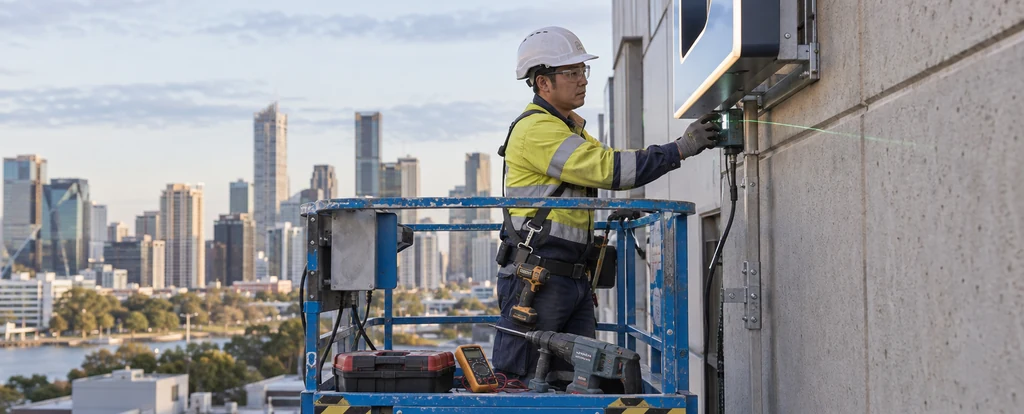
- Operating scissor lifts and elevated work platforms to reach high fascias and rooftops
- Removing old signage and making good the surface behind it
What skills do sign installers need?
Employers look for hand and power tool work, installation and maintenance, worksite safety management, backed by Cordless drill fluency and strong attention to detail.
Specialist skills
- Hand and power tool work
- Installation and maintenance
- Worksite safety management
- Reading plans and specifications
- Plant and equipment operation
Software and tools
- Cordless drill
- Rotary hammer
- Scissor lift
- Multimeter
- Laser level
General skills
- Attention to detail
- Problem solving
Is the job growing?
About 1,300 people work as sign installers in Australia, and employment is projected to grow 4.2% over the decade to 2035. That's modest growth: demand is steady rather than booming.
How do you become a sign installer?
Here's the path most sign installers take, step by step.
- 1Get on site as a trade assistant
Many installers begin in a signage workshop or as a labourer, learning how signs are made and fixed before taking on their own jobs. It is paid work, and it is the quickest way to find out whether the travel and the heights suit you.
- 2Complete the White Card
The general construction induction course takes about a day and is required before you can work on a construction site. Without it, most of the larger installation jobs are closed to you.
- 3Add access and rigging licences
A boom-type elevated work platform licence is the one employers ask for most often, because much of the work happens above head height. Rigging or crane licences open up larger signage and high-rise work, and these are short courses delivered by a registered training organisation.
- 4Consider a certificate III
A certificate III in signs and graphics (CPC30216), or another construction trade, covers fabrication, materials and the electrical safety knowledge that sits around installation. It can be done as an apprenticeship if you are starting out, or a traineeship if you are already working.
- 5Take charge of your own jobs
After a few years on site, installers commonly run their own jobs, quote small works or supervise a crew, or move into estimating and project coordination for a signage contractor.
Ready to apply as a sign installer?
Whether you're working toward becoming a sign installer or already are one and want a hand with the next step (sharpening your resume for ATS screening, tightening your cover letter, or knowing what you'll actually be asked at interview), here are examples grounded in this specific role, not generic templates.
What jobs can a sign installer move to?
Moving into Sign Writer typically comes with the biggest pay rise, worth $2,000 a year more on average.
| Move to | Typical pay change | Overlap | Retraining |
|---|---|---|---|
| Sign Writer Sign installers know how signage is mounted and positioned, while sign writing adds design and fabrication skills through reskilling.Known move | +$2,000 | 18% | reskill |
Moves are chosen from Jobs and Skills Australia's Data on Occupation Mobility, which follows income tax records between 2011-12 and 2020-21, together with entry requirements and skill overlap. A known move is one people were seen making in that data. Pay change compares median full-time pay for the two roles.
Who works as a sign installer?
The typical sign installer is 41 years old; 96% are men, 68% work full-time, and full-timers average 42 hours a week.
- 41
- Median age
- 4%
- Female share
- 68%
- Full-time
- +2h
- vs all-jobs avg
What's it like being a sign installer?
Sign installation is a job of short, self-contained days: load the van, drive to the site, work out how the sign will fit, and get it up before the shop opens or the client arrives. The physical side is real, with ladders, lifts and heavy panels, and the pressure usually comes from other trades waiting on you or a site that isn't ready. It suits people who like finishing something they can point to and are comfortable solving a fitting problem on the spot.
What people like
- The job finishes when the sign is up. Installation is one of the few parts of a project with a visible end, and you can drive past your work for years afterwards.
- Different site, different problem. A shopfront, a factory gate, a truck and a monument sign each need their own fixing, access and sequence, so the work doesn't settle into one routine.
- Working outdoors with your hands. Most of the day is spent outside, moving between the van, the lift and the wall, usually in a small crew rather than on a crowded site.
- Skills that carry across trades. Fixing, access equipment and safe work at height are wanted in construction and maintenance generally, so the experience transfers.
What people find hard
- Weather decides some days. Wind rules out lift work and rain slows sealing and electrical connections, so schedules move at short notice.
- Waiting on sites and other trades. You can arrive to find the wall isn't rendered, the power isn't connected or the shop is still trading, and the job waits.
- The drive can fill the day. Small crews cover wide areas, so an installer may spend hours in the van for a two-hour job.
- Mistakes are visible and expensive. A hole drilled in the wrong spot on a new panel or shopfront is hard to hide and costly to replace.
Based on our synthesis of professional-body surveys and public accounts of the role, not first-person verified reviews.
Which industries employ sign installers?
Construction employs the largest share of sign installers, followed by Professional, Scientific and Technical Services.
Top employing industries
- 1Construction
- 2Professional, Scientific and Technical Services
- 3Manufacturing
Ranked by employment share; the source doesn't publish an exact percentage per industry.
| Year 12 or below | 47% | |
|---|---|---|
| Certificate III/IV | 37.7% | |
| Diploma / Advanced Diploma | 7.2% | |
| Bachelor degree | 4.7% | |
| Postgraduate | 0.2% |
Will AI replace sign installers?
Sign installing sits low for AI exposure, because the core of the job is putting a physical object onto a real surface at height, and no software does that for you. Design files, large-format printing and CNC cutting have reshaped the sign writing side of the trade, while installation still turns on a drill, a level and a person reading the wall. Job management software and digital site surveys change how a day is planned, not what happens on the ladder.
Share of typical working time by exposure level
- Measuring and fixing signs to walls, fascias and structuresSetting out and anchoring into whatever surface the building presents is still hand work, and a drill needs someone holding it in the right spot.45%low
- Working at height from lifts and laddersJudging reach, wind and access from a scissor lift can't be done from a screen.25%low
- Reading drawings, job sheets and site photosDigital drawings and survey photos now arrive before the job, and estimating software can flag clashes, but someone still has to check the site matches them.15%moderate
- Loading, driving and paperwork between jobsScheduling apps route the day and handle the job records, though loading the van and signing off the site stay manual.15%moderate
Common questions about becoming a sign installer
Straight answers to the questions people ask most.
How much do sign installers earn?
Median pay for sign installers is $66,600 per year before tax, so treat that as a starting point rather than a fixed rate. The spread around it is wide, because award coverage, access licences, overtime and subcontracting all change what a year adds up to.
How do you become a sign installer?
Most sign installers start as a trade assistant or workshop hand with a signage company, learning fixings, access equipment and site behaviour on the job. A White Card is usually the first formal step, followed by an elevated work platform licence if the work involves lifts. A certificate III in signs and graphics (CPC30216), often through an apprenticeship, gives you the fabrication background larger employers look for.
Are sign installers in demand?
Sign installers are currently not in shortage, and employment is projected to grow 4.2% over the decade to 2035. With about 1,300 people in the role, openings come as much from people leaving the trade as from new signage work. A good word with a local signage company tends to be worth more than a broad job search.
Do you need a licence to install signs?
You don't need a licence to install a sign, but most sites won't let you start without a White Card, the general construction induction card. If the job needs a boom lift you'll need the high risk work licence for that class of plant, and any mains electrical connection has to be done by a licensed electrician. Working at heights and rigging qualifications are short courses through a registered training organisation and are worth holding before you apply.
Will AI affect sign installing?
The work is rated low for AI exposure, because putting a sign on a wall means fixing something to a real surface at height, which is still done by hand. Design software, large-format printing and CNC cutting have changed the sign writer's side of the trade more than the installer's, and job management apps mainly change how the day is scheduled. What you'll notice is better drawings and site information before you arrive, not a machine doing the fixing.
What can sign installers move into?
Sign installers can move into sign writing, which adds design and fabrication to the fixing skills they already have, and sign writers earn $2,000 more. Sign writers move the other way too, bringing fabrication knowledge into installation work. Some installers eventually subcontract or run their own installation business, which is often where earnings grow.
Related roles
Not sure this is you? Take the career quiz and get a ranked shortlist of roles that fit how you like to work.