Home Manufacturing & Production
Smallgoods Maker
Smallgoods makers turn fresh meat into sausages, ham, bacon and salami, supplying supermarkets, butcher shops and food service with safe, consistent products.
- Median salary*
- $65,000
4.0%vs last year, before tax
- People employed*
- 5,200
0.0%vs last year
- Projected growth*
- −3%
to 2035
- AI exposure*
- Moderate
- automation risk
- Average hours*
- 40/wk
matches all-jobs average
- Shortage status*
- In shortage
national
Smallgoods makers work in meat processing plants, smallgoods factories and the production rooms behind butcher shops and supermarkets, turning fresh meat into cured, smoked and cooked products. The job centres on batch production and consistency, which separates it from a butcher's retail cutting and customer work, though the two trades sit close together. Most are employed in meat and meat product manufacturing, with supermarket production kitchens and specialist food retailers making up much of the rest.
How much do smallgoods makers earn?
The median full-time salary for a smallgoods maker is $65,000 per annum, before tax, up $13,600 since 2018.
Pay follows the food processing or meat industry award that covers the plant, so shift loadings, overtime and weekend work can move it well above the base rate. Larger processors and sites covered by an enterprise agreement generally pay more, and a Certificate III or a supervisory role lifts the rate again.
What does a smallgoods maker do day to day?
The list below is what fills most weeks; the exact mix shifts with seniority and whatever stage the current work is at.
- Breaking down and trimming meat for mincing, curing or filling
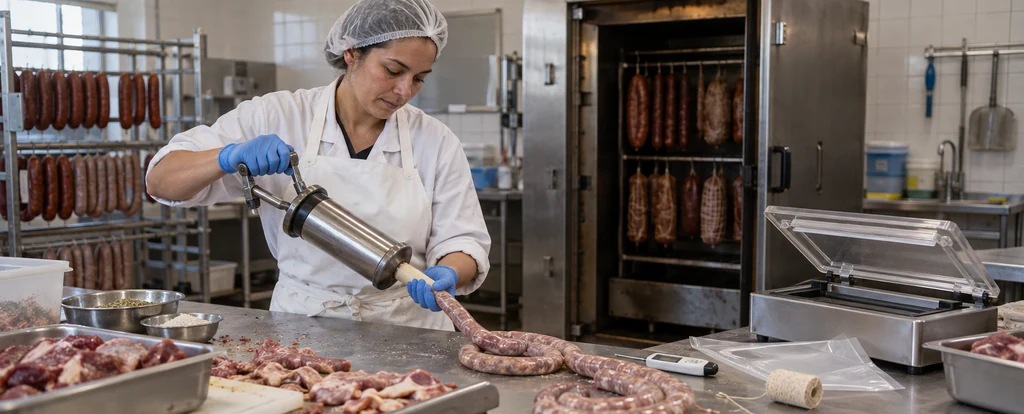
- Mixing seasonings and binders to a recipe, then stuffing sausages into casings
- Loading hams and bacon into cure, then into the smokehouse for a set cycle
- Monitoring cook and chill temperatures and recording them for food safety
- Running slicers, vacuum sealers and labelling equipment as a batch finishes
What skills do smallgoods makers need?
Employers look for food safety and hygiene, food preparation and cooking, plant and equipment operation, backed by Meat grinder fluency and strong attention to detail.
Specialist skills
- Food safety and hygiene
- Food preparation and cooking
- Plant and equipment operation
- Inventory management
- Process improvement
Software and tools
- Meat grinder
- Sausage stuffer
- Smokehouse
- Vacuum sealer
- Slicing machine
General skills
- Attention to detail
- Safety and compliance awareness
- Physical stamina and dexterity
Is the job growing?
About 5,200 people work as smallgoods makers in Australia, and employment is projected to decline 3% over the decade to 2035. That's a real decline, worth weighing carefully before training into the role.
How do you become a smallgoods maker?
Here's the path most smallgoods makers take, step by step.
- 1Start with a food processing qualification
A Certificate III in food processing (FBP30121) or meat processing with a smallgoods stream is the usual entry qualification, and many people complete it through a traineeship, so they are paid while they train.
- 2Meet the food safety requirements
Employers generally ask for a food safety supervisor certificate or equivalent hygiene training, and on site you work to state or territory food safety rules, including temperature logs and cleaning schedules.
- 3Learn the stages on the job
New starters usually begin on trimming, mixing or packing, then move into curing, smoking and sausage making as they show they can follow a recipe and keep accurate records.
- 4Add a Certificate IV or diploma for supervisory work
Team leader and production roles usually go to people with a Certificate IV or diploma in food science or meat processing, or to experienced makers who have already run a line.
Ready to apply as a smallgoods maker?
Whether you're working toward becoming a smallgoods maker or already are one and want a hand with the next step (sharpening your resume for ATS screening, tightening your cover letter, or knowing what you'll actually be asked at interview), here are examples grounded in this specific role, not generic templates.
What jobs can a smallgoods maker move to?
Moving into Brewer typically comes with the biggest pay rise, worth $20,600 a year more on average.
| Move to | Typical pay change | Overlap | Retraining |
|---|---|---|---|
| Brewer Fermentation, hygiene and batch production carry into brewing, with a short course covering brewery equipment and recipes. | +$20,600 | 52% | short course |
| Butcher Moving to butcher adds retail meat cutting and display skills, so a smallgoods maker retrains through the meat trade. | +$15,600 | 41% | reskill |
| Meat Inspector Meat inspection uses processing knowledge but needs a certificate for regulatory, hygiene and quality checks in meat plants. | +$12,000 | 21% | reskill |
| Cheesemaker Smallgoods makers bring curing, fermentation and food safety skills to cheese production, needing little extra training. | +$0 | 67% | minimal |
Moves are chosen from Jobs and Skills Australia's Data on Occupation Mobility, which follows income tax records between 2011-12 and 2020-21, together with entry requirements and skill overlap. A known move is one people were seen making in that data. Pay change compares median full-time pay for the two roles.
Who works as a smallgoods maker?
The typical smallgoods maker is 42 years old; 82% are men, 86% work full-time, and full-timers average 40 hours a week.
- 42
- Median age
- 18%
- Female share
- 86%
- Full-time
- +0h
- vs all-jobs avg
What's it like being a smallgoods maker?
Smallgoods work runs to batch cycles rather than the clock. A typical day starts early to get product into the smokehouse, then moves through cook and chill, packing and cleaning, with temperature records kept along the way. It suits people who like a hands-on trade where the standard for a good batch is clear.
What people like
- A finished batch you can taste. Curing, smoking and fermenting change the product over hours or days, so there is something concrete at the end of a run.
- Set production shifts. Most smallgoods work runs to a roster with regular start and finish times, since the smokehouse and the orders set the pace.
- Skills that carry into nearby food trades. Curing, fermentation and food safety knowledge transfer to cheesemaking, brewing and butcher work, which helps in a small trade.
- Room to refine a recipe. Experienced makers adjust cure times, smoke schedules and seasoning, and those changes show up straight away in the product.
What people find hard
- Cold rooms and repetitive physical work. Much of the day is spent standing on hard floors in cool temperatures, lifting, trimming and cleaning between runs.
- Food safety paperwork. Temperature logs, cleaning records and traceability checks are part of every batch and cannot be skipped when production is running late.
- Early starts and end of day cleaning. Production often begins before dawn, and the fillers, slicers and smokehouse need to be broken down and cleaned at the end of each run.
- An error can waste a whole batch. Getting a cure ratio or cook cycle wrong ruins the product and the time already invested in it, so mistakes are costly and visible.
Based on our synthesis of professional-body surveys and public accounts of the role, not first-person verified reviews.
Which industries employ smallgoods makers?
Meat and Meat Product Manufacturing employs the largest share of smallgoods makers, followed by Supermarket and Grocery Stores.
Top employing industries
- 1Meat and Meat Product Manufacturing
- 2Supermarket and Grocery Stores
- 3Food and Beverage Services
- 4Specialised Food Retailing
Ranked by employment share; the source doesn't publish an exact percentage per industry.
| Certificate III/IV | 34% | |
|---|---|---|
| Diploma / Advanced Diploma | 26% | |
| Bachelor degree | 20% | |
| Year 12 or below | 20% |
Will AI replace smallgoods makers?
Automation affects smallgoods making moderately. Recipe scaling, batch scheduling, temperature logging and label checks now run through plant software, and larger plants use inline weighing and automated filling. Cutting, trimming, casing work and the judgement calls on cure and smoke still come down to the person at the bench.
Share of typical working time by exposure level
- Cutting, trimming and preparing meatMachines assist with mincing and portioning, but someone still trims, sorts and checks each piece by hand.30%low
- Mixing, filling and linking sausagesAutomated fillers and linkers handle the volume, while the maker sets the recipe and adjusts the mix for texture.25%moderate
- Packing, labelling and quality recordsWeighing, vacuum sealing, date coding and traceability records are already heavily automated in larger plants.25%high
- Curing, smoking and monitoring cook cyclesSmokehouses run programmed cycles with sensors, but cure times and colour and aroma checks still rely on experience.20%moderate
Moves least exposed to AI
These career moves from smallgoods maker work are rated low for AI exposure:
- Brewer
Solid skill overlap (52%), short course to get there, and a low automation-risk profile.
Common questions about becoming a smallgoods maker
Straight answers to the questions people ask most.
How much do smallgoods makers earn?
Smallgoods makers earn a median of $65,000 per year before tax. Shift loadings, overtime and the enterprise agreement at a larger plant are the main things that move that figure.
How do you become a smallgoods maker?
Most people enter through a traineeship with a meat processor while completing a Certificate III in food processing (FBP30121) or meat processing with a smallgoods stream. Employers look for reliability, hygiene awareness and the ability to follow a recipe and record temperatures accurately.
Are smallgoods makers in demand?
Smallgoods makers are currently in shortage nationally, and employment is projected to decline 3% over the decade to 2035. The trade is small, so openings tend to be concentrated in meat processing plants and specialist producers rather than spread evenly around the country.
Will AI replace smallgoods makers?
Automation affects this work moderately: recipe scaling, batch scheduling, temperature logging and label checks increasingly run through plant software. Cutting, trimming, filling and reading a smokehouse by sight and smell stay manual, and automated lines still need someone to load, adjust and clean them.
What can smallgoods makers move into?
Curing, fermentation and food safety skills carry into cheesemaking with minimal retraining, and into brewing after a short course, where pay is $20,600 more. Moving to butcher work pays $15,600 more but needs retraining in retail meat cutting. Some experienced makers go on to run their own smallgoods business or smokehouse, which is often where earnings grow.
What are the hours like for a smallgoods maker?
Full-time smallgoods makers average around 40 hours a week, and production often starts early so batches are in the smokehouse by morning. Larger plants run shifts and weekend rosters to keep production going.
Related roles
Not sure this is you? Take the career quiz and get a ranked shortlist of roles that fit how you like to work.