Vehicle Accessories Fitter
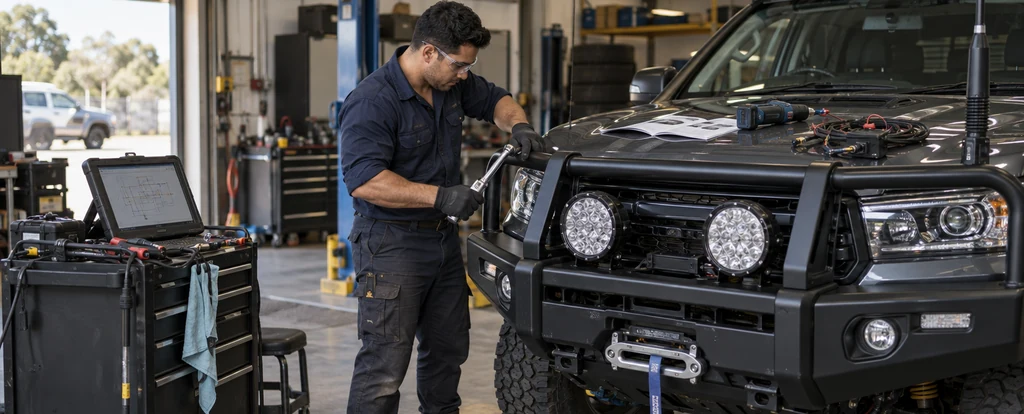
Vehicle accessories fitters install aftermarket equipment such as tow bars, bull bars, roof racks and reversing cameras so a vehicle can tow, carry or work as its owner needs.
- Median salary*
- $65,000
3.8%vs last year, before tax
- People employed
- 2,700
0.0%vs last year
- Projected growth
- +4.6%
to 2035
- AI exposure*
- Low
- automation risk
- Average hours
- 41/wk
+1h vs all jobs
- Shortage status
- Not in shortage
national
Vehicle accessories fitters work in dealerships, accessory retailers, 4WD workshops and mobile fitting vans, fitting parts to new and used cars, utes, vans and four-wheel drives. They are not mechanics: they fit and wire equipment rather than diagnose or repair engines, although the two roles often share a workshop. Most work arrives as a booked job, and the person doing the installation is responsible for it being safe and working the way the manufacturer and the customer expect.
How much do vehicle accessories fitters earn?
The median full-time salary for a vehicle accessories fitter is $65,000 per annum, before tax, up $13,500 since 2018.
Pay is usually set by the vehicle repair, services and retail award or a workplace agreement, so it moves with your classification level, whether you hold a trade qualification and what kind of business you work for. Overtime, weekend work and mobile jobs that include travel add to the base rate, and some employers pay a bonus or commission on the jobs completed.
What does a vehicle accessories fitter do day to day?
The list below is what fills most weeks; the exact mix shifts with seniority and whatever stage the current work is at.
- Reading fitting instructions, wiring diagrams and vehicle specifications before starting a job
- Removing and refitting trim, panels and interior parts to reach mounting points
- Drilling, bolting and sealing tow bars, bull bars, roof racks, trays and canopies into place
- Running and connecting wiring for lights, reversing cameras, brake controllers and dual batteries
- Testing each accessory, checking torque settings and showing the customer how it works
What skills do vehicle accessories fitters need?
Employers look for installation and maintenance, hand and power tool work, backed by Hand tools fluency and strong attention to detail.
Specialist skills
- Installation and maintenance
- Hand and power tool work
Software and tools
- Hand tools
- Power tools
- Torque wrench
- Vehicle diagnostic scanner
- Parts ordering software
General skills
- Attention to detail
- Problem solving
- Safety and compliance awareness
- Customer service
- Physical stamina and dexterity
Is the job growing?
About 2,700 people work as vehicle accessories fitters in Australia, and employment is projected to grow 4.6% over the decade to 2035. That's modest growth: demand is steady rather than booming.
How do you become a vehicle accessories fitter?
Here's the path most vehicle accessories fitters take, step by step.
- 1Finish Year 10 or Year 12
Most people start after school, and subjects such as maths, design and technology or automotive studies are useful background. You do not need an ATAR to get in.
- 2Do a certificate II or certificate III in automotive accessory fitting
TAFE and private training providers offer these qualifications, with a certificate II taking roughly six months to a year of full-time study and covering hand tools, vehicle systems, wiring and safe work practices. A certificate III is the trade-level qualification and is usually completed as an apprenticeship.
- 3Get a start in a workshop
Dealerships, accessories retailers and 4WD workshops take on entry-level workers, and most of the skill is learned on the job under an experienced tradesperson. Ask whether the employer will support an apprenticeship, because that is the paid route to the certificate III.
- 4Add the licences and short courses that widen your work
A current driver's licence is needed to move vehicles and to do mobile work, and a short course in 12 volt wiring or refrigerant handling makes you more useful to an employer. Some workshops also want a forklift licence.
Ready to apply as a vehicle accessories fitter?
Whether you're working toward becoming a vehicle accessories fitter or already are one and want a hand with the next step (sharpening your resume for ATS screening, tightening your cover letter, or knowing what you'll actually be asked at interview), here are examples grounded in this specific role, not generic templates.
What jobs can a vehicle accessories fitter move to?
Moving into Auto Electrician typically comes with the biggest pay rise, worth $81,000 a year more on average.
| Move to | Typical pay change | Overlap | Retraining |
|---|---|---|---|
| Auto Electrician Vehicle accessories fitters can specialise as auto electricians, installing and repairing vehicle electrical systems through an apprenticeship.Known move | +$81,000 | 53% | requalify |
| Sales Representative Vehicle accessories fitters can move into sales, using product knowledge to sell automotive parts and equipment with further training.Known move | +$23,000 | 10% | reskill |
| Motor Mechanic Vehicle accessories fitters can move into motor mechanics, gaining full mechanical repair skills through an apprenticeship.Known move | +$19,300 | 45% | requalify |
Moves are chosen from Jobs and Skills Australia's Data on Occupation Mobility, which follows income tax records between 2011-12 and 2020-21, together with entry requirements and skill overlap. A known move is one people were seen making in that data. Pay change compares median full-time pay for the two roles.
Who works as a vehicle accessories fitter?
The typical vehicle accessories fitter is 37 years old; 96% are men, 84% work full-time, and full-timers average 41 hours a week.
- 37
- Median age
- 4%
- Female share
- 84%
- Full-time
- +1h
- vs all-jobs avg
What's it like being a vehicle accessories fitter?
The rhythm is job to job rather than season to season: vehicles are booked in, fitted and handed back, often on the same day. The pressure comes from awkward spaces, customers waiting and the cost of a mistake on someone's new vehicle, so people who like finishing something they can see tend to settle into it well.
What people like
- Finished work you can point at. At the end of a shift there is a ute with a new bull bar and lights that work, and the customer drives it away.
- Something different on every vehicle. Wiring and mounting points change from model to model, so the job rarely becomes the same set of steps twice.
- Product knowledge that carries over. You learn how accessories, loads and wiring work together, which is useful if you later move into parts sales or your own installation business.
- Regular hours in a workshop. Most roles run standard weekday hours, with weekend or after-hours work mainly in mobile servicing and busy retail periods.
What people find hard
- Tight spaces and awkward angles. Reaching behind a dashboard or under a tray means working on your back, in the cold or in the heat, with limited room to move.
- Busy stretches that stack up. Demand builds before holidays and the four-wheel-drive season, and several vehicles can be waiting on the same day.
- Mistakes cost time. A scratched panel or a hole drilled in the wrong place means the job stops while it is fixed, and the customer notices.
- On your feet all day. The work is physical: lifting, kneeling, drilling and reaching, with tools in your hands for most of the shift.
Based on our synthesis of professional-body surveys and public accounts of the role, not first-person verified reviews.
Which industries employ vehicle accessories fitters?
Retail Trade employs the largest share of vehicle accessories fitters, followed by Other Services.
Top employing industries
- 1Retail Trade
- 2Other Services
- 3Manufacturing
Ranked by employment share; the source doesn't publish an exact percentage per industry.
| Year 12 or below | 46.9% | |
|---|---|---|
| Certificate III/IV | 41.1% | |
| Diploma / Advanced Diploma | 5% | |
| Bachelor degree | 3% | |
| Postgraduate | 0.6% |
Will AI replace vehicle accessories fitters?
AI exposure is low. The job is physical and one vehicle at a time, and most of it is judgement about how a part fits a particular model and whether the finished installation is safe to use. The technology that matters is already in the workshop: parts catalogues and quoting software, diagnostic scanners for tracing circuits, and manufacturer instructions online.
Share of typical working time by exposure level
- Installing tow bars, bull bars, roof racks and canopiesMounting points, torque settings and load ratings are set by the vehicle and the accessory, and the physical fitting cannot be automated.30%low
- Wiring and testing electrical accessoriesA diagnostic scanner can help trace a circuit, but running the loom, crimping, soldering and testing the finished job stay manual.30%moderate
- Removing and refitting trim, panels and interior partsClips, fasteners and wiring routes differ on every model, so this is still done by hand with trim tools and a bit of patience.25%low
- Reading fitting instructions and vehicle specificationsManufacturer instructions and online guides are already digital, and they speed the job up without changing who checks that the part suits the vehicle.15%low
Common questions about becoming a vehicle accessories fitter
Straight answers to the questions people ask most.
How much do vehicle accessories fitters earn?
Vehicle accessories fitters earn a median of $65,000 per year before tax. Pay moves with your classification under the award, whether you hold a certificate III, and how much overtime, weekend or mobile work you take on.
How do you become a vehicle accessories fitter?
Most people start with a certificate II in automotive accessory fitting at TAFE or a private provider, then look for an entry-level job or apprenticeship in a dealership, accessory retailer or 4WD workshop. The certificate II often gets you a start, and the certificate III, completed as an apprenticeship, is what makes you a qualified tradesperson.
Are vehicle accessories fitters in demand?
Vehicle accessories fitters are currently not in shortage, and employment is projected to grow 4.6% over the decade to 2035. The work sits mainly with dealerships, accessory retailers and 4WD workshops, so it is worth checking what those employers near you advertise and what they ask for.
What is the difference between a vehicle accessories fitter and a motor mechanic?
A vehicle accessories fitter fits and wires aftermarket equipment, while a motor mechanic services, diagnoses and repairs the vehicle itself. The two work side by side and share tools, but only the mechanic needs the full trade qualification in light vehicle mechanical technology.
Will AI replace vehicle accessories fitters?
AI changes very little of the hands-on side of this job. Parts catalogues, quoting software and diagnostic scanners already help identify the right part or trace a circuit, but the drilling, wiring, torqueing and testing happen in the vehicle, by hand.
What can a vehicle accessories fitter move into?
With the certificate III and a few years of experience, some requalify as motor mechanics through a light vehicle apprenticeship, where the pay gap is $19,300 more. Others move into automotive parts and equipment selling as a sales representative, where the gap is $23,000 more. Setting up on your own doing mobile installation is often where earnings grow.
Related roles
Not sure this is you? Take the career quiz and get a ranked shortlist of roles that fit how you like to work.