Home Manufacturing & Production
Watchmaker
Watchmakers service and repair mechanical and quartz watches, keeping precision timepieces running accurately and holding their value.
- Median salary*
- $65,000
4.2%vs last year, before tax
- People employed
- 520
4.0%vs last year
- Projected growth
- +8%
to 2035
- AI exposure*
- Low
- automation risk
- Average hours
- 41/wk
+1h vs all jobs
- Shortage status
- In shortage
national
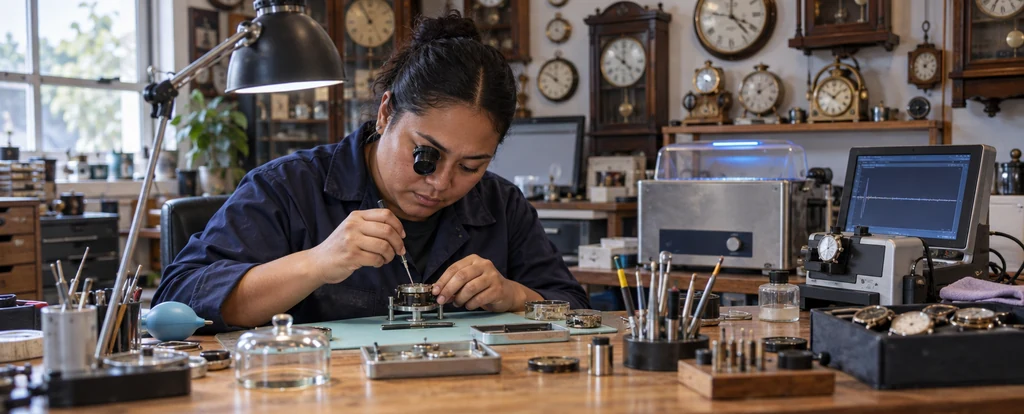
Most watchmakers work at a bench in a small repair workshop, a jeweller's service department or a brand-owned service centre. The work sits closer to precision engineering than to jewellery, because a watchmaker strips a movement down to its smallest parts, cleans and oils it, then rebuilds it until it keeps time. With about 520 people in the trade nationally, it is a small occupation where reputation and access to parts matter as much as skill.
How much do watchmakers earn?
The median full-time salary for a watchmaker is $65,000 per annum, before tax, up $13,700 since 2018.
Pay depends heavily on where you work and what you can service. Brand-owned service centres and authorised dealers usually pay more than small independent repair shops, and watchmakers accredited for particular makes, or able to handle vintage and complicated movements, can ask for more. Self-employed watchmakers set their own rates but carry the cost of tools, parts and quiet periods.
What does a watchmaker do day to day?
The list below is what fills most weeks; the exact mix shifts with seniority and whatever stage the current work is at.
- Diagnosing faults in mechanical and quartz movements, from a watch that stops overnight to one that loses minutes a day
- Stripping movements down to individual parts and cleaning them in an ultrasonic cleaner
- Replacing worn or broken components such as balance staffs, mainsprings and gaskets
- Oiling and reassembling movements, applying the right lubricant in the right quantity at each pivot
- Regulating watches on a timegrapher and testing them over several days before they go back to the customer
What skills do watchmakers need?
Employers look for craft and handmade production, inventory management, backed by Timegrapher fluency and strong attention to detail.
Specialist skills
- Craft and handmade production
- Inventory management
Software and tools
- Timegrapher
- Ultrasonic cleaner
- Watchmaker's screwdrivers
- Loupe
- Watch movement holder
General skills
- Attention to detail
- Problem solving
- Client relationships and advisory
- Written communication
Is the job growing?
About 520 people work as watchmakers in Australia, and employment is projected to grow 8% over the decade to 2035. That's modest growth: demand is steady rather than booming.
How do you become a watchmaker?
Here's the path most watchmakers take, step by step.
- 1Start with a Certificate III
The standard entry point is a Certificate III in watch and clock service and repair, delivered through TAFE or a registered training organisation and often combined with a traineeship so you earn while you learn. It covers movement theory, hand skills, timing and fault diagnosis.
- 2Get bench time with real watches
Traineeships and casual work in a repair workshop are where the hand skills develop, because no qualification replaces hours on a movement. Expect to start on battery changes, strap fitting and quartz servicing before you touch mechanical calibres.
- 3Build your own toolkit
Employers generally expect watchmakers to own the basics: screwdrivers in the right sizes, a loupe, movement holders, tweezers and an ultrasonic cleaner, with a timegrapher usually supplied at the bench. Good tools protect the watch and your reputation.
- 4Add brand accreditation
Once you are employed, many watchmakers train with a brand or its Australian service centre to gain access to parts and technical documentation, which is often restricted to accredited workshops. That accreditation widens the work you can take in and usually lifts pay.
- 5Specialise or work for yourself
Experienced watchmakers move into vintage restoration, complicated movements or running their own repair business. Each path narrows the work but raises the rates you can charge for it.
Ready to apply as a watchmaker?
Whether you're working toward becoming a watchmaker or already are one and want a hand with the next step (sharpening your resume for ATS screening, tightening your cover letter, or knowing what you'll actually be asked at interview), here are examples grounded in this specific role, not generic templates.
What jobs can a watchmaker move to?
Moving into Precision Instrument Maker typically comes with the biggest pay rise, worth $13,000 a year more on average.
| Move to | Typical pay change | Overlap | Retraining |
|---|---|---|---|
| Precision Instrument Maker Watchmakers bring careful hand skills and precision measurement to instrument making, but need to complete a new apprenticeship. | +$13,000 | 8% | requalify |
| Gunsmith Watchmakers bring precision assembly and fine mechanism repair skills to gunsmithing, though a separate apprenticeship is required. | +$5,200 | 25% | requalify |
Moves are chosen from Jobs and Skills Australia's Data on Occupation Mobility, which follows income tax records between 2011-12 and 2020-21, together with entry requirements and skill overlap. A known move is one people were seen making in that data. Pay change compares median full-time pay for the two roles.
Who works as a watchmaker?
The typical watchmaker is 55 years old; 91% are men, 62% work full-time, and full-timers average 41 hours a week.
- 55
- Median age
- 9%
- Female share
- 62%
- Full-time
- +1h
- vs all-jobs avg
What's it like being a watchmaker?
The rhythm of the job is quiet and repetitive in the best sense: long stretches at a bench with a loupe in one eye, broken up by customers collecting watches and the occasional job that refuses to behave. The pressure comes from precision, because one slip with a screwdriver or tweezers can damage a part that is hard to replace, and a repair quoted at two hours can take a day. It suits people who like working with their hands, solving mechanical puzzles and finishing one job before starting the next.
What people like
- Bringing a stopped watch back to life. A watch that arrives dead often leaves running within a few hours, and a full service can restore accuracy it has not had in years.
- The work tells you whether you got it right. A timegrapher shows rate and beat error straight away, so you know within minutes whether a rebuild is sound rather than guessing.
- Faults that need real detective work. An intermittent stop can take tracing through a train of tiny components to find, and patience is what solves it.
- Customers bring you things that matter. Much of the work is on watches inherited from a parent or grandparent, and people often care about the outcome beyond the cost.
What people find hard
- Parts supply is controlled by the brands. Many manufacturers release components only to accredited service centres, which leaves independent watchmakers hunting for donor movements or aftermarket parts that may not fit properly.
- A small slip is expensive. Scratching a dial, losing a screw or over-oiling a jewel can turn a routine service into a repair, and the cost lands on the workshop.
- Cheap quartz watches are often not worth servicing. Customers reasonably compare a service quote with the price of a new watch, so a lot of quartz work is a battery or module swap rather than a repair.
- It is close, still bench work. Hours of focus under a lamp strain the eyes, neck and back, so most watchmakers build breaks and good lighting into the day.
Based on our synthesis of professional-body surveys and public accounts of the role, not first-person verified reviews.
Which industries employ watchmakers?
Other Services employs the largest share of watchmakers, followed by Retail Trade.
Top employing industries
- 1Other Services
- 2Retail Trade
- 3Manufacturing
Ranked by employment share; the source doesn't publish an exact percentage per industry.
| Certificate III/IV | 56.8% | |
|---|---|---|
| Year 12 or below | 21.5% | |
| Bachelor degree | 7.7% | |
| Diploma / Advanced Diploma | 4.8% | |
| Postgraduate | 2.3% |
Will AI replace watchmakers?
Watchmaking is not very exposed to AI or automation, because almost every repair is done by hand on one movement at a time. What technology does change is the measuring and the paperwork: timegraphers read rate and beat error electronically, service documentation and parts catalogues are now digital, and some workshops use imaging to inspect tiny components. Automated assembly exists inside watch factories, but it does not reach the diagnostic and repair work at a bench.
Share of typical working time by exposure level
- Servicing and oiling movementsStripping, cleaning and re-oiling a mechanical calibre is done with screwdrivers, tweezers and a loupe, and no machine does that at repair scale.35%low
- Sourcing parts and advising customersOnline catalogues and digital service records speed up the search for components, while quotes, timelines and explanations still rest on the person at the bench knowing the watch.30%moderate
- Testing and regulating timekeepingA timegrapher measures rate and beat error and software can suggest a correction, but the watchmaker still turns the regulating screws and retests.20%moderate
- Replacing batteries and quartz modulesBattery changes and module swaps are the most routine part of the job, with testers and presses doing much of the checking.15%high
Common questions about becoming a watchmaker
Straight answers to the questions people ask most.
How much do watchmakers earn?
Watchmakers earn a median of $65,000 per year before tax. Pay varies with the workshop, the brands you are accredited for and whether you work for an employer or run your own repair business.
How do you become a watchmaker in Australia?
The usual route is a Certificate III in watch and clock service and repair, often as part of a traineeship with a repair workshop or service centre. That gives you bench time and a qualification at the same time, which matters because employers hire on hand skills as much as on the certificate.
Are watchmakers in demand?
Watchmakers are currently in shortage nationally, and employment is projected to grow 8% over the decade to 2035 over the decade to 2035. The trade is small nationally, so openings cluster around service centres and established repair workshops rather than being spread evenly across the country.
Will AI replace watchmakers?
Little of this work is exposed to automation, because disassembly, cleaning, oiling and adjustment all happen by hand on a single movement. Software helps with timing analysis, service records and parts catalogues, and it cannot handle a bent pivot or a worn jewel.
What can a watchmaker move into?
Precision instrument making uses much the same hand and measurement skills and pays $13,000 more, while gunsmithing pays $5,200 more; both need a separate apprenticeship before you can work unsupervised. Many experienced watchmakers instead open their own repair business, which is often where earnings grow.
How long does it take to become a watchmaker?
A traineeship combined with the Certificate III usually takes about three years, and building the range of movements you can handle confidently takes longer. Brand-specific accreditation comes after that, once you are working in a service centre.
Related roles
Not sure this is you? Take the career quiz and get a ranked shortlist of roles that fit how you like to work.