Agronomist
Agronomists advise farmers on how to get the best result from their soil and crops, using science to work out what's going wrong in a paddock and what to do about it.
- Median salary
- $107,800
3.7%vs last year, before tax
- People employed
- 3,400
0.0%vs last year
- Projected growth
- +17.5%
to 2035
- AI exposure*
- Moderate
- automation risk
- Average hours
- 43/wk
+3h vs all jobs
- Shortage status
- In shortage
national
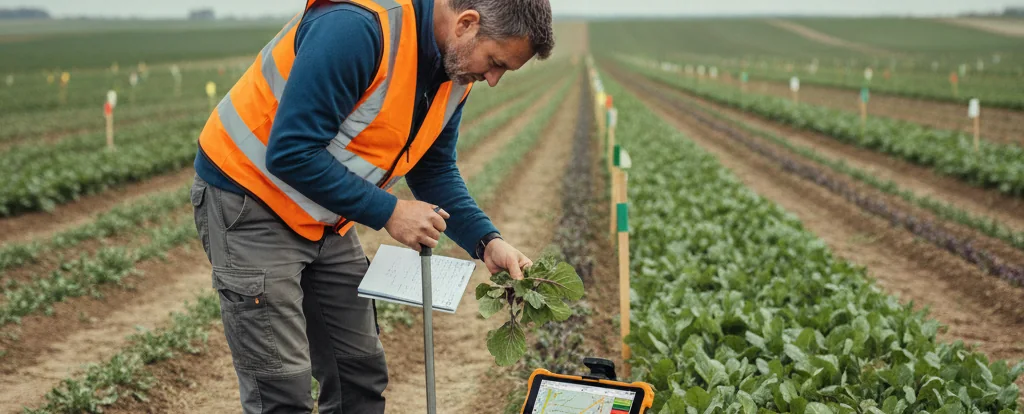
Agronomists work between the paddock and the lab, testing soil and plant samples to find out why a crop is underperforming, then turning that into a recommendation a farmer can act on that season. Unlike a research scientist, who might stay with a trial for years, an agronomist usually works for an agribusiness, seed company or rural merchandise supplier rather than for the farm itself, and is expected to give an answer while the problem is still in the ground. Because most of the work happens on someone else's land, building trust with growers matters as much as getting the science right.
How much do agronomists earn?
The median full-time salary for an agronomist is $107,800 per annum, before tax, up $22,200 since 2018.
Pay depends heavily on who employs you, since agribusiness and rural merchandise firms often add a bonus tied to the grower accounts you manage, while government and university roles pay on fixed classification scales. Experience and the size of the client base you carry move it most, and senior agronomists who move into management or independent consulting usually earn well above the graduate end.
What does an agronomist do day to day?
The list below is what fills most weeks; the exact mix shifts with seniority and whatever stage the current work is at.
- Walking paddocks and testing soil or plant tissue to work out what a crop is missing
- Matching in-season pest, weed and disease advice to what is actually happening in the ground
- Running trial plots to see which varieties or inputs perform
- Timing planting and harvest advice around weather forecasts and grower deadlines
- Translating research findings into recommendations a farmer will act on
What skills do agronomists need?
Employers look for field research and sampling, laboratory analysis, data analysis, backed by Soil testing equipment (pH meters, moisture probes) fluency and strong problem solving.
Specialist skills
- Field research and sampling
- Laboratory analysis
- Data analysis
- Environmental assessment
Software and tools
- Soil testing equipment (pH meters, moisture probes)
- GIS and remote sensing software
- Weather data platforms (BOM, AgriTech dashboards)
- Spreadsheet and statistical analysis software (R, Python, SPSS)
- Field mapping and digital farm planning apps
General skills
- Problem solving
- Written communication
- Client relationships and advisory
Is the job growing?
About 3,400 people work as agronomists in Australia, and employment is projected to grow 17.5% over the decade to 2035. That's healthy, above-average growth, and the role should stay in solid demand.
How do you become an agronomist?
Here's the path most agronomists take, step by step.
- 1Start with a degree in agricultural science or a related field
A bachelor degree in agricultural science, agriculture or plant science is the standard entry point and takes three to four years full time. It covers soil chemistry, crop physiology, entomology and plant pathology, which are the subjects the daily advice draws on.
- 2Build field experience while you study
Holiday work with a grower, an agribusiness or a trial site teaches you to read a paddock in a way a lecture cannot, and graduate employers usually ask about it. Vacation programs and cadetships with seed companies and rural merchandise suppliers are common routes in.
- 3Take a graduate or trainee agronomist role
New agronomists generally start under an experienced adviser, handling a defined group of clients while they learn the local crops and the seasonal calendar. This stage typically runs two to three years before you carry your own client list.
- 4Add postgraduate study if you want to specialise
A graduate certificate or masters in soil science, plant pathology or precision agriculture suits people heading for a technical or research-heavy path. It is common in this field, and it also helps if you move into consulting or land assessment later.
- 5Keep your accreditation and professional development current
Chemical advice usually requires accreditation such as ChemCert, and chemical registrations, varieties and regulations change every season. Ag Institute Australia runs accredited courses and continuing professional development, and rules for chemical use differ by state and territory.
Ready to apply as an agronomist?
Whether you're working toward becoming an agronomist or already are one and want a hand with the next step (sharpening your resume for ATS screening, tightening your cover letter, or knowing what you'll actually be asked at interview), here are examples grounded in this specific role, not generic templates.
What jobs can an agronomist move to?
None of the roles agronomists typically move into pay more than the role itself. Environmental Scientist is the closest match. If a bigger salary is the goal, moving up into a senior or principal position within the role is usually the faster route than moving sideways.
| Move to | Typical pay change | Overlap | Retraining |
|---|---|---|---|
| Environmental Scientist Agronomists bring field sampling and land management skills to environmental science, though further study is needed for the broader role.Known move | −$6,200 | 74% | requalify |
| Soil Scientist Agronomists can specialise in soil science, applying their soil and crop knowledge to detailed land assessment and fertility work. | −$11,600 | 74% | minimal |
| Biologist Agronomists with strong plant and soil science can move into biology roles, requiring further study in broader biological sciences.Known move | −$11,600 | 74% | requalify |
| Agricultural Consultant Agronomists move into advisory consulting, using crop and soil science to help farm clients improve production and solve paddock problems.Known move | −$19,400 | 41% | reskill |
Moves are chosen from Jobs and Skills Australia's Data on Occupation Mobility, which follows income tax records between 2011-12 and 2020-21, together with entry requirements and skill overlap. A known move is one people were seen making in that data. Pay change compares median full-time pay for the two roles.
Who works as an agronomist?
The typical agronomist is 41 years old; 69% are men, 85% work full-time, and full-timers average 43 hours a week.
- 41
- Median age
- 31%
- Female share
- 85%
- Full-time
- +3h
- vs all-jobs avg
What's it like being an agronomist?
The work follows the season rather than the calendar, with quiet weeks of monitoring and trial work giving way to long days when a crop breaks dormancy, a pest arrives or harvest closes in. Most of it happens on someone else's property, standing in a paddock with a grower who has a decision to make that week. It suits people who like applied science and don't mind driving, because the advice you give is tested in a real crop within months.
What people like
- Most of the week is spent outside. Paddocks, trial plots and farm sheds, with a ute for an office. Laboratory and desk work is real but it is a minority of the week for most agronomists.
- The result shows up in the same season. A disease or nutrition call you make in July is visible in the yield at harvest, so the feedback loop is much shorter than in most scientific work.
- Every property is a different problem. Soil type, rainfall, rotation and the grower's own preferences all change the answer, so the same crop rarely gets identical advice twice.
- You get to know your clients' businesses. Working the same district season after season means you know the family, the paddocks and the history behind each decision, which is a large part of why the advice lands.
What people find hard
- The season sets the hours. Planting, spraying windows and harvest push the average week to about 43 hours, and a weather change can stretch that considerably with little notice.
- Weather can wipe out a good call. Frost, drought or hail can undo the best recommendation you have ever made, and the grower still carries the cost of it.
- Not every grower takes your advice. You can back a recommendation with trial data and watch it get set aside for cost or habit, which is hard when you can see the problem coming.
- Long drives between properties. Client farms in a district can be an hour or more apart, so a good share of the job happens behind the wheel on gravel roads.
Based on our synthesis of professional-body surveys and public accounts of the role, not first-person verified reviews.
Which industries employ agronomists?
Agriculture, Forestry and Fishing employs the largest share of agronomists, followed by Professional, Scientific and Technical Services.
Top employing industries
- 1Agriculture, Forestry and Fishing
- 2Professional, Scientific and Technical Services
- 3Wholesale Trade
Ranked by employment share; the source doesn't publish an exact percentage per industry.
| Bachelor degree | 49.2% | |
|---|---|---|
| Postgraduate | 33.8% | |
| Diploma / Advanced Diploma | 8.6% | |
| Year 12 or below | 5% | |
| Certificate III/IV | 2.2% |
Will AI replace agronomists?
Agronomic work sits in the middle of the range for AI exposure. The measuring and number-crunching side is being steadily automated, with satellite imagery, yield mapping and decision-support models doing work that once took weeks of paddock time. The advisory side is harder to automate because it depends on local knowledge, a grower's budget and trust built over seasons, and someone has to stay accountable for the recommendation.
Share of typical working time by exposure level
- Paddock inspections and crop diagnosisWalking a crop, digging plants and checking leaves for pests, disease or deficiency is still done by eye and hand, and imagery or sensors mainly tell you where to look.30%low
- Soil and tissue testing and interpretationLaboratory results and nutrient models can be read quickly with software, but deciding what a number means for this paddock and this rotation stays with the agronomist.25%moderate
- Grower advice and recommendationsDrafting recommendations and reports is faster with tools that summarise trial data and seasonal forecasts, though the grower still wants to hear it from a person who knows the property.25%moderate
- Trial plot data analysisStatistically analysing variety and input trials, once done by hand, is now largely automated, and models are increasingly used to work out which differences are real.20%high
Common questions about becoming an agronomist
Straight answers to the questions people ask most.
How much do agronomists earn?
Agronomists earn a median of $107,800 per year before tax. Pay rises with experience and with the size of the client base you manage, and agribusiness roles often add a bonus tied to grower accounts on top of the base salary.
How do you become an agronomist?
Most agronomists start with a bachelor degree in agricultural science or a related field, then spend two or three years as a trainee or graduate agronomist before managing clients on their own. Practical experience on farms or trial sites during study is what usually separates applicants for graduate roles.
Are agronomists in demand in Australia?
Agronomists are currently in shortage nationally, and employment is projected to grow 17.5% over the decade to 2035. For someone entering the field that means vacancies across the farming regions, especially in broadacre cropping and horticulture districts, rather than in the cities.
Will AI replace agronomists?
Not in the near term. Satellite imagery, yield mapping and decision-support models now handle much of the monitoring and pattern-finding that once took a week of paddock inspections, and they do it well. What they cannot do is stand in a failing crop, weigh the grower's budget and rotation against the season ahead, and take responsibility for the recommendation.
What can agronomists move into?
Agronomists who move into agricultural consulting keep the same clients and production systems, with pay around $19,400 less. Soil science is a closer technical fit, drawing on the soil chemistry and fertility side of the job, while environmental science is a bigger step that usually needs further study. Experienced agronomists sometimes set up their own advisory practice, which is often where earnings grow.
How much travel is involved?
Most agronomists cover a district, so expect to drive between client properties daily, sometimes an hour or more each way, and to be away from home through peak season. Living in or near the district you cover is common, because the driving is part of the working day rather than an exception to it.
Related roles
- Agricultural Consultant
- Soil Scientist
- Environmental Scientist
- Biologist
- Agricultural Technician
- Agricultural Consultant
Not sure this is you? Take the career quiz and get a ranked shortlist of roles that fit how you like to work.