Biochemist
Biochemists study the chemical reactions inside living things, work that underpins new medicines, diagnostic tests and food production.
- Median salary*
- $99,800
4.2%vs last year, before tax
- People employed
- 130
30.0%vs last year
- Projected growth
- +19.8%
to 2035
- AI exposure*
- Moderate
- automation risk
- Average hours
- 41/wk
+1h vs all jobs
- Shortage status
- Not in shortage
national
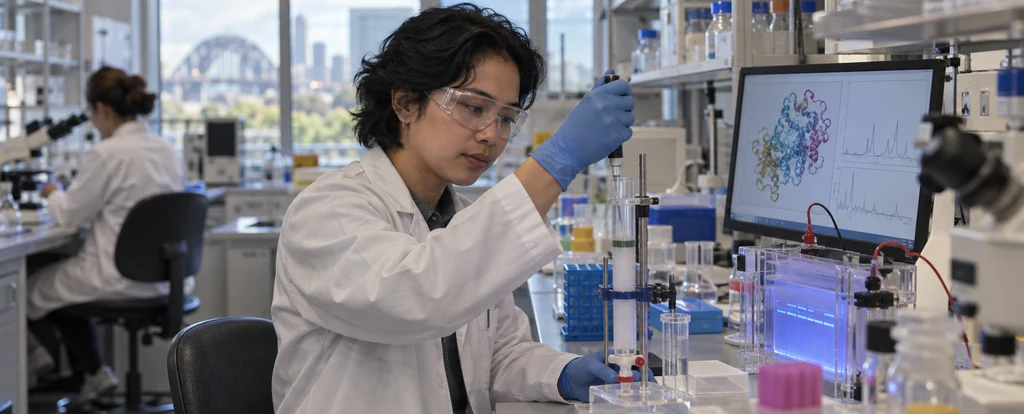
Biochemists work mainly in laboratories at universities, medical research institutes, hospitals and pharmaceutical, biotech or food companies. What separates them from chemists is the subject: the molecules are studied inside living systems, where conditions are harder to control and results need more interpretation. Most people enter through a science degree, and research roles usually expect a PhD.
How much do biochemists earn?
The median full-time salary for a biochemist is $99,800 per annum, before tax, up $21,000 since 2018.
Where you work moves pay more than the job title does: universities and medical research institutes generally pay less than pharmaceutical, biotech and food companies for similar technical work. A PhD opens the higher research and senior scientist bands, while fixed-term funding cycles can hold salary growth back even for experienced staff. Industry employers often add bonuses or share schemes on top of base pay.
What does a biochemist do day to day?
The list below is what fills most weeks; the exact mix shifts with seniority and whatever stage the current work is at.
- Designing and running experiments on proteins, enzymes and metabolic pathways
- Purifying and characterising biological molecules using chromatography and electrophoresis
- Analysing samples with techniques such as mass spectrometry and spectroscopy
- Recording and interpreting experimental data, then writing it up for papers, reports or product teams
- Maintaining laboratory equipment and following safety and quality standards
What skills do biochemists need?
Employers look for laboratory analysis, data analysis, statistical modelling, backed by GraphPad Prism fluency and strong attention to detail.
Specialist skills
- Laboratory analysis
- Data analysis
- Statistical modelling
- Project management
Software and tools
- GraphPad Prism
- Benchling
- R
- PyMOL
- ImageJ
General skills
- Attention to detail
- Problem solving
- Written communication
Is the job growing?
About 130 people work as biochemists in Australia, and employment is projected to grow 19.8% over the decade to 2035. That's healthy, above-average growth, and the role should stay in solid demand.
How do you become a biochemist?
Here's the path most biochemists take, step by step.
- 1Complete a science degree
A Bachelor of Science majoring in biochemistry, molecular biology or a related field takes three years full time and includes the laboratory practicals employers expect to see. It is the minimum for almost every entry-level role.
- 2Add an honours year or a masters
A fourth year research project or a two-year masters gives you a supervised project, a thesis and references. Many laboratory assistant, technical officer and research assistant jobs ask for this level, and it is the usual bridge into a PhD.
- 3Do a PhD if you want to run research
A doctorate takes three to four years and is expected for independent research, postdoctoral positions and academic or institute scientist roles. It is built around a single original project, so it suits people who can work on one question for years.
- 4Build bench experience as early as you can
Vacation scholarships, part-time work in a university lab, honours projects and industry internships all count, because hiring panels look for hands-on technique with specific methods. Skills in cell culture, protein purification or mass spectrometry are often what decide between two applicants.
- 5Choose your sector and prepare for it
Academic research, industry research and development, clinical diagnostics and food or agricultural science each value different experience. Hospital pathology work generally expects an accredited medical laboratory science qualification, while biochemists themselves are not part of a national registration scheme.
Ready to apply as a biochemist?
Whether you're working toward becoming a biochemist or already are one and want a hand with the next step (sharpening your resume for ATS screening, tightening your cover letter, or knowing what you'll actually be asked at interview), here are examples grounded in this specific role, not generic templates.
What jobs can a biochemist move to?
Moving into Chemist typically comes with the biggest pay rise, worth $14,300 a year more on average.
| Move to | Typical pay change | Overlap | Retraining |
|---|---|---|---|
| Chemist Biochemists bring laboratory and analytical skills to chemistry roles, with minimal retraining needed for testing, formulation or research work.Known move | +$14,300 | 67% | minimal |
| Food Scientist Biochemists bring molecular and biochemical knowledge to food science, but the move needs further study in food technology and safety.Known move | +$14,300 | 57% | requalify |
| Medical Laboratory Scientist Biochemists bring biochemical and analytical skills to clinical testing, though hospital laboratory practice requires a recognised qualification.Known move | +$7,100 | 43% | requalify |
| Biotechnologist Biochemists bring cell and molecular techniques to biotechnology, with a short course covering commercial and regulatory practices.Known move | +$1,600 | 52% | short course |
| Biologist Biochemists bring molecular and laboratory expertise to biological research, with a short course bridging into broader organismal and ecological study.Known move | −$3,600 | 57% | short course |
Moves are chosen from Jobs and Skills Australia's Data on Occupation Mobility, which follows income tax records between 2011-12 and 2020-21, together with entry requirements and skill overlap. A known move is one people were seen making in that data. Pay change compares median full-time pay for the two roles.
Who works as a biochemist?
The typical biochemist is 35 years old; 57% are women, 75% work full-time, and full-timers average 41 hours a week.
- 35
- Median age
- 57%
- Female share
- 75%
- Full-time
- +1h
- vs all-jobs avg
What's it like being a biochemist?
The work runs on experiments, and experiments take time: a single assay can take a day, a cell culture weeks, and a research project years. Most of the week is spent at the bench, with the rest on data analysis, troubleshooting and writing. The people who settle into it tend to enjoy patient problem solving and are not too bothered when a result fails to appear.
What people like
- Getting a result nobody has seen before. The moment an assay finally works, or a structure resolves, is the reward the bench work is built around, and it can be the first evidence for something genuinely new.
- Work that reaches people. A drug target, a diagnostic test or a food safety method connects what happens at the bench to patients or consumers, even when that link is years away.
- A field that keeps moving. New techniques arrive constantly, from gene editing to high-throughput screening, so there is always a method to learn and a reason to read the current literature.
- Small teams with real expertise. Research groups are usually a handful of people who know their subject well, and collaboration across labs and countries is normal rather than occasional.
What people find hard
- Experiments that fail for no obvious reason. A reaction that worked last week may not work today, and finding out why can take days of systematic troubleshooting before any useful data appears.
- Short funding cycles. Many positions are fixed-term and tied to grants, so contracts run for two or three years and postdoctoral researchers often move cities or countries for the next one.
- Long stretches of repetitive bench work. Large experiments mean hundreds of samples prepared the same way, and hours of pipetting or plate reading are part of the job rather than an occasional chore.
- A slow path to independence. Years of study and usually one or more postdoctoral positions sit between a science degree and running your own research group, and not everyone who wants that role gets it.
Based on our synthesis of professional-body surveys and public accounts of the role, not first-person verified reviews.
Which industries employ biochemists?
Education and Training employs the largest share of biochemists, followed by Health Care and Social Assistance.
Top employing industries
- 1Education and Training
- 2Health Care and Social Assistance
- 3Professional, Scientific and Technical Services
Ranked by employment share; the source doesn't publish an exact percentage per industry.
| Postgraduate | 57.5% | |
|---|---|---|
| Bachelor degree | 44% | |
| Diploma / Advanced Diploma | 0% | |
| Certificate III/IV | 0% |
Will AI replace biochemists?
Biochemists sit in the middle: analysis, imaging and structure prediction have moved quickly to software and machine learning, but the experiments still need a person at the bench. Tools such as AlphaFold and automated microscopy change how fast a biochemist gets to an answer, not whether the experiments happen.
Share of typical working time by exposure level
- Planning and running bench experimentsCell culture, protein purification and assay work still depend on a person's hands and judgement, though automated liquid handlers now take on repetitive plate preparation.30%low
- Analysing data and imagesSoftware counts cells, detects peaks and flags anomalies in microscopy and spectrometry data far faster than manual review, so the skill shifts to checking and interpreting what the algorithm reports.30%high
- Modelling protein and molecular structuresPrediction tools such as AlphaFold produce structures that once took months of crystallography or NMR work, leaving biochemists to test the predictions experimentally.20%high
- Writing papers, grant applications and reportsDrafting and editing speed up considerably, but the argument, the interpretation of the data and the response to reviewers are still the researcher's own.20%moderate
Common questions about becoming a biochemist
Straight answers to the questions people ask most.
How much do biochemists earn?
Biochemists earn a median of $99,800 per annum, before tax, though this is a guide and individual salaries vary. Sector matters a lot: pharmaceutical, biotech and food companies typically pay above universities and research institutes. A PhD generally moves you into higher salary bands.
How do you become a biochemist?
Start with a Bachelor of Science majoring in biochemistry or molecular biology, then add an honours year or a masters to get supervised research experience. A PhD is the standard qualification for research roles and takes another three to four years. Industry and hospital laboratories sometimes accept a degree plus relevant laboratory experience.
Are biochemists in demand in Australia?
Biochemists are currently not in shortage, and employment is projected to grow 19.8% over the decade to 2035. About 130 people work as biochemists, so the occupation is small and the number of advertised roles in any year is limited. Research funding, pharmaceutical investment and hospital laboratory staffing are the main things that drive hiring.
Will AI replace biochemists?
Not the job as a whole, but it is changing the analysis side quickly. Machine learning now identifies peaks, counts cells and flags anomalies in imaging data, and structure prediction tools such as AlphaFold answer questions that once took years of crystallography. The bench work, experimental design and interpretation of what a result means still rest with the scientist.
What jobs can biochemists move into?
Chemists are close by, with laboratory and analytical skills carrying over and minimal retraining for testing or formulation work, and the move pays $14,300 more. Medical laboratory scientists apply similar techniques to clinical testing but usually need to requalify, and moving that way pays $7,100 more. Biologists work on broader life science questions and a short course helps bridge the gap, though that move pays $3,600 less.
Do you need a PhD to work as a biochemist?
No, but it decides what kind of work you do. Technical officer, laboratory assistant and quality control roles are open to degree and honours graduates, and they are steady jobs with defined hours. Independent research, academic positions and most senior industry scientist roles expect a doctorate.
Related roles
Not sure this is you? Take the career quiz and get a ranked shortlist of roles that fit how you like to work.