Marine Mechanic
Marine mechanics service and repair the engines, drives and electrical systems on boats and other vessels, keeping commercial fleets and recreational owners on the water.
- Median salary*
- $75,400
4.0%vs last year, before tax
- People employed
- 1,500
0.0%vs last year
- Projected growth*
- +2%
to 2035
- AI exposure*
- Moderate
- automation risk
- Average hours*
- 42/wk
+2h vs all jobs
- Shortage status*
- Not in shortage
national
Marine mechanics work in boatyards, marina workshops and dealerships, and often travel to a vessel, a slipway or a mooring to finish a job. They sit closest to motor and diesel mechanics, but the engines run in a wet, cramped and corrosive environment, and marine electrical and cooling systems come with the territory. Employers include boatbuilding and repair businesses, marine equipment dealers, commercial fishing and aquaculture operators, and tourism and hire operators.
How much do marine mechanics earn?
The median full-time salary for a marine mechanic is $75,400 per annum, before tax, up $15,700 since 2018.
Pay depends heavily on where you work: dealerships and commercial fleets tend to pay more than small hire operators, and a mobile service that charges for after-hours breakdowns can earn more again. Overtime, callouts and sea trials add to a base wage, so a week in the summer servicing rush looks different from a quiet winter one. Marine electrical and diesel inboard experience usually attracts a higher rate because those faults take longer to trace.
What does a marine mechanic do day to day?
The list below is what fills most weeks; the exact mix shifts with seniority and whatever stage the current work is at.
- Diagnosing faults in outboard, inboard and sterndrive engines and the systems around them
- Servicing engines, gearboxes, cooling and fuel systems to manufacturer schedules, often in the pre-summer rush
- Testing and repairing low voltage marine electrical systems, from charging circuits to instrument wiring
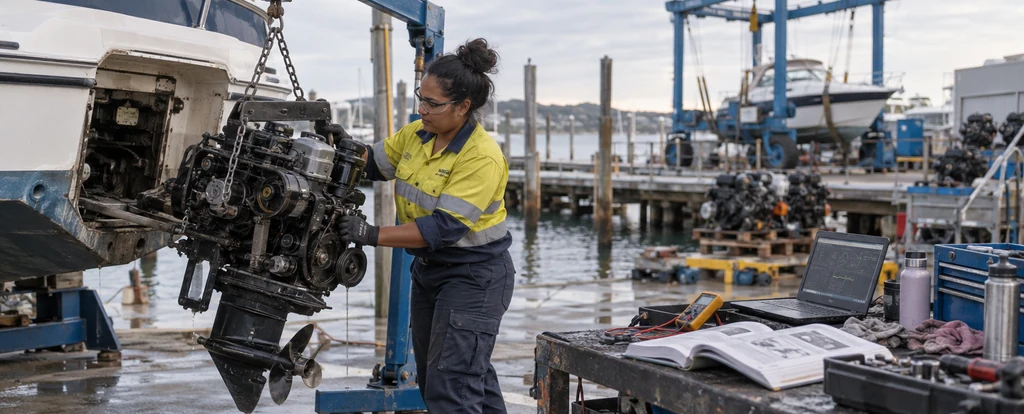
- Removing, refitting and aligning engines, drives and propellers, sometimes with a crane or hydraulic hoist
- Quoting repairs, ordering parts and keeping service records the owner can carry to the next workshop
What skills do marine mechanics need?
Employers look for installation and maintenance, plant and equipment operation, hand and power tool work, backed by Manufacturer diagnostic software (Mercury G3, Yamaha YDS) fluency and strong problem solving.
Specialist skills
- Installation and maintenance
- Plant and equipment operation
- Hand and power tool work
- Quoting and estimating
Software and tools
- Manufacturer diagnostic software (Mercury G3, Yamaha YDS)
- Digital multimeter
- Compression and leak-down testers
- Hydraulic engine hoist and lifting gear
- Marine parts and service catalogues
General skills
- Problem solving
- Attention to detail
- Customer service
- Safety and compliance awareness
Is the job growing?
About 1,500 people work as marine mechanics in Australia, and employment is projected to grow 2% over the decade to 2035. That's modest growth: demand is steady rather than booming.
How do you become a marine mechanic?
Here's the path most marine mechanics take, step by step.
- 1Start with a pre-apprenticeship or school-based traineeship
A Certificate II in Marine Mechanical Technology or an automotive pre-apprenticeship gives you workshop time before you commit, and it is usually how an employer first sees you. It is an introduction rather than the qualification itself.
- 2Complete a Certificate III in Marine Mechanical Technology
The trade qualification is normally done as a four-year apprenticeship, combining paid work in a workshop or marina with study at TAFE. It is the credential most employers ask for.
- 3Get a boat licence and take manufacturer training
Sea trials and vessel testing usually need a recreational boat licence. Branded courses from outboard and sterndrive makers such as Mercury, Yamaha and Volvo Penta let you work on newer engines, including warranty jobs.
- 4Choose a speciality
Marine electrical work, diesel inboards and high-horsepower outboards each build on the trade and give an employer a reason to pay more. Marine electrical skills are particularly sought after because those faults are slow to trace.
- 5Move into fleet work or go out on your own
After a few years, mechanics commonly join a commercial fishing, aquaculture or tourism fleet, take a dealership role, or start a mobile service. Each path changes the mix of warranty work, after-hours callouts and customer contact.
Ready to apply as a marine mechanic?
Whether you're working toward becoming a marine mechanic or already are one and want a hand with the next step (sharpening your resume for ATS screening, tightening your cover letter, or knowing what you'll actually be asked at interview), here are examples grounded in this specific role, not generic templates.
What jobs can a marine mechanic move to?
Moving into Auto Electrician typically comes with the biggest pay rise, worth $70,600 a year more on average.
| Move to | Typical pay change | Overlap | Retraining |
|---|---|---|---|
| Auto Electrician Marine electrical fault-finding, wiring and charging system repair skills carry into vehicle electrical work, though a separate electrical qualification is needed. | +$70,600 | 63% | reskill |
| Motor Mechanic Engine diagnosis, servicing and repair fundamentals transfer to cars and light vehicles, with retraining to cover road vehicle systems and standards. | +$8,900 | 55% | reskill |
| Diesel Mechanic Diesel engine, fuel system and drivetrain skills carry across to road transport and heavy plant, with some retraining for land-based equipment. | +$5,200 | 63% | reskill |
| Agricultural Mechanic Diesel and petrol engine repair experience transfers to tractors and farm machinery, with retraining in agricultural systems and hydraulics. | +$0 | 63% | reskill |
Moves are chosen from Jobs and Skills Australia's Data on Occupation Mobility, which follows income tax records between 2011-12 and 2020-21, together with entry requirements and skill overlap. A known move is one people were seen making in that data. Pay change compares median full-time pay for the two roles.
Who works as a marine mechanic?
The typical marine mechanic is 31 years old; 98% are men, 85% work full-time, and full-timers average 42 hours a week.
- 31
- Median age
- 2%
- Female share
- 85%
- Full-time
- +2h
- vs all-jobs avg
What's it like being a marine mechanic?
The work follows a season: spring and early summer bring a rush of servicing and pre-season repairs, then the holidays bring breakdowns that need same-day attention, often on a mooring or at the slipway. Winter is quieter and often goes to rebuilds, warranty jobs and stock. It suits someone who enjoys tracing a fault they cannot fully see, and who does not mind cramped engine bays, saltwater and an owner who wants the boat back by Friday.
What people like
- Every engine is a different puzzle. Outboards, stern drives and diesel inboards fail in their own ways, and a single day can mix mechanical, electrical and cooling faults.
- You get out on the water. Sea trials, test runs and servicing at a mooring break up the workshop week, which is part of why people stay in the trade.
- The skill travels. Boats need mechanics wherever there is coastline, from tourism operators and fishing fleets to aquaculture, and the experience carries interstate and overseas.
- A clear result at the end of the job. An engine that starts, idles and pulls cleanly under load is proof the diagnosis was right, and customers often say so directly.
What people find hard
- The pre-summer rush. Spring servicing and pre-season repairs stack into a few months, with long days and pressure to turn boats around before the holidays.
- Awkward places to work. Engines sit under floors, behind seats and below deck, so much of the job is done lying down and reaching into a space you can barely see.
- Saltwater and seized parts. Corrosion welds fasteners in place, and a straightforward job can turn into hours of freeing bolts, drilling and retapping.
- Waiting on parts and weather. Marine parts can be slow to arrive and the customer's deadline does not move with the freight schedule, while wind and rough water can cancel the sea trial needed to confirm a repair.
Based on our synthesis of professional-body surveys and public accounts of the role, not first-person verified reviews.
Which industries employ marine mechanics?
Boatbuilding and repair services employs the largest share of marine mechanics, followed by Marine equipment retailing.
Top employing industries
- 1Boatbuilding and repair services
- 2Marine equipment retailing
- 3Water transport support services
- 4Commercial fishing and aquaculture
- 5Recreational and tourism vessel operations
Ranked by employment share; the source doesn't publish an exact percentage per industry.
| Certificate III/IV | 34% | |
|---|---|---|
| Diploma / Advanced Diploma | 26% | |
| Bachelor degree | 20% | |
| Year 12 or below | 20% |
Will AI replace marine mechanics?
This is a moderately exposed trade. Diagnostic software, online parts catalogues and job management systems now do much of the preparation around a repair, but the work itself happens in awkward places on a wet boat, where someone has to reach in, free corroded fasteners and judge noise and vibration by feel. That keeps most of the day in human hands.
Share of typical working time by exposure level
- Servicing and mechanical repairOil, filters, impellers, gearboxes and cooling systems are done by hand in an engine bay or on a slipway, and getting to them is the slow part.35%low
- Quoting, parts ordering and service recordsCatalogues, online pricing and job management software now produce much of a quote and hold the service history, cutting the paperwork around each job.25%high
- Reading fault codes and running diagnostic softwareManufacturer software on Mercury, Yamaha and Volvo Penta engines narrows down where to look, but the reading still has to be checked against how the engine behaves under load.20%moderate
- Marine electrical and electronic system repairWiring, charging circuits and instrument faults can be mapped with a multimeter and wiring diagrams, though corroded terminals and hidden cable runs take time to trace.20%moderate
Moves least exposed to AI
These career moves from marine mechanic work are rated low for AI exposure:
- Auto Electrician
High skill overlap (63%), reskill to get there, and a low automation-risk profile.
- Agricultural Mechanic
High skill overlap (63%), reskill to get there, and a low automation-risk profile.
Common questions about becoming a marine mechanic
Straight answers to the questions people ask most.
How much do marine mechanics earn?
Full-time marine mechanics earn a median of $75,400 per year before tax, and that figure covers a wide spread from small hire operators to dealerships and commercial fleets. Overtime, after-hours callouts and specialist skills such as marine electrical work push earnings above the median.
How do you become a marine mechanic?
Most marine mechanics complete a Certificate III in Marine Mechanical Technology (AUR30520) as an apprenticeship, which takes about four years and is paid from the start. A pre-apprenticeship or a Certificate II gets you workshop time first, and a recreational boat licence helps if the job involves sea trials.
Are marine mechanics in demand?
Marine mechanics are currently not in shortage, and employment is projected to grow 2% over the decade to 2035. With about 1,500 people in the trade, openings come up as mechanics retire or move on, and they cluster around marinas, boatyards and coastal centres rather than being spread evenly.
Will AI replace marine mechanics?
Not the hands-on side of the work. Diagnostic software and online parts catalogues already speed up fault finding and quoting, but someone still has to reach into an engine bay, free a corroded bolt and judge whether a noise is the gearbox or a worn mount. Expect the tools to improve rather than the job to disappear.
What can marine mechanics move into?
The engine and fuel system skills carry across to diesel mechanic work, which pays $5,200 more, and to motor mechanic and small engine roles on land. Marine electrical fault-finding points toward auto electrician work, though that needs a separate electrical qualification. Many experienced mechanics end up running their own mobile service or joining a commercial fleet, and running your own business is often where earnings grow.
Do you need a licence to work as a marine mechanic?
There is no single national licence for the trade, so requirements vary by state and it is worth checking with the regulator where you plan to work. What most employers ask for is the trade qualification, and work on commercial vessels can bring extra requirements.
Related roles
- Diesel Mechanic
- Auto Electrician
- Motor Mechanic
- Agricultural Mechanic
- Small Engine Mechanic
- Mechanic's Assistant
Not sure this is you? Take the career quiz and get a ranked shortlist of roles that fit how you like to work.