Home Manufacturing & Production
Metal Polisher
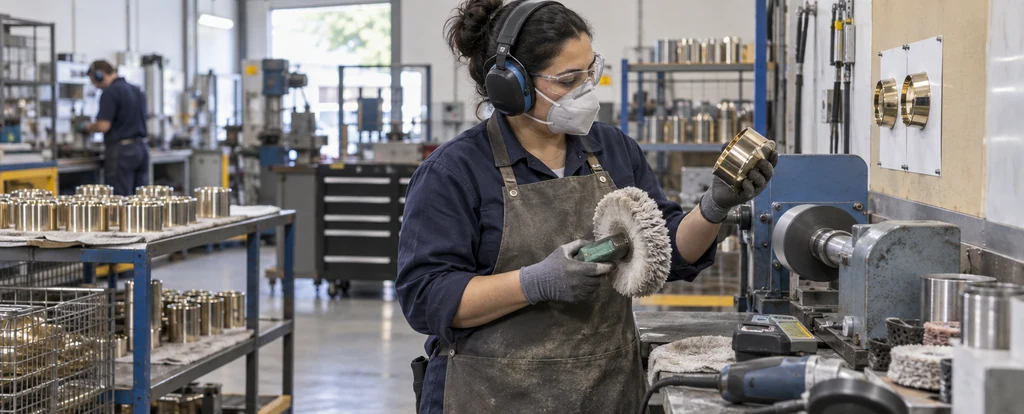
Metal polishers grind, buff and polish metal surfaces to a set finish, so components resist corrosion and meet the appearance a customer or a standard requires.
- Median salary*
- $65,000
4.5%vs last year, before tax
- People employed
- 350
16.7%vs last year
- Projected growth
- +4.8%
to 2035
- AI exposure*
- Moderate
- automation risk
- Average hours
- 41/wk
+1h vs all jobs
- Shortage status
- In shortage
national
Metal polishers work in fabrication workshops, foundries and manufacturing plants, finishing stainless steel, aluminium and cast components by hand and on polishing lathes. It is often the last step before a part is assembled, packed or installed, so the finish is what the customer sees. The role differs from metal fabrication and machining in that nothing is being cut to size: the shape is already there and the job is to bring the surface to a standard.
How much do metal polishers earn?
The median full-time salary for a metal polisher is $65,000 per annum, before tax, up $13,800 since 2018.
Most metal polishers are covered by the manufacturing award or a site enterprise agreement, so the base rate, overtime and shift loadings account for much of the difference between one job and the next. Employers pay more for high-spec finishing work, such as mirror finishes on food or pharmaceutical equipment, and for people who can set up and run the polishing equipment themselves. Whether the workshop does long production runs or one-off custom work matters more to your take-home pay than where it is.
What does a metal polisher do day to day?
The list below is what fills most weeks; the exact mix shifts with seniority and whatever stage the current work is at.
- Grinding and sanding surfaces to remove scratches, weld discolouration and casting marks
- Running polishing lathes, mops and belt grinders to bring parts up to a specified finish
- Matching abrasive grades and compounds to the metal, since stainless steel, aluminium and brass all cut differently
- Checking finished parts against a sample or specification, by eye and by touch, and reworking anything that fails
- Dressing wheels, changing mops and keeping dust extraction and respirators in working order
What skills do metal polishers need?
Employers look for craft and handmade production, hand and power tool work, plant and equipment operation, backed by Bench and pedestal polishing lathes fluency and strong attention to detail.
Specialist skills
- Craft and handmade production
- Hand and power tool work
- Plant and equipment operation
Software and tools
- Bench and pedestal polishing lathes
- Angle grinders and die grinders
- Buffing wheels and mops
- Abrasive and polishing compounds
- Surface roughness testers and micrometers
General skills
- Attention to detail
- Safety and compliance awareness
- Physical stamina and dexterity
- Problem solving
Is the job growing?
About 350 people work as metal polishers in Australia, and employment is projected to grow 4.8% over the decade to 2035. That's modest growth: demand is steady rather than booming.
How do you become a metal polisher?
Here's the path most metal polishers take, step by step.
- 1Start in a workshop
Many metal polishers come in as a trades assistant or production worker and learn the work at the bench, because polishing itself is taught on the job rather than through a dedicated apprenticeship. 66% of people in the role list Year 12 or below as their highest level of study, which reflects how much of it is learned at the bench rather than in a classroom.
- 2Add the trade qualification if you want to go further
A Certificate III in Engineering (Fabrication Trade) apprenticeship, usually three to four years and paid, covers the broader metal trades and keeps open the option of moving into fabrication, welding or sheet metal work later.
- 3Pick up short courses in surface finishing
TAFE and industry providers run short courses in abrasive selection, polishing technique and surface finishing that suit someone already working at the bench.
- 4Cover the site requirements
Polishing itself needs no licence, but workshops require an induction and PPE, and a White Card is needed if you work on construction sites. A forklift licence helps where you also move stock around.
- 5Specialise
Mirror finishing for food, dairy and pharmaceutical equipment, or restoration work on automotive and marine parts, is where the most skilled polishers end up and where the work stays varied.
Ready to apply as a metal polisher?
Whether you're working toward becoming a metal polisher or already are one and want a hand with the next step (sharpening your resume for ATS screening, tightening your cover letter, or knowing what you'll actually be asked at interview), here are examples grounded in this specific role, not generic templates.
What jobs can a metal polisher move to?
Moving into Metal Fabricator typically comes with the biggest pay rise, worth $22,800 a year more on average.
| Move to | Typical pay change | Overlap | Retraining |
|---|---|---|---|
| Metal Fabricator Metal polishers bring surface finishing and metal handling skills, but metal fabrication requires a separate apprenticeship and broader fabrication training. | +$22,800 | 20% | requalify |
| Welder Metal polishers bring metal preparation and finishing skills, but welding requires a separate apprenticeship and welding certification. | +$22,800 | 20% | requalify |
| Process Worker Metal polishers bring metal finishing and production experience, moving into process work with additional training.Known move | +$14,000 | 32% | reskill |
| Sheet Metal Worker Metal polishers bring metal finishing and hand tool skills, while sheet metal work requires an apprenticeship in forming and assembly. | +$6,800 | 20% | requalify |
Moves are chosen from Jobs and Skills Australia's Data on Occupation Mobility, which follows income tax records between 2011-12 and 2020-21, together with entry requirements and skill overlap. A known move is one people were seen making in that data. Pay change compares median full-time pay for the two roles.
Who works as a metal polisher?
The typical metal polisher is 47 years old; 96% are men, 82% work full-time, and full-timers average 41 hours a week.
- 47
- Median age
- 4%
- Female share
- 82%
- Full-time
- +1h
- vs all-jobs avg
What's it like being a metal polisher?
The rhythm of the job follows the workshop: parts arrive from welding, casting or machining, and the polisher works through them at a bench or lathe, checking each surface against a sample. Much of the day is physical and noisy, and the finish is judged by eye and hand, so patience and a good eye matter more than speed. People who like watching a rough casting leave as a finished component tend to take to it.
What people like
- You can see what you have done. Every part leaves the bench visibly better than it arrived, and a mirror finish is a clear end point rather than a judgement call about whether the job is complete.
- Different metals and shapes. Castings, stainless tube, sheet and machined parts all behave differently under the mop, so the work changes even when the product type does not.
- Focused, mostly solo work. Polishing is largely done at your own bench with the noise of the wheel around you, which suits people who prefer to get on with a job rather than talk through it.
- Craft that rests on your hands and eye. The skill shows in the finish, and experienced polishers are recognised for what they can rescue from a scratched or damaged part.
What people find hard
- Dust, noise and heat. Polishing throws fine metal dust and compound into the air, so a respirator and hearing protection are part of every shift, and parts get hot enough to burn a bare hand.
- Repetitive production runs. A contract for a few thousand identical brackets can mean the same sequence of grind, buff and check for weeks at a time.
- Finishes get rejected. A surface that looks fine to you can fail an inspector's standard or a customer's eye on reflected light, which sends the part back for rework.
- Load on the hands and shoulders. Standing all day with a grinder or holding a part against a spinning wheel builds up in the wrists, arms and back over a long career.
Based on our synthesis of professional-body surveys and public accounts of the role, not first-person verified reviews.
Which industries employ metal polishers?
Manufacturing employs the largest share of metal polishers, followed by Other Services.
Top employing industries
- 1Manufacturing
- 2Other Services
Ranked by employment share; the source doesn't publish an exact percentage per industry.
| Year 12 or below | 65.8% | |
|---|---|---|
| Certificate III/IV | 18% | |
| Bachelor degree | 5.5% | |
| Diploma / Advanced Diploma | 4.3% | |
| Postgraduate | 0% |
Will AI replace metal polishers?
Metal polishing is partly exposed: automated and robotic polishing cells now handle long runs of identical parts, particularly in larger plants, which takes away the most repetitive work first. The judgement parts of the job hold up better, because someone still sets up the wheels, picks the compound for each metal and decides when a surface is finished. One-off parts, repair jobs and irregular castings are where the trade stays busiest.
Share of typical working time by exposure level
- Hand finishing and blendingIrregular castings, repaired welds and one-off fabrications still come to a person with a die grinder and a mop, because the shape changes from part to part.30%low
- Polishing long production runsLarger plants run identical parts through robotic polishing cells and CNC finishing machines, though someone still loads the work and checks the first piece.25%high
- Setting up wheels, mops and compoundsChoosing abrasive grades and wheel speeds for each metal relies on experience, while software now logs settings and flags when a wheel needs dressing.25%moderate
- Judging when a surface is finishedAcceptance often turns on reflected light and the feel of the surface, which inspection cameras only partly assess on complex shapes.20%low
Moves least exposed to AI
These career moves from metal polisher work are rated low for AI exposure:
- Metal Fabricator
Some skill overlap (20%), requalify to get there, and a low automation-risk profile.
- Welder
Some skill overlap (20%), requalify to get there, and a low automation-risk profile.
Common questions about becoming a metal polisher
Straight answers to the questions people ask most.
How much do metal polishers earn?
Metal polishers earn a median of $65,000 per annum, before tax. That covers full-time workers across both production polishing and high-spec finishing work, and shift loadings, overtime and the award classification you sit on move it up or down.
How do you become a metal polisher?
Most people start as a trades assistant or production worker in a workshop and learn polishing on the job, because there is no dedicated apprenticeship for it. A Certificate III in Engineering (Fabrication Trade) apprenticeship is the way to add the broader metal trades qualification, which keeps the door open to fabrication or welding later.
Are metal polishers in demand?
Metal polishers are currently in shortage nationally, and employment is projected to grow 4.8% over the decade to 2035. With about 350 people in the role, openings come mostly from workers leaving the trade, so approaching fabrication and finishing shops directly is worth more than watching job boards.
Will AI or robots replace metal polishers?
Automation has already taken part of the work: robotic polishing cells and CNC finishing machines handle long runs of identical parts in larger plants, starting with the most repetitive jobs. They cope poorly with one-off parts, irregular castings and repair work, where someone still has to blend a weld or bring a scratched surface back by hand. Setting up the wheels and choosing compounds for each metal stay with the polisher.
What can a metal polisher move into?
Metal fabricators and welders earn $22,800 more than metal polishers, but each needs its own apprenticeship, so it is a requalification rather than a sideways step. Sheet metal work is closer to the bench and pays $6,800 more than polishing, with an apprenticeship in forming and assembly as the entry point. Moving into process work is the smallest step, using production experience and paying $14,000 more than polishing.
Do you need a qualification to work as a metal polisher?
No, polishing is not a licensed or regulated trade, and most people learn it on the job. Employers look for a steady hand, an eye for surface quality and a careful approach to safety, and many will train someone with workshop experience into the role.
Related roles
Not sure this is you? Take the career quiz and get a ranked shortlist of roles that fit how you like to work.