Musical Instrument Maker
Musical instrument makers build and repair guitars, violins, woodwinds and other instruments, shaping wood, metal and other materials into something a musician can play.
- Median salary*
- $65,000
3.5%vs last year, before tax
- People employed
- 830
3.8%vs last year
- Projected growth
- +8.3%
to 2035
- AI exposure*
- Low
- automation risk
- Average hours
- 45/wk
+5h vs all jobs
- Shortage status
- Not in shortage
national
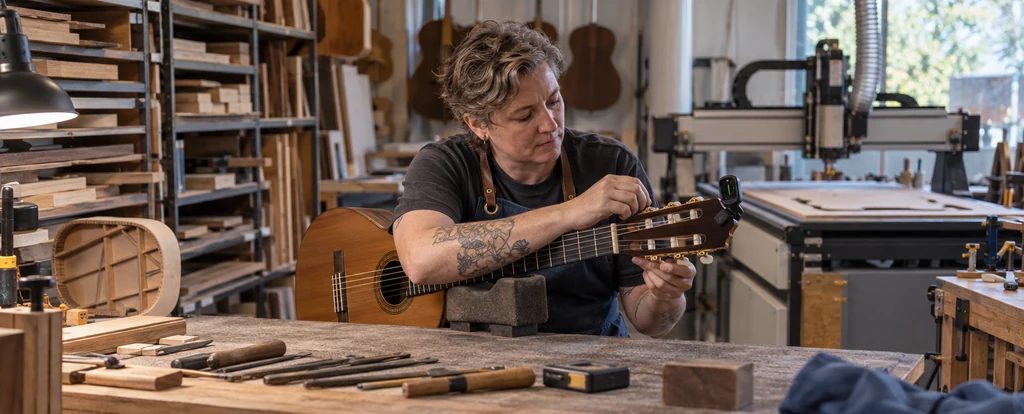
Most work at a bench in a small workshop, either their own or a manufacturer's, and the trade shares its hand skills with cabinet making and jewellery while adding acoustics, intonation and set-up. A single instrument can take weeks or months to build, and because musicians need their existing instruments kept playable, repair and restoration work fills a steady share of the week alongside new builds.
How much do musical instrument makers earn?
The median full-time salary for a musical instrument maker is $65,000 per annum, before tax, up $13,800 since 2018.
Pay depends heavily on whether you are employed in a workshop or selling your own instruments: manufacturing and retail roles sit under an award or enterprise agreement, while self-employed makers set a price per commission and carry the cost of materials until the instrument sells. Repair and restoration work usually brings steadier income than bespoke builds, which can take months to pay. Specialising in a niche, such as violin family instruments or early music, can lift what clients are willing to pay.
What does a musical instrument maker do day to day?
The list below is what fills most weeks; the exact mix shifts with seniority and whatever stage the current work is at.
- Selecting and seasoning tonewoods, metals and other materials for a build or a repair
- Shaping and joining components by hand and with power tools, working to fine tolerances
- Assembling and finishing instruments so they play in tune and feel right under the hand
- Repairing and restoring worn instruments, from crack repairs and fret work to full rebuilds
- Testing instruments with players and adjusting action, intonation and tone before they leave the bench
What skills do musical instrument makers need?
Employers look for craft and handmade production, hand and power tool work, fabrication and finishing, backed by Fusion 360 fluency and strong attention to detail.
Specialist skills
- Craft and handmade production
- Hand and power tool work
- Fabrication and finishing
- Engineering design and analysis
Software and tools
- Fusion 360
- AutoCAD
- CNC router
- Electronic tuner
- Moisture meter
General skills
- Attention to detail
- Problem solving
- Client relationships and advisory
- Written communication
Is the job growing?
About 830 people work as musical instrument makers in Australia, and employment is projected to grow 8.3% over the decade to 2035. That's modest growth: demand is steady rather than booming.
How do you become a musical instrument maker?
Here's the path most musical instrument makers take, step by step.
- 1Build your hand skills at school
Subjects such as design and technology, woodwork and music teach the bench habits and the ear the trade needs, and a school project instrument makes a reasonable first item for a portfolio.
- 2Take a certificate III or IV in musical instrument making and repair
Some TAFE colleges and specialist workshops offer these, usually over one to two years and sometimes part-time while you work. Availability differs by state, so check what your local provider runs before you enrol.
- 3Or start with an apprenticeship in cabinet making or furniture making
If there is no instrument-specific course nearby, an apprenticeship in the wood trades builds joinery, material knowledge and finishing skills that transfer, and you earn while you learn.
- 4Learn the repair and set-up side
Restrings, fret work, action adjustments and crack repairs are the work that pays between builds, so many makers take a short course in instrument repair or learn it on the job in a retail or repair workshop.
- 5Build a portfolio and work alongside an established maker
Employers and senior makers judge you on the instruments you have built and repaired, so keep that evidence together and approach a workshop for part-time or casual work as a way in.
Ready to apply as a musical instrument maker?
Whether you're working toward becoming a musical instrument maker or already are one and want a hand with the next step (sharpening your resume for ATS screening, tightening your cover letter, or knowing what you'll actually be asked at interview), here are examples grounded in this specific role, not generic templates.
What jobs can a musical instrument maker move to?
Moving into Special Effects Technician typically comes with the biggest pay rise, worth $23,400 a year more on average.
| Move to | Typical pay change | Overlap | Retraining |
|---|---|---|---|
| Special Effects Technician Instrument making's workshop craft, model making and mechanical assembly suit special effects fabrication, though retraining in effects techniques and safety is required. | +$23,400 | 43% | reskill |
| Orthotic and Prosthetic Technician The maker's fine hand fabrication, material shaping and finishing skills transfer to custom orthotic and prosthetic devices, with a short course in clinical methods. | +$7,800 | 71% | short course |
| Engraver A musical instrument maker's precision cutting and decorative finishing carry into hand engraving, with further training in engraving techniques and tool control. | +$0 | 27% | reskill |
| Piano Tuner A musical instrument maker's knowledge of instrument construction and acoustics supports piano tuning and servicing, though specialist tuning training is needed. | −$5,200 | 21% | reskill |
| Jeweller Fine metalwork, stone setting and hand finishing from instrument making support jewellery work, but a formal jewellery apprenticeship or equivalent is needed. | −$5,200 | 32% | requalify |
Moves are chosen from Jobs and Skills Australia's Data on Occupation Mobility, which follows income tax records between 2011-12 and 2020-21, together with entry requirements and skill overlap. A known move is one people were seen making in that data. Pay change compares median full-time pay for the two roles.
Who works as a musical instrument maker?
The typical musical instrument maker is 50 years old; 90% are men, 49% work full-time, and full-timers average 45 hours a week.
- 50
- Median age
- 10%
- Female share
- 49%
- Full-time
- +5h
- vs all-jobs avg
What's it like being a musical instrument maker?
The work suits someone who likes slow, precise craft, because an instrument can take weeks or months and progress is measured in small adjustments rather than finished jobs. Most of the week is spent at the bench with hand tools, and income is uneven: repair work arrives steadily enough to cover costs, while a bespoke build only pays when the instrument sells. The trade rewards patience and a willingness to redo a joint, a finish or a set-up that isn't right yet.
What people like
- Your work leaves the bench and gets played. A finished instrument goes out into lessons, gigs and orchestras, so you hear the result of the work rather than just seeing it shipped.
- Every instrument brings a different problem. Timber varies, players want different things, and one repair rarely repeats the last, so the work stays varied even after years at the bench.
- You control the whole build. A maker follows a job from material selection through to final set-up instead of repeating one step on a production line, which is where a lot of the satisfaction sits.
- Quiet, focused time with tools. Much of the day is spent alone with hand tools and a plan, with few of the interruptions that come with customer-facing work.
What people find hard
- Income is uneven. A bespoke build ties up materials and months of work before it sells, and repair jobs arrive in unpredictable batches, so planning around quiet months is part of running a workshop.
- Progress is slow. A violin or a guitar can take weeks, and a joint or a finish that isn't right has to be taken apart and redone, which tests anyone who likes to see a job finished.
- Dust, fumes and machine noise. Sanding, solvents and power tools are part of the day, so dust extraction, masks and hearing protection are standard equipment rather than optional.
- The market is small and personal. Most makers depend on a modest circle of repeat clients, music shops and schools, and finding the next customer takes time away from the bench.
Based on our synthesis of professional-body surveys and public accounts of the role, not first-person verified reviews.
Which industries employ musical instrument makers?
Other Services employs the largest share of musical instrument makers, followed by Manufacturing.
Top employing industries
- 1Other Services
- 2Manufacturing
- 3Retail Trade
Ranked by employment share; the source doesn't publish an exact percentage per industry.
| Year 12 or below | 28.4% | |
|---|---|---|
| Certificate III/IV | 28.1% | |
| Bachelor degree | 16.4% | |
| Diploma / Advanced Diploma | 15.6% | |
| Postgraduate | 7.2% |
Will AI replace musical instrument makers?
Musical instrument making has low exposure to AI and automation because the core work is physical: shaping, voicing and finishing an instrument by hand in response to how a particular piece of timber behaves. CAD software and CNC routers are already in use for drawing plans and cutting templates and inlays, which speeds up the repeatable parts of a build, but they cannot voice a soundboard or judge how an instrument plays. Repair and restoration, which depends on assessing each instrument individually, stays with the maker.
Share of typical working time by exposure level
- Shaping, bending and joining partsBending sides, carving braces and cutting joints depend on feel and on how each piece of timber responds, so this stays by hand.35%low
- Finishing, tuning and voicingSanding, polishing and adjusting a bridge or soundpost to change the tone are judged by ear and touch, and small changes shift the sound in ways software cannot predict.30%low
- Repair, restoration and talking with clientsDiagnosing a crack, a warped neck or a sticking tuning peg means inspecting the instrument in person and agreeing with the owner on what the repair should achieve.20%low
- Drawing plans and cutting templates and inlaysCAD and a CNC router can produce accurate templates and decorative inlay pieces, which saves time on repeated shapes, though a maker still sets the tool paths and checks every cut against the design.15%moderate
Common questions about becoming a musical instrument maker
Straight answers to the questions people ask most.
How much do musical instrument makers earn?
Musical instrument makers earn a median of $65,000 per year before tax. What moves that figure is whether you are paid a wage in a workshop or sell your own instruments, since repair work brings steadier money than bespoke builds that only pay on sale.
How do you become a musical instrument maker?
There is no single required qualification, but a certificate III or IV in musical instrument making and repair, offered by some TAFE colleges and specialist workshops, covers the fundamentals. Many makers start with an apprenticeship in cabinet making or furniture making instead, then learn instrument work on the job or through a short course. Employers and senior makers want to see instruments you have built and repaired, so keep the pieces you make.
Are musical instrument makers in demand?
Musical instrument makers are currently not in shortage, and employment is projected to grow 8.3% over the decade to 2035. The occupation is small, with about 830 people working in it, so openings often come from makers retiring or leaving the trade rather than from new positions. Repair and maintenance work for schools, music shops and orchestras is usually the most reliable source of ongoing jobs.
Will AI take over musical instrument making?
Not much of it, because shaping, voicing and finishing are physical and judged by ear and hand. CAD software and CNC routers already handle plans, templates and inlays, speeding up repetitive cutting without deciding how an instrument should sound. Repair work, which means assessing each instrument in person, is the least exposed part of the job.
Where can musical instrument making lead?
The fine fabrication and finishing skills carry into nearby trades: orthotic and prosthetic technicians make custom devices from similar materials and pay $7,800 more, while piano tuning draws on the same knowledge of acoustics but needs specialist tuning training. Special effects technicians earn $23,400 more for workshop model making and mechanical assembly. Many makers eventually run their own workshop or take commissions directly, which is often where earnings grow.
How many hours do musical instrument makers work?
Full-time musical instrument makers average about 45 hours a week, and self-employed makers often work longer when a build is close to finished or a deadline is near. Workshop employment is usually closer to standard hours.
Related roles
- Piano Tuner
- Orthotic and Prosthetic Technician
- Special Effects Technician
- Engraver
- Jeweller
- Cabinet Maker
Not sure this is you? Take the career quiz and get a ranked shortlist of roles that fit how you like to work.