Plumber's Assistant
Plumber's assistants work alongside qualified plumbers, preparing sites, handling tools and materials, and doing the basic pipe work that keeps a job moving.
- Median salary*
- $52,000
3.6%vs last year, before tax
- People employed
- 1,600
0.0%vs last year
- Projected growth
- +6.4%
to 2035
- AI exposure*
- Low
- automation risk
- Average hours
- 41/wk
+1h vs all jobs
- Shortage status*
- Not in shortage
national
Plumber's assistants work on residential and commercial building sites, in maintenance work and in people's homes, usually as part of a small crew led by a licensed plumber. The role is a support one: they measure, cut, lift and prepare while the plumber makes the decisions and signs off on the finished work. It is often how people get their first paid experience of the trade before starting an apprenticeship.
How much do plumber's assistants earn?
The median full-time salary for a plumber's assistant is $52,000 per annum, before tax, up $10,700 since 2018.
Pay for plumber's assistants usually follows the Plumbing and Fire Sprinklers Award or a site enterprise agreement, and rates are lowest while you are still learning the basics. Junior rates apply to workers under 21, and emergency callouts after hours normally attract penalty rates. Once you begin an apprenticeship, pay moves onto the apprentice scale for your year and rises each year you progress.
What does a plumber's assistant do day to day?
The list below is what fills most weeks; the exact mix shifts with seniority and whatever stage the current work is at.
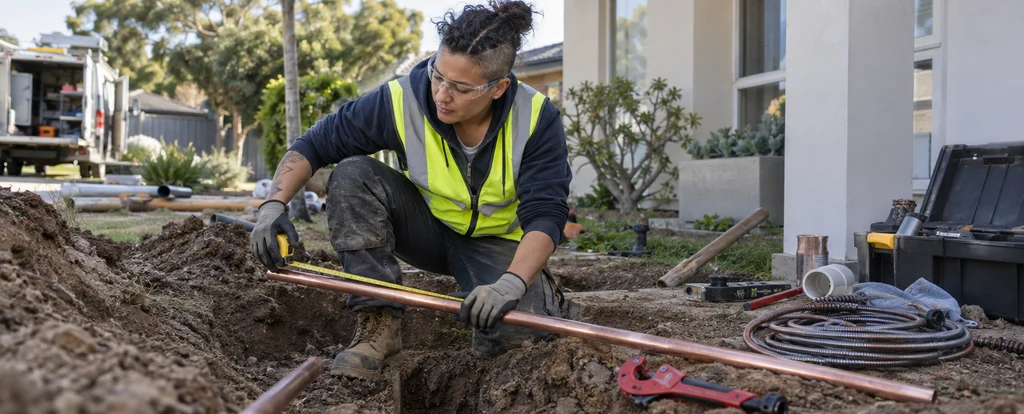
- Measuring and cutting copper, PVC and other pipe to length so the plumber can fit it without stopping
- Assembling and sealing joints with solvent cement or a soldering torch, under supervision
- Clearing blocked drains and sewer lines with a drain snake and hand tools
- Digging and backfilling trenches for underground pipe runs
- Carrying tools and materials to the work area and keeping the site clean and safe
What skills do plumber's assistants need?
Employers look for hand and power tool work, installation and maintenance, worksite safety management, backed by Pipe wrenches fluency and strong physical stamina and dexterity.
Specialist skills
- Hand and power tool work
- Installation and maintenance
- Worksite safety management
- Reading plans and specifications
Software and tools
- Pipe wrenches
- Drain snakes
- Power drills
- Pipe cutters
- Safety goggles
General skills
- Physical stamina and dexterity
- Attention to detail
- Problem solving
- Written communication
Is the job growing?
About 1,600 people work as plumber's assistants in Australia, and employment is projected to grow 6.4% over the decade to 2035. That's modest growth: demand is steady rather than booming.
How do you become a plumber's assistant?
Here's the path most plumber's assistants take, step by step.
- 1Get a start on site
No formal qualification is needed to begin as a plumber's assistant, but you need a White Card, the general construction induction card required on construction sites, which takes a short course. Most employers also want a driver's licence, because the work moves between jobs through the day.
- 2Build the practical basics
Learn the pipe types, tools and jointing methods used on the jobs you attend, and ask the plumber you work with about the parts of the job you have not done yet. A Certificate II in Plumbing (52946WA) pre-apprenticeship at TAFE covers the same ground formally and can count toward an apprenticeship later.
- 3Start a plumbing apprenticeship
The Certificate III in Plumbing (CPC32420) is a four-year apprenticeship that combines paid on-the-job training with TAFE, and it is the qualification that leads to a plumbing licence. A plumber who has watched you work is well placed to take you on, which is why assisting and pre-apprenticeship experience help.
- 4Get registered or licensed in your state
Plumbers must be registered or licensed with the plumbing regulator in their state or territory, and some states issue a provisional licence so you can keep working under supervision while you finish your training. Requirements and the name of the licence differ between states, so check with your local regulator.
Ready to apply as a plumber's assistant?
Whether you're working toward becoming a plumber's assistant or already are one and want a hand with the next step (sharpening your resume for ATS screening, tightening your cover letter, or knowing what you'll actually be asked at interview), here are examples grounded in this specific role, not generic templates.
What jobs can a plumber's assistant move to?
Moving into Plumber typically comes with the biggest pay rise, worth $51,500 a year more on average.
| Move to | Typical pay change | Overlap | Retraining |
|---|---|---|---|
| Plumber Assistants already handle pipes and tools on site, so an apprenticeship builds their practical knowledge into full plumbing qualifications.Known move | +$51,500 | 74% | requalify |
| Pipelayer Laying pipes and trench work overlap with pipelaying, and a short course covers the specific certification.Known move | +$26,000 | 74% | short course |
| Home Improvement Installer Installing home fixtures uses similar plumbing and tool skills, with a short course covering the specialist installation methods. | +$15,600 | 82% | short course |
| Builder's Labourer Site preparation and tool skills carry across to general building labouring, though the work shifts to broader construction tasks.Known move | +$13,000 | 40% | reskill |
Moves are chosen from Jobs and Skills Australia's Data on Occupation Mobility, which follows income tax records between 2011-12 and 2020-21, together with entry requirements and skill overlap. A known move is one people were seen making in that data. Pay change compares median full-time pay for the two roles.
Who works as a plumber's assistant?
The typical plumber's assistant is 29 years old; 94% are men, 65% work full-time, and full-timers average 41 hours a week.
- 29
- Median age
- 6%
- Female share
- 65%
- Full-time
- +1h
- vs all-jobs avg
What's it like being a plumber's assistant?
The day starts early and is spent on your feet, moving between sites or between jobs in a van. The work is physical and often dirty, in trenches, subfloors and roof spaces, and it continues in most weather. It suits people who want to learn a trade by doing it and who are comfortable taking instructions while they build up the skills to work independently.
What people like
- You learn the trade from the inside. Assisting puts you on real jobs from the first week, watching how a licensed plumber traces a leak or plans a pipe run rather than reading about it.
- The results are visible. Pipe that runs straight, joints that hold, a drain that flows again: you can see by the end of the day what the crew has done.
- It opens the door to an apprenticeship. A plumber who has seen you turn up and work is in a good position to take you on, so the job puts you close to the decision when an apprenticeship place comes up.
- No two jobs are the same. One day a new build, the next a blocked sewer at a rental, the next a bathroom renovation, so the setting and the problem change constantly.
What people find hard
- Hard on the body. Digging trenches, lifting pipe and kneeling in subfloors take a toll, and you are on your feet for most of the day.
- The decisions are not yours. You do the preparation and the basic work while the licensed plumber decides how a job will be done and takes responsibility for it, which can wear thin once you know what you are doing.
- Weather and delays. Rain stops outdoor work, and waiting on materials, other trades or an inspection can leave you standing around on site.
- The carrying and the clean-up. Fetching materials, sweeping and tidying up is a genuine part of the job, and on some days it is most of what you do.
Based on our synthesis of professional-body surveys and public accounts of the role, not first-person verified reviews.
Which industries employ plumber's assistants?
Construction employs the largest share of plumber's assistants.
Top employing industries
- 1Construction
Ranked by employment share; the source doesn't publish an exact percentage per industry.
| Year 12 or below | 61.1% | |
|---|---|---|
| Certificate III/IV | 26.6% | |
| Diploma / Advanced Diploma | 5.2% | |
| Bachelor degree | 3.4% | |
| Postgraduate | 0.5% |
Will AI replace plumber's assistants?
This is hands-on work in unpredictable spaces, so AI and automation reach only the edges of the job. Drain cameras, jetting equipment and laser levels help locate problems and set out pipe runs, and scheduling apps organise the day, but cutting, fitting, digging and sealing still happen by hand. What changes is the diagnosis and the paperwork around a job, not the work itself.
Share of typical working time by exposure level
- Cutting and fitting pipeMeasuring copper or PVC to length and dry-fitting it is done by eye on site, because every subfloor and wall cavity has its own obstacles.35%low
- Joining and sealing pipeworkSoldered and solvent-welded joints depend on clean surfaces and the feel of the torch or cement, which is judged on the spot.25%low
- Clearing blocked drainsA drain camera can show where the blockage is, but feeding the snake or jetter through the line and cleaning up afterwards is still manual work.20%moderate
- Trenching and site set-outExcavators and laser levels do more of the digging and levelling, though the assistant still works carefully by hand around existing services.20%moderate
Common questions about becoming a plumber's assistant
Straight answers to the questions people ask most.
How much do plumber's assistants earn?
Plumber's assistants earn a median of $52,000 per year before tax, and entry-level rates sit below that until you have some experience. Pay is set by the Plumbing and Fire Sprinklers Award or a site agreement, with junior rates for workers under 21 and penalty rates for after-hours emergency work.
How do you become a plumber's assistant?
You can start without a qualification, but you need a White Card to work on construction sites and most employers ask for a driver's licence. A Certificate II in Plumbing (52946WA) pre-apprenticeship is worth doing if you can, because it teaches the basics and counts toward the apprenticeship that follows.
Are plumber's assistants in demand?
Plumber's assistants are currently not in shortage, and employment is projected to grow 6.4% over the decade to 2035. About 1,600 people work in the role, so openings tend to come from individual plumbers and builders taking on help rather than from large hiring drives.
Will AI replace plumber's assistants?
The hands-on parts of the job are difficult to automate, so AI mainly changes the tools around the work. Drain cameras, jetting machines and laser levels help find and set out problems, and scheduling software organises the day, but pipe still has to be cut, fitted and sealed by hand.
What can a plumber's assistant move on to?
The main move is into a plumbing apprenticeship, since assisting already covers pipes, tools and site work, and licensed plumbers earn $51,500 more. Pipelaying is a shorter step that shares the trench and pipe work, with pay of $26,000 more. The usual route to running your own business goes through a plumbing licence, and licensed plumbers who start their own business often earn more than they did on wages.
Do plumber's assistants need a licence?
No, you work under the supervision of a licensed plumber, and only that plumber can carry out regulated plumbing work and certify it. What an assistant may do without direct supervision varies by state, so check with your local plumbing regulator.
Related roles
Not sure this is you? Take the career quiz and get a ranked shortlist of roles that fit how you like to work.