Service Station Attendant
Service station attendants serve customers, sell fuel and shop items and keep the forecourt clean and safe.
- Median salary
- $64,100
4.6%vs last year, before tax
- People employed
- 13,300
0.8%vs last year
- Projected growth
- +6.6%
to 2035
- AI exposure*
- Moderate
- automation risk
- Average hours
- 41/wk
+1h vs all jobs
- Shortage status*
- Not in shortage
national
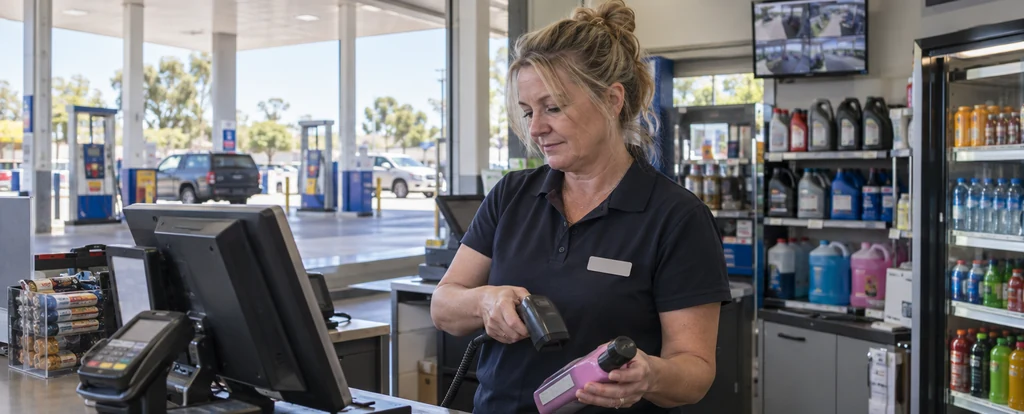
Service station attendants work across the forecourt and the shop of a fuel retail site, which separates the job from ordinary retail work: a shift moves between fuel sales, counter service and safety checks on the pumps. Most sites trade long hours, so nights, weekends and public holidays sit on the roster, and quieter shifts are often worked alone. Fuel handling and spill procedures are part of the job from day one, whatever else the site sells.
How much do service station attendants earn?
The median full-time salary for a service station attendant is $64,100 per annum, before tax, up $13,600 since 2018.
The roster affects take-home pay more than anything else, because night, weekend and public holiday shifts attract penalty rates, so two attendants at the same site can earn quite different amounts. Rates come from the award or enterprise agreement covering the site, and these vary between operators. Larger highway sites and those with a food or convenience franchise often pay above the minimum, and second-in-charge or site manager roles pay more again.
What does a service station attendant do day to day?
The list below is what fills most weeks; the exact mix shifts with seniority and whatever stage the current work is at.
- Processing fuel sales at the console and taking payment for fuel and shop purchases
- Serving customers at the counter and answering questions about products, fuel and directions
- Restocking shelves, drink fridges and automotive items such as oil and screen wash
- Cleaning and checking bowsers, forecourt equipment and fuel spill kits
- Completing till reconciliation, fuel dip readings and site security checks
What skills do service station attendants need?
Employers look for inventory management, cleaning and grounds maintenance, operations management, backed by Gilbarco Passport point-of-sale fluency and strong customer service.
Specialist skills
- Inventory management
- Cleaning and grounds maintenance
- Operations management
Software and tools
- Gilbarco Passport point-of-sale
- Verifone Commander console
- EFTPOS terminals
- Veeder-Root tank gauge
- CCTV and site monitoring systems
General skills
- Customer service
- Attention to detail
- Safety and compliance awareness
- Written communication
Is the job growing?
About 13,300 people work as service station attendants in Australia, and employment is projected to grow 6.6% over the decade to 2035. That's modest growth: demand is steady rather than booming.
How do you become a service station attendant?
Here's the path most service station attendants take, step by step.
- 1Check what the job needs
There is no required qualification. Employers look for people who can handle cash accurately, follow safety procedures and commit to a shift roster, and a driver licence helps for sites with limited public transport.
- 2Apply to the operator or franchisee
Most sites are run by fuel retailers or franchisees, and jobs are advertised online, on the company website and on the site itself. A short resume listing customer service, cash handling or shift work experience is usually enough to get an interview.
- 3Complete induction and on-site training
You learn the point-of-sale and console system, fuel handling, spill response and emergency procedures on the job, usually across your first few shifts. If the site sells takeaway food, food safety training is added.
- 4Add a retail qualification when you want to move up
A Certificate II or III in Retail, or a short course in frontline management, supports a move into supervision or site management. These are usually studied part time while you keep working.
Ready to apply as a service station attendant?
Whether you're working toward becoming a service station attendant or already are one and want a hand with the next step (sharpening your resume for ATS screening, tightening your cover letter, or knowing what you'll actually be asked at interview), here are examples grounded in this specific role, not generic templates.
What jobs can a service station attendant move to?
Moving into Store Manager typically comes with the biggest pay rise, worth $20,100 a year more on average.
| Move to | Typical pay change | Overlap | Retraining |
|---|---|---|---|
| Store Manager Service station attendants bring retail and cash handling experience to store manager roles, though management training is needed.Known move | +$20,100 | 17% | reskill |
| Retail Supervisor Service station attendants bring shop and cash handling experience to retail supervisor roles, with a short course building supervisory skills. | +$1,800 | 50% | short course |
| Retail Assistant Service station attendants bring shop floor and customer service experience to retail assistant roles, with further retail training needed.Known move | +$400 | 26% | reskill |
| Checkout Operator Service station attendants bring cash handling and customer service to checkout work, though further retail training is needed.Known move | −$8,100 | 16% | reskill |
Moves are chosen from Jobs and Skills Australia's Data on Occupation Mobility, which follows income tax records between 2011-12 and 2020-21, together with entry requirements and skill overlap. A known move is one people were seen making in that data. Pay change compares median full-time pay for the two roles.
Who works as a service station attendant?
The typical service station attendant is 35 years old; 53% are men, 43% work full-time, and full-timers average 41 hours a week.
- 35
- Median age
- 47%
- Female share
- 43%
- Full-time
- +1h
- vs all-jobs avg
What's it like being a service station attendant?
The job runs on a roster rather than a fixed week, built around busy commuter periods and the quiet hours in between. A shift mixes counter work with forecourt cleaning, stock and safety checks, often with one person on site, so you set the pace until a tanker arrives or a pump fails. It suits people who are steady, comfortable working alone and happy to spend the shift on their feet.
What people like
- Quiet shifts leave you to work your own way. Between the rush periods there is no one watching over your shoulder, and you can work through cleaning, stock and the daily checks at a sensible pace.
- You can start earning within days. Training on the console, fuel safety and spill procedures takes a handful of shifts, so this is one of the quicker entry points into paid work.
- Shift patterns can fit around other commitments. Nights and weekends are always needed, which suits students, carers and anyone fitting work around daytime study or family.
- You see how a whole site runs. Fuel deliveries, tank readings, security, stock and retail sales all pass through your shift, which is useful groundwork if you want to move into supervision.
What people find hard
- Nights and public holidays are part of the deal. The roster follows the site's trading hours rather than the calendar, so Christmas, weekends and overnight shifts come around regularly.
- Sole charge means no backup. On quiet shifts you handle a spill, a faulty pump or a difficult customer on your own until help arrives.
- Forecourt work means weather. Cleaning bowsers and the apron happens in summer heat, winter rain and everything between, and the shift is spent mostly standing.
- Busy periods stack up. When a fuel delivery arrives during the commuter rush, the forecourt and the counter both need attention at once.
Based on our synthesis of professional-body surveys and public accounts of the role, not first-person verified reviews.
Which industries employ service station attendants?
Retail Trade employs the largest share of service station attendants.
Top employing industries
- 1Retail Trade
Ranked by employment share; the source doesn't publish an exact percentage per industry.
| Year 12 or below | 50.6% | |
|---|---|---|
| Postgraduate | 13.5% | |
| Bachelor degree | 13.4% | |
| Certificate III/IV | 12% | |
| Diploma / Advanced Diploma | 6.6% |
Will AI replace service station attendants?
Exposure is moderate. Automated tank gauges, self-serve payment and stock systems have taken over the routine recording and simple transactions, and CCTV covers much of the site monitoring. What is left is physical and face to face: cleaning the forecourt, handling spills and dealing with customers and equipment faults on the spot.
Share of typical working time by exposure level
- Cleaning the forecourt and equipmentBowsers, spill kits and the apron need a person with gloves, a hose and a spill procedure, and no system does that work.30%low
- Operating the console and processing paymentsPay-at-pump terminals and self-serve checkouts now handle many transactions, though someone still has to fix faults, change prices and take cash.25%high
- Serving customers and handling problemsDirections, complaints, a spill or a pump that will not start all need someone on site who can read the situation and decide.25%low
- Restocking shelves and drink fridgesAutomatic reordering flags what is running low, but lifting, rotating stock and filling fridges stays manual.20%moderate
Common questions about becoming a service station attendant
Straight answers to the questions people ask most.
How much do service station attendants earn?
Full-time service station attendants earn $64,100 per year before tax, and that median covers sites with very different rosters and agreements. Penalty rates for nights, weekends and public holidays are the main reason pay varies between people doing the same job.
How do you become a service station attendant?
There is no qualification required to start. Operators advertise online and on site, and train new staff on the console, fuel safety and spill procedures during their first shifts, so reliability and cash handling matter more than study. A Certificate II or III in Retail helps later if you want to move into supervision.
Are service station attendants in demand?
Service station attendants are currently not in shortage. Employment is projected to grow 6.6% over the decade to 2035, and most openings come from staff turnover rather than new sites, so hiring continues through the year. Being available for nights and weekends makes it easier to be taken on.
Will AI replace service station attendants?
Automated tank gauges, self-serve payment and stock systems have already absorbed some routine work, which is why exposure here is moderate rather than low. Cleaning the forecourt, responding to a spill and sorting out problems at the counter still need someone on site.
What can service station attendants move into?
Store manager is the bigger step and pays $20,100 more than this role, using the same retail and cash handling experience, though it needs management training. Retail supervisor is closer to the floor at $1,800 more, and a short course in supervision is usually what gets you there. Moving across to general retail is also common for attendants who want a standard daytime roster.
What are the hours like?
Many sites trade 24 hours, so rosters include nights, weekends and public holidays, and quieter shifts are often worked alone. Full-time attendants average around 41 hours a week.
Related roles
Not sure this is you? Take the career quiz and get a ranked shortlist of roles that fit how you like to work.