Test and Tag Technician
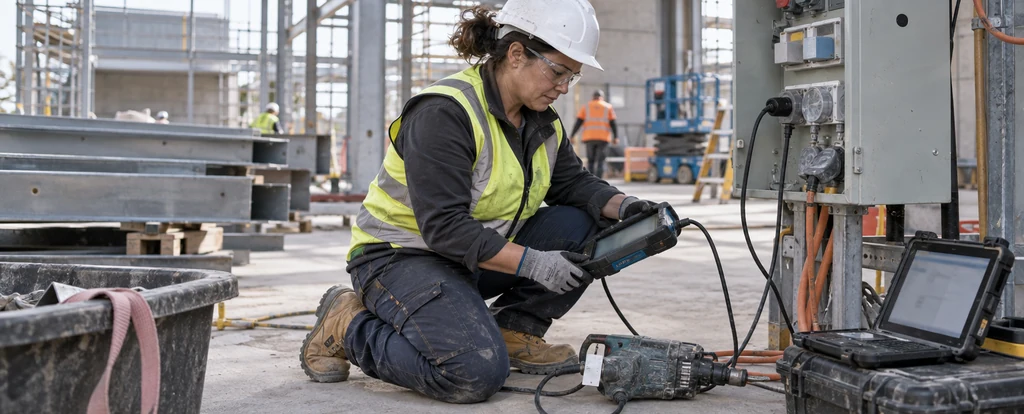
Test and tag technicians test portable electrical appliances such as power tools, leads and kitchen equipment, label the ones that pass and take the faulty ones out of use.
- Median salary*
- $65,000
4.3%vs last year, before tax
- People employed*
- 6,000
0.0%vs last year
- Projected growth*
- +4%
to 2035
- AI exposure*
- Moderate
- automation risk
- Average hours*
- 38/wk
−2h vs all jobs
- Shortage status*
- Not in shortage
national
They work on site across construction, manufacturing, hospitality, retail and health care, testing anything that plugs in rather than the fixed wiring of the building. Most arrive as a van-based technician, either employed by an electrical contractor or facilities company or running their own round of regular clients. The person doing the work has to be trained and competent to do it, and how that is regulated differs between states.
How much do test and tag technicians earn?
The median full-time salary for a test and tag technician is $65,000 per annum, before tax, up $13,700 since 2018.
How you are paid shapes the figure more than almost anything else in this job. Employees usually fall under the Electrical, Electronic and Communications Contracting Award or a state equivalent, which sets minimum rates and penalty loadings, while technicians who run their own round charge per item or per site and earn according to how much work they book. Site access, travel between jobs and whether you specialise in construction, mining or hospitality all move it as well.
What does a test and tag technician do day to day?
The list below is what fills most weeks; the exact mix shifts with seniority and whatever stage the current work is at.
- Inspecting appliances and leads for damage, wear and missing parts
- Testing earth continuity, insulation resistance and polarity with a portable appliance tester
- Attaching a durable tag showing the test date and the date the next test is due
- Recording each result in an asset register or test and tag software
- Telling the site contact which items failed and should be taken out of service
What skills do test and tag technicians need?
Employers look for field inspection and testing, plant and equipment operation, regulatory compliance, backed by Portable appliance tester fluency and strong safety and compliance awareness.
Specialist skills
- Field inspection and testing
- Plant and equipment operation
- Regulatory compliance
Software and tools
- Portable appliance tester
- Insulation resistance tester
- Test and tag software (e.g., PATGuard, TestTagPro)
- Multimeter
- Asset register or CMMS
General skills
- Safety and compliance awareness
- Attention to detail
- Problem solving
- Customer service
Is the job growing?
About 6,000 people work as test and tag technicians in Australia, and employment is projected to grow 4% over the decade to 2035. That's modest growth: demand is steady rather than booming.
How do you become a test and tag technician?
Here's the path most test and tag technicians take, step by step.
- 1Complete the test and tag unit of competency
The nationally recognised unit UEERL0003 Conduct in-service safety testing of electrical cord connected equipment and cord assemblies is delivered by registered training organisations, often as a day or two of training or a short course with a practical assessment. Without it you are not considered competent to do the work, and clients increasingly ask to see the statement of attainment.
- 2Get a White Card if you want construction sites
A general construction induction card is required to work on building sites in every state, and it takes about a day. The course itself is short but it opens up the largest single source of test and tag work.
- 3Learn your tester and tagging software on the job
A portable appliance tester handles the electrical checks, but the record keeping is what clients pay for: asset registers, retest schedules and reports. Most technicians pick this up in their first few months, and it is the part that turns a one-off visit into a regular contract.
- 4Choose employed work or your own round
Electrical contractors, facilities maintenance firms and equipment hire companies employ technicians, which suits people who want steady hours and set pay. Others buy a tester, tags and a van and build a client list, which pays better once the round is full but starts slowly.
- 5Extend into higher-level inspection work
Further study opens the better-paid end of the field: a Certificate III in Electrotechnology through an apprenticeship if you want to work on fixed wiring, or short courses in calibration, non-destructive testing or asset inspection to move into testing of larger equipment.
Ready to apply as a test and tag technician?
Whether you're working toward becoming a test and tag technician or already are one and want a hand with the next step (sharpening your resume for ATS screening, tightening your cover letter, or knowing what you'll actually be asked at interview), here are examples grounded in this specific role, not generic templates.
What jobs can a test and tag technician move to?
Moving into Welding Inspector typically comes with the biggest pay rise, worth $39,000 a year more on average.
| Move to | Typical pay change | Overlap | Retraining |
|---|---|---|---|
| Welding Inspector Experience testing electrical equipment applies to checking welding quality, with a short course in welding inspection. | +$39,000 | 53% | short course |
| Electrical Asset Inspector Test and tag technicians bring electrical safety testing experience to inspecting larger assets, with a short course covering asset inspection. | +$36,400 | 50% | short course |
| Non-destructive Testing Technician Inspection and testing methods carry over to non-destructive testing of materials, with a short course in NDT techniques. | +$36,400 | 71% | short course |
| Train Examiner Safety inspection skills transfer to examining trains, with a short course covering rail systems. | +$33,800 | 71% | short course |
| Calibration Technician Testing and measurement skills transfer directly to calibrating instruments, with a short course to cover calibration standards. | +$10,400 | 65% | short course |
Moves are chosen from Jobs and Skills Australia's Data on Occupation Mobility, which follows income tax records between 2011-12 and 2020-21, together with entry requirements and skill overlap. A known move is one people were seen making in that data. Pay change compares median full-time pay for the two roles.
Who works as a test and tag technician?
The typical test and tag technician is 35 years old; 94% are men, 65% work full-time, and full-timers average 38 hours a week.
- 35
- Median age
- 6%
- Female share
- 65%
- Full-time
- −2h
- vs all-jobs avg
What's it like being a test and tag technician?
The work has a steady, repetitive rhythm to it: some days are long runs of the same lead or drill in a warehouse, others are short visits spread across town. It suits someone who is methodical, comfortable working alone for most of the day and happy to solve the practical problem of getting access to equipment. The results are clear and immediate, which is a large part of why people stay with it.
What people like
- Steady demand for the work. Electrical safety testing is required for most workplaces under work health and safety rules and the Australian standard, so the work tends to keep coming rather than rising and falling with one industry.
- Results you can see. An appliance passes or fails, and at the end of the day the tags on the board show what you got through. There is not much ambiguity to carry home.
- Working on your own terms. Many technicians run a van and set their own route and hours, and the job itself is done mostly without supervision once your competence is established.
- Sites you would not otherwise see. The round takes you through breweries, schools, mine sites, cafes and workshops, so the setting changes even when the testing routine does not.
What people find hard
- The repetition is real. A large site can mean row after row of identical extension leads and power tools, and the test you do on the four hundredth one is exactly the test you did on the first.
- Travel and waiting time. Technicians spend a lot of the week on the road between sites, and arriving to find equipment locked away or a contact who has forgotten you were coming is a common frustration.
- Someone else's record keeping. When there is no asset register or the tags have fallen off, you are the one rebuilding the list before you can start testing, and that time is rarely billed.
- A ceiling on hourly earnings. Award-based pay climbs slowly, so the financial step up usually comes from taking on larger assets, moving into inspection work or running your own round rather than from staying on the tools alone.
Based on our synthesis of professional-body surveys and public accounts of the role, not first-person verified reviews.
Which industries employ test and tag technicians?
Construction employs the largest share of test and tag technicians, followed by Manufacturing.
Top employing industries
- 1Construction
- 2Manufacturing
- 3Retail Trade
- 4Accommodation and Food Services
- 5Health Care and Social Assistance
Ranked by employment share; the source doesn't publish an exact percentage per industry.
| Certificate III/IV | 34% | |
|---|---|---|
| Diploma / Advanced Diploma | 26% | |
| Bachelor degree | 20% | |
| Year 12 or below | 20% |
Will AI replace test and tag technicians?
Automation reaches the paperwork in this job far more than the work itself. Testers now log results straight to an app, scheduling software plans the round and report generation is largely automatic, but the actual test, the visual inspection and the judgement about whether an appliance is fit to stay in service remain physical and hands-on. That keeps overall exposure moderate.
Share of typical working time by exposure level
- Running the electrical testsEarth continuity, insulation resistance and polarity all come from connecting an instrument to the appliance, and the result is only as good as the leads and the setup.35%low
- Inspecting appliances and leads for damageSpotting a crushed lead, a cracked plug or a missing screw is a visual and physical check that a camera or app can record but not make.25%low
- Recording results and managing retest schedulesTesters that sync to cloud software and generate the register automatically have already replaced most manual entry and reminder systems.20%high
- Quoting, scheduling and client adminBooking rounds, issuing quotes and sending certificates are increasingly handled by scheduling and invoicing tools, especially for solo operators.20%high
Common questions about becoming a test and tag technician
Straight answers to the questions people ask most.
How much does a test and tag technician earn?
Full-time test and tag technicians earn a median of $65,000 per annum, before tax. Earnings depend heavily on the arrangement: award-based employees are paid hourly with loadings, while technicians running their own round are paid per item or per site, so a quiet month shows up directly in what they take home.
How do I become a test and tag technician?
You need the unit of competency in in-service safety testing of cord-connected equipment, plus a White Card if you plan to work on construction sites. The unit is short, often a day or two of training with a practical assessment, so many people enter the field within a few weeks rather than years.
Is there demand for test and tag technicians?
Test and tag technicians are currently not in shortage, and employment is projected to grow 4% over the decade to 2035. Around 6,000 people work in the role, and most of the work comes from workplaces needing to keep retest schedules up to date, so steady rounds matter more than chasing new sites.
Will AI replace test and tag technicians?
Not the testing itself. The instruments are physical and the inspection is visual, and no software can see a frayed lead or a cracked plug, though AI-assisted scheduling, cloud reporting and testers that log results automatically do cut the paperwork around each visit.
Where can test and tag work lead?
The recorded transitions for this role point to inspection work: electrical asset inspector, where pay is $36,400 more, and calibration technician, where it is $10,400 more. Both build on the same testing habits and generally need a short course rather than a fresh qualification. Plenty of technicians instead build a test and tag business of their own, which is often where earnings grow because you are paid per item or per site rather than by the hour.
Do I need an electrical licence to test and tag?
In most states you do not need an electrical licence to test cord-connected plug-in equipment, but you must be trained and competent and the requirements differ between states, so check your local regulator. Work on fixed wiring is licensed electrical work and needs a Certificate III in Electrotechnology through an apprenticeship.
Related roles
- Electrical Asset Inspector
- Calibration Technician
- Non-destructive Testing Technician
- Welding Inspector
- Train Examiner
- Electrical Trades Assistant
Not sure this is you? Take the career quiz and get a ranked shortlist of roles that fit how you like to work.