Dog Walker
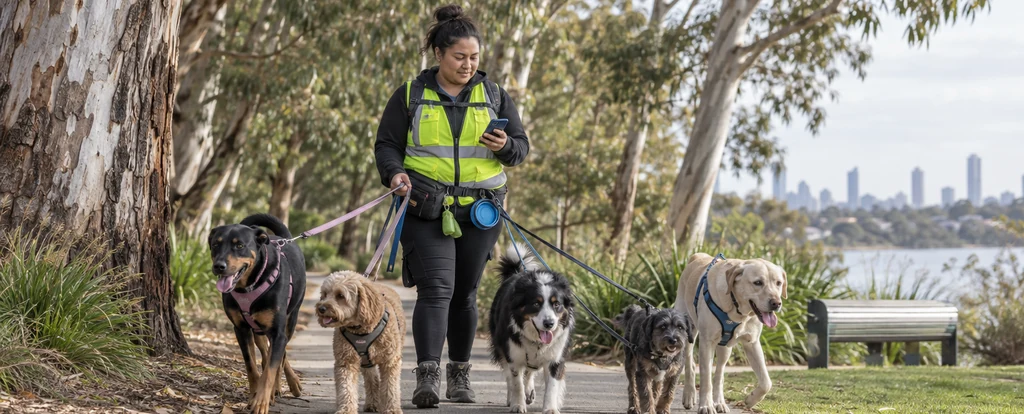
Dog walkers exercise other people's dogs, collecting them from home and taking them out in groups or one at a time.
- Median salary*
- $49,900
4.0%vs last year, before tax
- People employed
- 1,100
0.0%vs last year
- Projected growth*
- +6%
to 2035
- AI exposure*
- Low
- automation risk
- Average hours*
- 38/wk
−2h vs all jobs
- Shortage status*
- Not in shortage
national
Most dog walkers work outdoors and on the move, picking dogs up from owners' homes and walking them in small groups or one at a time. The job sits close to dog training, grooming and boarding in pet care, but the work itself is exercise, supervision and basic care rather than instruction or coat work. Many are sole traders with their own client list, while others take jobs through pet care apps or established pet sitting businesses.
How much do dog walkers earn?
The median full-time salary for a dog walker is $49,900 per annum, before tax, up $10,300 since 2018.
Pay depends on how you work: sole traders set their own rates and keep what they charge, while walkers on apps or with pet care businesses take a share after the platform or employer's cut. Rates usually rise with the number of dogs on a walk, the length of the walk and clients who book the same slot every week, and extras such as overnight stays or puppy visits add to the day. Working for yourself also means covering insurance, transport and equipment from the same money, with no paid leave.
What does a dog walker do day to day?
The list below is what fills most weeks; the exact mix shifts with seniority and whatever stage the current work is at.
- Collecting dogs from owners' homes and returning them safely
- Walking set routes at a pace that suits the group, because a mix of sizes and energy levels changes what a walk can look like
- Managing dogs during the walk, separating them when play gets rough and steering them clear of traffic and other dogs
- Feeding, watering and giving toilet breaks, then cleaning up and disposing of waste
- Messaging owners about behaviour, appetite or anything out of the ordinary
What skills do dog walkers need?
Employers look for animal care and handling, operations management, backed by PetPocketbook fluency and strong customer service.
Specialist skills
- Animal care and handling
- Operations management
Software and tools
- PetPocketbook
- Time To Pet
- Rover
- Google Calendar
General skills
- Customer service
- Written communication
- Physical stamina and dexterity
- Attention to detail
Is the job growing?
About 1,100 people work as dog walkers in Australia, and employment is projected to grow 6% over the decade to 2035. That's modest growth: demand is steady rather than booming.
How do you become a dog walker?
Here's the path most dog walkers take, step by step.
- 1Spend real time handling dogs
Walk dogs for friends and family, volunteer at a shelter or help at a local club before you charge anyone. Employers and clients want to know how you manage a strong dog, a nervous one or two that don't get along, and that experience is what they are checking for.
- 2Add a short qualification if you want one
A Certificate II or III in Animal Care Services or Animal Studies covers handling, health and first aid over about six months to a year, and a pet first aid course can be done in a day. Neither is required to start, and about 38% of people working as dog walkers hold a Bachelor degree, but they help when you approach vet clinics, boarding kennels or clients who ask about insurance.
- 3Set up the business side
If you work for yourself you need an ABN, public liability insurance and usually a police check, which many clients and platforms ask for, plus a car, harnesses and leads. Having these in place before your first paid client keeps a dog bite or an escaped dog from becoming a personal cost.
- 4Build a client list
Most work comes from repeat weekly slots, so start with the hours owners need most, usually the middle of the day, and add clients through local advertising, vet clinic referrals and apps such as Rover, Time To Pet or PetPocketbook. Walking a couple of dogs well is what generates the referrals that fill the rest of the week.
Ready to apply as a dog walker?
Whether you're working toward becoming a dog walker or already are one and want a hand with the next step (sharpening your resume for ATS screening, tightening your cover letter, or knowing what you'll actually be asked at interview), here are examples grounded in this specific role, not generic templates.
What jobs can a dog walker move to?
Moving into Dog Trainer typically comes with the biggest pay rise, worth $16,500 a year more on average.
| Move to | Typical pay change | Overlap | Retraining |
|---|---|---|---|
| Dog Trainer Dog walkers already read canine behaviour and manage groups, but trainer work needs formal behaviour study and client instruction skills. | +$16,500 | 31% | reskill |
| Dog Groomer Handling and calming dogs carries into grooming, though clipping, bathing and coat care require a grooming certificate. | +$16,500 | 50% | short course |
| Animal Husbandry Technician Dog handling and daily animal care transfer to livestock and companion animal husbandry, with training in nutrition and health routines. | +$12,500 | 82% | minimal |
| Boarding Kennel Operator Experience exercising and supervising dogs translates to kennel operations, with added study in boarding standards and animal health. | +$4,700 | 53% | short course |
| Dog Breeder Knowledge of dog behaviour and daily care supports breeding work, though genetics, whelping and record keeping need further study. | +$4,700 | 60% | short course |
Moves are chosen from Jobs and Skills Australia's Data on Occupation Mobility, which follows income tax records between 2011-12 and 2020-21, together with entry requirements and skill overlap. A known move is one people were seen making in that data. Pay change compares median full-time pay for the two roles.
Who works as a dog walker?
The typical dog walker is 35 years old; 74% are women, 17% work full-time, and full-timers average 38 hours a week.
- 35
- Median age
- 74%
- Female share
- 17%
- Full-time
- −2h
- vs all-jobs avg
What's it like being a dog walker?
The day runs on a schedule built around other people's working hours: pick-ups in the morning and at midday, walks in between, and messages to owners afterwards. It is physical, weather-dependent work with real responsibility for animals that can bolt, fight or refuse to move, and the income is only as steady as the bookings. People who like being outside, work well on their own and enjoy the company of dogs tend to settle into it, while those who need a predictable pay packet often keep another job alongside.
What people like
- Most of the day is outdoors. Walks happen in parks, along beaches and on suburban streets, which suits people who would rather not sit at a desk.
- You get to know the dogs. The same dogs turn up week after week, so you learn their quirks and their owners come to trust you with them.
- You set the shape of your day. Sole traders choose which clients, suburbs and hours to take on, and the work can be scaled up or down around another job or study.
- You can start with very little. There is no qualification requirement, so a couple of regular clients is enough to test whether the work suits you before you commit.
What people find hard
- The weather doesn't negotiate. Walks go ahead in rain, heat and cold, and summer means early starts, hot pavement and watching dogs for heat stress.
- Income moves with the bookings. Cancellations, school holidays and wet days cut a day's earnings, and sole traders get no paid leave or sick pay.
- It is harder on the body than it looks. Long days of walking, lifting dogs in and out of cars and holding a lead against a sudden pull add up to sore shoulders and backs.
- You are responsible when things go wrong. A dog that slips its collar, bites another dog or nips a passer-by is your problem on the walk, and it can mean vet bills or an insurance claim.
Based on our synthesis of professional-body surveys and public accounts of the role, not first-person verified reviews.
Which industries employ dog walkers?
Pet care services employs the largest share of dog walkers, followed by Household services.
Top employing industries
- 1Pet care services
- 2Household services
- 3Veterinary services
- 4Pet and pet supplies retailing
Ranked by employment share; the source doesn't publish an exact percentage per industry.
| Bachelor degree | 38% | |
|---|---|---|
| Diploma / Advanced Diploma | 24% | |
| Certificate III/IV | 20% | |
| Postgraduate | 10% | |
| Other | 8% |
Will AI replace dog walkers?
Dog walking is a low-exposure job, because the work is physical and happens in public with live animals on the end of a lead. Scheduling and client management apps such as Time To Pet and Rover have taken over bookings, reminders and payment, and they make running a client list easier than it used to be. The parts most exposed are the office tasks that sit around the walking: invoices, records and marketing.
Share of typical working time by exposure level
- Walking and supervising dogsThe walk depends on reading each dog's pace, traffic, other dogs and the weather, and no tool does that for you.45%low
- Pick-ups, drop-offs and handlingGetting a nervous or excited dog into a harness, a car or a client's hallway is hands-on work that changes with every dog.25%low
- Scheduling and client updatesBooking apps fill slots, send reminders and collect photos for owners, which cuts most of the day's back-and-forth.20%moderate
- Invoicing, marketing and recordsDraft invoices, social posts and follow-up emails are quick to generate, though sole traders still check the details before sending.10%high
Common questions about becoming a dog walker
Straight answers to the questions people ask most.
How much do dog walkers earn?
Dog walkers earn a median $49,900 per year before tax. What you take home depends on how many dogs you walk, your rates and whether you work for yourself or through an app, since sole traders pay insurance and running costs out of the same money.
How do you become a dog walker?
There is no qualification required: most people start by walking dogs for friends or volunteering at a shelter, then take on paying clients. An ABN, public liability insurance and a police check are the practical requirements if you work for yourself, and a Certificate II or III in Animal Care Services helps if you want to approach vet clinics or boarding kennels.
Are dog walkers in demand?
Dog walkers are currently not in shortage, and employment is projected to grow 6% over the decade to 2035. Demand follows pet ownership and households where nobody is home during the day, so the work concentrates around midday and holiday periods. Much of it is casual or part time, and it usually comes from building your own client list rather than applying for advertised positions.
Will AI replace dog walkers?
Not in any direct way. Booking, invoicing and client updates are already handled by scheduling apps, and marketing tools can draft ads and social posts, but the walk itself needs someone physically there to read a dog and manage it. The main effect is less admin for people running a client list.
What else can a dog walker move into?
With experience, dog walkers often move into dog training or grooming, where handling and calming dogs carries over but behaviour study or a grooming certificate is needed, and trainers typically earn $16,500 more. Boarding kennels suit walkers who want a fixed site and steadier hours, paying $4,700 more. Running your own walking business is the other common path, and for many sole traders that is where earnings grow as regular slots and extra services such as overnight care build up.
Do you need a licence or insurance to walk dogs?
There is no licence for dog walking in Australia, but public liability insurance is standard practice and many clients and platforms ask for it. Some councils set limits on how many dogs one person can walk in public places and where dogs may be off lead, so check your local rules. A police check is also common, particularly for anyone entering clients' homes.
Related roles
Not sure this is you? Take the career quiz and get a ranked shortlist of roles that fit how you like to work.