Entomologist
Entomologists study insects and the roles they play in ecosystems, from pollinating crops to spreading disease and recycling nutrients.
- Median salary*
- $98,800
4.0%vs last year, before tax
- People employed
- 330
10.0%vs last year
- Projected growth*
- +4%
to 2035
- AI exposure*
- Low
- automation risk
- Average hours*
- 40/wk
matches all-jobs average
- Shortage status*
- Not in shortage
national
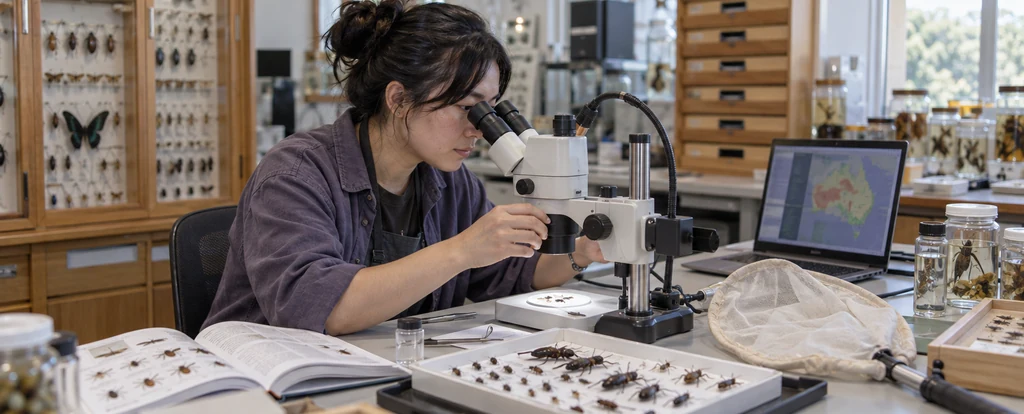
Entomologists work in laboratories, field sites and advisory offices, and it is the focus on insects that separates them from biologists and zoologists covering a wider range of animals. Most are employed by state agriculture and biosecurity agencies, universities, museums and agricultural research bodies, usually in small teams that mix fieldwork with long stretches of sorting and identification. Reference collections matter in this job: an entomologist may spend as much time building and curating specimens as studying live populations.
How much do entomologists earn?
The median full-time salary for an entomologist is $98,800 per annum, before tax, up $20,600 since 2018.
Pay follows the sector you work in and the classification level you hold, with government and university roles set by awards and enterprise agreements that step up with experience and qualifications. Private agricultural and environmental consultancies pay on their own scales, and project-funded contracts may trade a higher rate for less security. A PhD or a scarce taxonomic skill tends to open the higher bands, while seasonal field assistant work sits well below them.
What does an entomologist do day to day?
The list below is what fills most weeks; the exact mix shifts with seniority and whatever stage the current work is at.
- Collecting insect specimens with traps, nets and rearing methods, often inside a narrow seasonal window when a species is active
- Sorting and identifying specimens under a microscope using taxonomic keys and comparison with reference collections
- Running field surveys to measure insect populations and biodiversity in crops, forests, wetlands and waterways
- Analysing ecological data and mapping insect distributions with statistical and GIS software
- Advising growers, land managers and biosecurity officers on pest control, pollination and quarantine measures
What skills do entomologists need?
Employers look for field research and sampling, laboratory analysis, data analysis, backed by R fluency and strong written communication.
Specialist skills
- Field research and sampling
- Laboratory analysis
- Data analysis
- Environmental assessment
- Statistical modelling
Software and tools
- R
- QGIS
- Atlas of Living Australia
- Leica Application Suite
- GenStat
General skills
- Written communication
- Attention to detail
Is the job growing?
About 330 people work as entomologists in Australia, and employment is projected to grow 4% over the decade to 2035. That's modest growth: demand is steady rather than booming.
How do you become an entomologist?
Here's the path most entomologists take, step by step.
- 1Complete a science degree
A bachelor degree in science with a major in biology, zoology or environmental science is the standard entry point, and it covers the ecology, statistics and laboratory skills the work assumes. Around 52% of the people working as entomologists hold Bachelor degree as their highest qualification.
- 2Build field and identification experience while you study
Volunteer with a museum or herbarium collection, join a field naturalists group, or take casual survey work over the summer, because recognising insect families and running a trap line are learned on the job rather than in lectures.
- 3Add an honours year or postgraduate study
A fourth-year honours project or a master's degree gives you a research question to carry end to end, which is the evidence employers look for when hiring into research and taxonomy roles. A PhD is usually expected for museum curator and CSIRO research positions.
- 4Sort out the practical requirements for field work
Entomology is not a licensed profession, but field roles usually expect a current driver's licence, and some survey, quarantine and chemical work needs state-based permits, chemical handling accreditation or first aid training.
- 5Apply to the organisations that hire
State agriculture and primary industries departments, the CSIRO, universities, museums and agronomy consultancies are the main employers, and many run graduate or cadetship programs that take people straight from a degree.
Ready to apply as an entomologist?
Whether you're working toward becoming an entomologist or already are one and want a hand with the next step (sharpening your resume for ATS screening, tightening your cover letter, or knowing what you'll actually be asked at interview), here are examples grounded in this specific role, not generic templates.
What jobs can an entomologist move to?
Moving into Fisheries Scientist typically comes with the biggest pay rise, worth $2,600 a year more on average.
| Move to | Typical pay change | Overlap | Retraining |
|---|---|---|---|
| Fisheries Scientist An entomologist brings knowledge of aquatic insect life cycles and sampling methods to fisheries research and management. | +$2,600 | 76% | minimal |
| Zoologist An entomologist brings expertise in insect taxonomy and behaviour to the study of animals and their habitats. | +$0 | 85% | minimal |
| Biologist An entomologist brings deep knowledge of insect biology and ecology to broader biological research and fieldwork. | −$2,600 | 94% | minimal |
| Forensic Scientist An entomologist brings expertise in insect succession and decomposition to forensic investigations and casework. | −$3,100 | 67% | minimal |
| Marine Biologist An entomologist brings animal biology and field research skills to the study of marine organisms and ecosystems. | −$18,500 | 89% | minimal |
Moves are chosen from Jobs and Skills Australia's Data on Occupation Mobility, which follows income tax records between 2011-12 and 2020-21, together with entry requirements and skill overlap. A known move is one people were seen making in that data. Pay change compares median full-time pay for the two roles.
Who works as an entomologist?
The typical entomologist is 42 years old; 54% are men, 80% work full-time, and full-timers average 40 hours a week.
- 42
- Median age
- 46%
- Female share
- 80%
- Full-time
- +0h
- vs all-jobs avg
What's it like being an entomologist?
Much of the work is seasonal and slow: field trips cluster around the warmer months, then the samples come back to the lab for months of sorting, counting and identifying. The job suits people who like detail and can stay patient through repetition, and who get something out of resolving a specimen that refuses to key out. Pressure comes less from daily deadlines than from funding cycles, since a lot of survey and research work sits inside short-term grants or government programs.
What people like
- Fieldwork that takes you outdoors. Survey seasons mean real days in crops, forests, wetlands and trap lines, so the outdoors stays part of the job rather than an occasional break from the lab.
- Finding something worth recording. A new species record, a range extension or the first catch of a target insect is a concrete result in a field where progress is often measured in notebooks.
- Advice that changes a decision. Working out whether a pest population has crossed a treatment threshold, or which pollinators a crop actually depends on, can shift what a grower does within the same season.
- A small, well-connected field. Australian entomology is compact, and collections, taxonomic expertise and identification skills link you to researchers across agencies, museums and universities.
What people find hard
- Long hours at the microscope. Sorting bulk trap samples is painstaking, and a single survey can produce thousands of specimens that each need counting, labelling and storing.
- Identification skills take years to build. Confidence with a group comes slowly, many groups have no usable key, and you may need to send specimens to a specialist and wait months for an answer.
- Work tied to short projects. A large share of entomological work sits inside grant-funded research or time-limited biosecurity programs, so contracts often end when the funding does.
- Seasonal fieldwork pressure. When the insects are active you go, which can mean early starts, remote travel and weeks away from home at the busiest point in the year.
Based on our synthesis of professional-body surveys and public accounts of the role, not first-person verified reviews.
Which industries employ entomologists?
Agriculture, Forestry and Fishing employs the largest share of entomologists, followed by Public Administration and Safety.
Top employing industries
- 1Agriculture, Forestry and Fishing
- 2Public Administration and Safety
- 3Professional, Scientific and Technical Services
- 4Education and Training
- 5Arts and Recreation Services
Ranked by employment share; the source doesn't publish an exact percentage per industry.
| Bachelor degree | 52% | |
|---|---|---|
| Postgraduate | 26% | |
| Diploma / Advanced Diploma | 13% | |
| Other | 9% |
Will AI replace entomologists?
Entomology sits at the low end of AI exposure because so much of the job happens in a paddock, a trap line or at a microscope. Machine learning is genuinely useful for sorting images of insects, flagging likely species and pulling patterns from long survey datasets, and identification apps have improved quickly for common groups. It does not decide whether a specimen belongs to a cryptic species complex, design a survey that will stand up to review, or tell a grower what to do about an outbreak this week.
Share of typical working time by exposure level
- Field surveys and trappingSetting trap lines, sweep netting and rearing larvae depend on being in the right habitat at the right time of year, which is not something software can do.35%low
- Sorting and identifying specimensImage recognition can suggest a likely family from a photo, but confirming a species still means a microscope, a taxonomic key and often a specialist's opinion.30%moderate
- Pest and biosecurity adviceRecommending a treatment threshold or a quarantine response means weighing local conditions, chemical restrictions and the cost to the grower, and standing behind the call.20%low
- Data analysis and reportingStatistical modelling in R, distribution mapping and drafting sections of survey reports are the parts most assisted by automated tools.15%high
Common questions about becoming an entomologist
Straight answers to the questions people ask most.
How much do entomologists earn?
$98,800 per annum, before tax, is the median for full-time entomologists. What you take home depends on your sector and classification, so a state government research scientist and a consultant in private agriculture can sit at different points on the same range. Experience, postgraduate qualifications and scarce taxonomic skills are what lift you into the higher bands.
How do you become an entomologist?
Start with a science degree majoring in biology, zoology or environmental science, then build identification and survey experience through museum volunteering, honours projects or seasonal field work. Most research and taxonomy roles expect a postgraduate qualification, and a PhD is common in museums and the CSIRO. There is no registration or licence to obtain, though field roles usually want a driver's licence.
Are entomologists in demand?
Entomologists are currently not in shortage, and employment is projected to grow 4% over the decade to 2035 over the decade to 2035. With a workforce of about 330 people, openings tend to come from retirements and specific programs rather than steady expansion, so it pays to watch the agencies that hire, including state agriculture departments, universities and museums.
Will AI replace entomologists?
Not in the near term, and the field's exposure is low overall. Image recognition and machine learning are already useful for sorting photos of insects, flagging likely species and finding patterns in large survey datasets, and identification apps keep improving for common groups. The field work, specimen handling and taxonomic judgement that decide what a record actually means still need a person.
What can entomologists move into?
Broader biology work is one route across, where the overlap with biologist roles is around 94% and the fieldwork, statistics and research skills carry straight across. Fisheries science is another, because aquatic insect ecology and sampling methods transfer to fish habitat and water quality work. Coming in from a laboratory technician role is possible but needs requalifying, since independent research expects a science degree.
Where do entomologists work?
The largest employers are state agriculture and biosecurity agencies, universities, museums and agricultural research bodies, with smaller numbers in environmental consulting, forestry, horticulture and education. Roles range from quarantine and surveillance work at ports and farms to collection-based taxonomy and long-term ecological research. Most combine a lab or office base with a regular field season.
Related roles
Not sure this is you? Take the career quiz and get a ranked shortlist of roles that fit how you like to work.