Waterproofer
Waterproofers install the membranes and sealants that keep water out of wet areas, roofs, balconies and below-ground structures.
- Median salary*
- $84,200
4.3%vs last year, before tax
- People employed
- 2,400
0.0%vs last year
- Projected growth*
- +5%
to 2035
- AI exposure*
- Low
- automation risk
- Average hours*
- 42/wk
+2h vs all jobs
- Shortage status*
- In shortage (metro)
national
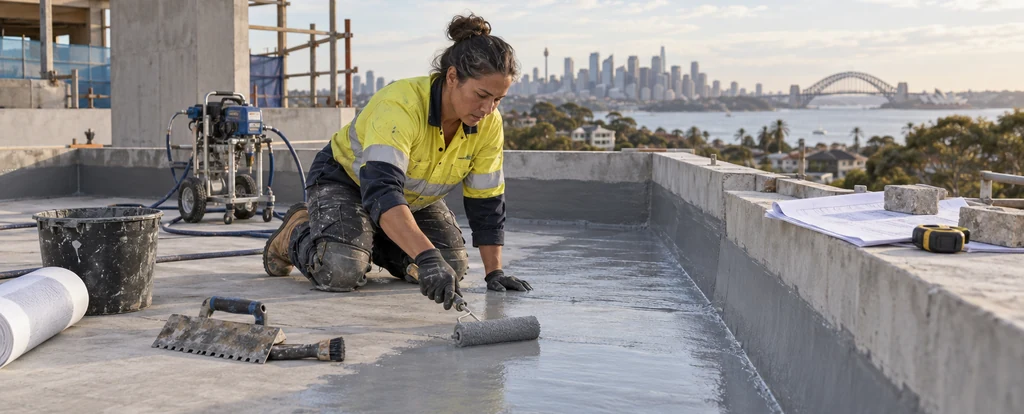
They work on new builds and renovations, mostly in bathrooms, balconies, roofs, basements and retaining walls, preparing the surface before laying down a liquid or sheet membrane and sealing every joint and penetration. The job sits close to tiling and roofing but is distinct from both: tilers lay the finish over a waterproofed substrate, and waterproofers are the ones who make that substrate watertight. Most waterproofers work as subcontractors to a builder, tiler or project manager, and residential waterproofing usually requires a licence or registration in the state or territory where it is done.
How much do waterproofers earn?
The median full-time salary for a waterproofer is $84,200 per annum, before tax, up $17,800 since 2018.
A lot of waterproofers work as subcontractors, so what you take home depends on how you price jobs and whether you carry your own insurance, materials and travel. On wages, pay follows the building and construction award or an enterprise agreement, and commercial and below-ground work generally pays better than small residential bathrooms. Holding the licence or registration your state requires, and being signed off on the major membrane systems, both push rates up.
What does a waterproofer do day to day?
The list below is what fills most weeks; the exact mix shifts with seniority and whatever stage the current work is at.
- Preparing substrates by cleaning, priming and repairing surfaces before any membrane goes down
- Applying liquid membrane by roller or spray, and laying sheet membrane where the system calls for it
- Detailing corners, junctions and pipe penetrations with reinforcing tape and sealant
- Reading plans to check falls, setouts and where the waterproofing has to stop
- Flood testing completed wet areas and photographing the result for the builder's records
What skills do waterproofers need?
Employers look for installation and maintenance, building codes and standards, worksite safety management, backed by Moisture meters fluency and strong attention to detail.
Specialist skills
- Installation and maintenance
- Building codes and standards
- Worksite safety management
- Hand and power tool work
- Reading plans and specifications
Software and tools
- Moisture meters
- Airless spray and roller membrane applicators
- Notched trowels and detailing brushes
- Procore
- Xero
General skills
- Attention to detail
- Problem solving
Is the job growing?
About 2,400 people work as waterproofers in Australia, and employment is projected to grow 5% over the decade to 2035. That's modest growth: demand is steady rather than booming.
How do you become a waterproofer?
Here's the path most waterproofers take, step by step.
- 1Get a White Card
General construction induction training is required before you can set foot on a site in any state or territory, and it takes about a day.
- 2Start a Certificate III in Construction Waterproofing
The qualification is usually done as a paid apprenticeship or traineeship with a waterproofing or building contractor, takes around three years, and covers substrate preparation, membrane systems and the standards that apply to wet areas.
- 3Get licensed or registered where you work
Requirements differ between states and territories: some license waterproofers directly, while others tie the work to building registration, so check with your local regulator before quoting on residential jobs.
- 4Learn the membrane systems
Product warranties often depend on the applicator being trained in that manufacturer's system, so getting signed off on the main brands opens up more work.
- 5Set yourself up to subcontract
Most waterproofers eventually work for themselves, which means public liability insurance, a registered business name and a reliable vehicle before you take on your own jobs.
Ready to apply as a waterproofer?
Whether you're working toward becoming a waterproofer or already are one and want a hand with the next step (sharpening your resume for ATS screening, tightening your cover letter, or knowing what you'll actually be asked at interview), here are examples grounded in this specific role, not generic templates.
What jobs can a waterproofer move to?
Moving into Concreter typically comes with the biggest pay rise, worth $30,700 a year more on average.
| Move to | Typical pay change | Overlap | Retraining |
|---|---|---|---|
| Concreter Below-ground waterproofing often involves concrete, so waterproofer skills carry into concreting with minimal retraining. | +$30,700 | 67% | minimal |
| Fire Protection Technician Fire protection work shares sealing and penetration skills with waterproofing, and a short course bridges the gap. | −$1,000 | 85% | short course |
| Pool Builder Waterproofing pools is part of pool building, so a waterproofer can move into pool building with minimal retraining. | −$1,000 | 80% | minimal |
| Roofer Waterproofers already work on roofs and apply membranes, so moving into roofing needs only minimal retraining to adapt skills. | −$17,400 | 100% | minimal |
| Tiler Waterproofers understand wet area preparation, but becoming a tiler requires reskilling to learn tiling techniques. | −$22,800 | 70% | reskill |
Moves are chosen from Jobs and Skills Australia's Data on Occupation Mobility, which follows income tax records between 2011-12 and 2020-21, together with entry requirements and skill overlap. A known move is one people were seen making in that data. Pay change compares median full-time pay for the two roles.
Who works as a waterproofer?
The typical waterproofer is 37 years old; 97% are men, 74% work full-time, and full-timers average 42 hours a week.
- 37
- Median age
- 3%
- Female share
- 74%
- Full-time
- +2h
- vs all-jobs avg
What's it like being a waterproofer?
The work is quiet and precise rather than fast and loud: you spend most of the day on your own or in a small crew, working across several sites in a week and often under time pressure because the tiler, renderer or concreter is waiting on you. It suits someone who likes doing a job properly once and being able to prove it, and who does not mind kneeling in a bathroom or a plant room for hours.
What people like
- You can prove the job is right. A flood test on a finished wet area settles the question before the tiler arrives, which is a rare kind of certainty on a construction site.
- The work moves around. A week might take in a bathroom in a new apartment block, a balcony repair on an older building and a basement tanking job, so you are not stuck in the same room for months.
- Hands-on rather than crew management. Most of the day is spent with a roller, trowel and detailing brush rather than coordinating a team, which suits people who like concentrating on the surface in front of them.
- Low overheads if you go out on your own. The tools are portable and the setup is small, so plenty of waterproofers build a business around subcontracting to the same builders for years.
What people find hard
- A hidden failure comes back to you. A missed pinhole in a membrane can leak months later behind a tiled wall, and the repair bill usually lands on the waterproofer who did the job.
- Other trades set your day. If the screed is not down or the frame has moved, you cannot start, so a fair amount of waiting and rescheduling is out of your control.
- Tight, awkward spaces. Bathrooms, plant rooms and under-floor areas mean kneeling, reaching around pipes and working in the warmer months with limited airflow.
- Primers and solvent-based products. These need proper ventilation and personal protective equipment, and the smell tends to follow you home at the end of the day.
Based on our synthesis of professional-body surveys and public accounts of the role, not first-person verified reviews.
Which industries employ waterproofers?
Construction employs the largest share of waterproofers.
Top employing industries
- 1Construction
Ranked by employment share; the source doesn't publish an exact percentage per industry.
| Certificate III/IV | 34% | |
|---|---|---|
| Diploma / Advanced Diploma | 26% | |
| Bachelor degree | 20% | |
| Year 12 or below | 20% |
Will AI replace waterproofers?
Waterproofing is a hands-on trade with low exposure to AI, because the decisions that matter happen at the wall in front of you: whether the substrate is dry, whether the fall runs the right way, whether a corner has been detailed properly. Software such as Procore and Xero already handles scheduling, quoting and invoicing, and that paperwork is where AI mostly reaches the job. The trade also depends on site conditions and on a licence that a program cannot hold.
Share of typical working time by exposure level
- Applying membrane and detailing penetrationsRolling membrane into a corner or taping around a shower waste is manual work in a tight space that has to be done by hand.35%low
- Preparing and priming substratesChecking moisture with a meter and deciding whether a screed needs more drying time comes down to judgement on site, not a calculation.30%low
- Flood testing, records and compliance evidencePhotographing a flood test, filling in a waterproofing certificate and logging the products used are the parts most easily handled by software.20%high
- Working out setouts and falls from plansSoftware can help measure a wet area and check levels, but someone still has to confirm the setout against what is actually built.15%moderate
Common questions about becoming a waterproofer
Straight answers to the questions people ask most.
How much does a waterproofer earn?
The median for waterproofers is $84,200 per year before tax, though subcontractors earn what their jobs are worth rather than a set rate. Rates are higher on commercial and below-ground work than on small residential bathrooms.
How do you become a waterproofer?
The usual route is a paid apprenticeship or traineeship leading to a Certificate III in Construction Waterproofing (CPC31420), which takes around three years. You need a White Card before starting on site, and most states and territories require a licence or registration for residential work.
Are waterproofers in demand?
Waterproofers are currently in shortage in metropolitan areas. Employment is projected to grow 5% over the decade to 2035, and because waterproofing is a required step on almost every wet area, the work tends to follow building activity rather than rise and fall on its own.
Will AI replace waterproofers?
Very little of the job is exposed to automation. Judging whether a substrate is dry enough, or how much membrane a shower recess needs, depends on being in the room and reading the surface, so apps such as Procore and Xero mostly reach the scheduling and invoicing side of the business.
What other jobs can a waterproofer move into?
Waterproofing skills carry into several nearby trades with minimal retraining. Concreters typically earn $30,700 more than waterproofers, since below-ground waterproofing already involves concrete work, while roofers and fire protection technicians reuse the same sealing and detailing skills, with pay at $17,400 less and $1,000 less respectively. Many waterproofers also set up their own subcontracting business, which is often where earnings grow.
Do you need a licence to waterproof?
It depends where you work. Some states and territories license waterproofers directly, while others tie the work to building registration, so check with the regulator in your state before taking on residential jobs.
Related roles
Not sure this is you? Take the career quiz and get a ranked shortlist of roles that fit how you like to work.