Solid Plasterer
Solid plasterers apply and finish render, plaster and cement coatings to walls, ceilings and other building surfaces, giving a structure its weather protection and its final look.
- Median salary*
- $75,400
3.6%vs last year, before tax
- People employed
- 4,500
0.0%vs last year
- Projected growth*
- +5.2%
to 2035
- AI exposure*
- Low
- automation risk
- Average hours*
- 41/wk
+1h vs all jobs
- Shortage status*
- In shortage
national
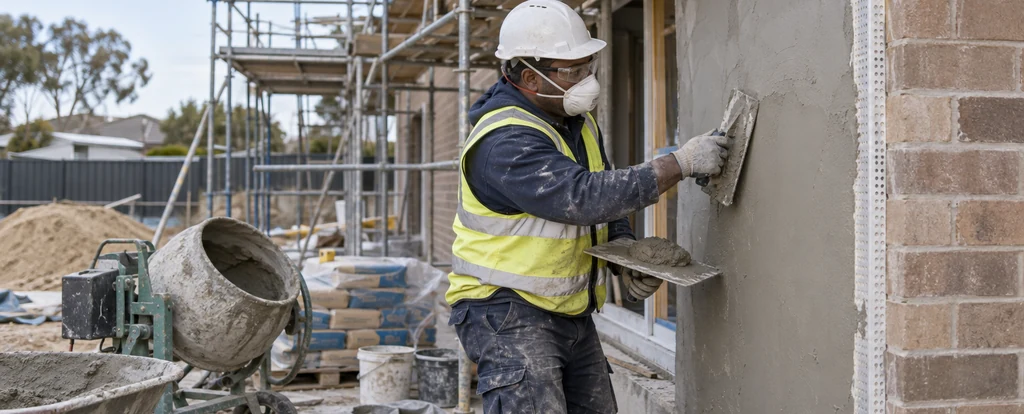
Solid plasterers work on new builds, renovations and civil projects, usually for small plastering or rendering subcontractors. The nearest trade, a plasterer, lines interiors with plasterboard and cornice, while a solid plasterer works in render and cement-based coatings, which is what gives external walls their finish and their protection from the weather. Most of the day is spent on site, on a scaffold against a facade or inside a shell, often as part of a crew of two or three.
How much do solid plasterers earn?
The median full-time salary for a solid plasterer is $75,400 per annum, before tax, up $16,100 since 2018.
Pay follows the building and construction award or a company enterprise agreement, and apprentices earn well below the qualified rate while they train. Subcontractors are often paid by the square metre, so a fast, tidy plasterer on a steady run of work can earn more than an hourly rate suggests, while wet weather and gaps between jobs cut into it. Commercial and civil projects, and work at height or on access equipment, generally pay above small residential repair jobs.
What does a solid plasterer do day to day?
The list below is what fills most weeks; the exact mix shifts with seniority and whatever stage the current work is at.
- Applying coats of render, plaster and cement to interior and exterior walls and ceilings, usually in two or three passes as each coat sets
- Mixing sand, cement, plaster and additives to the right consistency for the coat and the weather, because a mix that is too wet slumps and one that is too dry drags on the trowel
- Preparing and cleaning substrates, then fixing beads, mesh and corner angles so the render has a straight edge to work to
- Finishing surfaces to a smooth, floated or textured standard, and cutting decorative patterns or running mouldings where the design calls for them
- Patching and repairing damaged render and plaster, matching the existing texture so the repair blends into the wall
What skills do solid plasterers need?
Employers look for hand and power tool work, installation and maintenance, worksite safety management, backed by Plastering trowels fluency and strong attention to detail.
Specialist skills
- Hand and power tool work
- Installation and maintenance
- Worksite safety management
- Building codes and standards
- Craft and handmade production
Software and tools
- Plastering trowels
- Hawk and float
- Mortar mixer
- Render spray machine
- Corner bead tools
General skills
- Attention to detail
- Physical stamina and dexterity
Is the job growing?
About 4,500 people work as solid plasterers in Australia, and employment is projected to grow 5.2% over the decade to 2035. That's modest growth: demand is steady rather than booming.
How do you become a solid plasterer?
Here's the path most solid plasterers take, step by step.
- 1Get your White Card before you look for work
General construction induction training is required on every Australian construction site, takes about a day, and has to be done before you can start on site.
- 2Start a Certificate III in Solid Plastering apprenticeship
This is the standard entry into the trade, usually three to four years, and it is paid: you learn on site alongside a qualified plasterer and attend TAFE in blocks. Finding an employer willing to take you on is the hard part, so approach render crews directly rather than waiting for advertised vacancies.
- 3Learn the full range of finishes
Cement render, acrylic render, bagging, set finishes and decorative moulding are separate skills, and being able to produce and price several of them keeps you working across different kinds of jobs.
- 4Check registration rules in your state
Some states require registration with the building authority before you can contract for domestic work above a set value, and the thresholds differ, so confirm the rule where you live before taking on your own jobs.
- 5Work toward subcontracting or your own business
Once qualified, many plasterers start quoting smaller jobs of their own, buying their own tools and mixer, and building a client base among builders and homeowners.
Ready to apply as a solid plasterer?
Whether you're working toward becoming a solid plasterer or already are one and want a hand with the next step (sharpening your resume for ATS screening, tightening your cover letter, or knowing what you'll actually be asked at interview), here are examples grounded in this specific role, not generic templates.
What jobs can a solid plasterer move to?
Moving into Concreter typically comes with the biggest pay rise, worth $39,500 a year more on average.
| Move to | Typical pay change | Overlap | Retraining |
|---|---|---|---|
| Concreter Experience with cement mixes and trowel finishing transfers to concrete work, with a short course in concrete placement and finishing. | +$39,500 | 46% | short course |
| Plasterer Solid plasterers bring rendering and surface finishing skills to interior plastering, with additional training in sheet fixing and cornice work. | +$20,300 | 62% | reskill |
| Waterproofer Knowledge of substrates and render preparation suits waterproofing work, with additional training in membrane systems and wet area detailing. | +$8,800 | 62% | reskill |
| Stonemason Mortar mixing, levelling and finishing skills carry into stonemasonry, with training in stone cutting, setting and pointing. | −$2,600 | 70% | reskill |
Moves are chosen from Jobs and Skills Australia's Data on Occupation Mobility, which follows income tax records between 2011-12 and 2020-21, together with entry requirements and skill overlap. A known move is one people were seen making in that data. Pay change compares median full-time pay for the two roles.
Who works as a solid plasterer?
The typical solid plasterer is 39 years old; 99% are men, 68% work full-time, and full-timers average 41 hours a week.
- 39
- Median age
- 1%
- Female share
- 68%
- Full-time
- +1h
- vs all-jobs avg
What's it like being a solid plasterer?
The work runs on rhythm: mixing, coating and finishing in a set order that moves along a wall, with the weather and the state of the substrate setting the pace. Solid plasterers tend to enjoy seeing a surface they produced by hand, and the trade suits people who are patient with a trowel and can hold a straight line over a long wall. Site conditions, program deadlines and the sheer amount of handling are the main pressures.
What people like
- A finish you can point to. At the end of a day you can stand back and see a wall that is flat, straight and clean because you made it that way, which suits people who like visible results.
- Every site is slightly different. Substrates, weather and design details change from job to job, so the work rarely settles into one repeated motion.
- A trade that travels. Render and plaster skills carry across residential, commercial and civil work and around the country, so there is usually a crew hiring somewhere.
- Room to specialise. Decorative finishes, heritage work and large commercial facades let experienced plasterers move into work that pays better or is easier on the body.
What people find hard
- Hard on the body. Shoulders, wrists and knees carry the load of trowelling overhead and crouching at skirting level, and the wear builds up over a career.
- The weather sets the schedule. Rain, wind and extreme heat stop render going on properly, and a crew can lose days to conditions nobody controls.
- Dust and clean-up. Mixing, cutting and sanding fill the air with dust, so masks and other protective gear matter and cleaning up is part of every day.
- Paid by what you get done. Subcontract work pays by the square metre, so a slow week, a difficult substrate or a quiet patch in building activity comes straight out of your income.
Based on our synthesis of professional-body surveys and public accounts of the role, not first-person verified reviews.
Which industries employ solid plasterers?
Construction employs the largest share of solid plasterers.
Top employing industries
- 1Construction
Ranked by employment share; the source doesn't publish an exact percentage per industry.
| Certificate III/IV | 34% | |
|---|---|---|
| Diploma / Advanced Diploma | 26% | |
| Bachelor degree | 20% | |
| Year 12 or below | 20% |
Will AI replace solid plasterers?
Solid plastering is largely hands-on work in conditions that change wall by wall, so AI and automation reach only the edges of the job. Render spray machines and mixers take some of the labour out of coating large facades, and estimating software has sped up quoting, but the set-out, the straightening and the judgement about whether a substrate will hold render stay with the plasterer.
Share of typical working time by exposure level
- Trowel work and finishing coatsDeciding how thick each coat goes on and working it flat is a feel judgement, and a spray machine still needs someone ruling off and finishing behind it.45%low
- Surface preparation and set-outLaser levels and measuring apps speed up setting out, but someone still has to check whether a wall is sound enough to take render and how far out of plumb it is.20%moderate
- Repairs, patching and decorative finishesMatching an existing texture or running a decorative moulding depends on eye and hand, so it stays manual work on site.20%low
- Quoting, scheduling and material ordersEstimating software can price a job from plans and measurements in minutes, which is where the biggest change has landed so far.15%high
Common questions about becoming a solid plasterer
Straight answers to the questions people ask most.
How much do solid plasterers earn?
Solid plasterers earn a median $75,400 per annum, before tax. What you actually take home depends on whether you are on wages or paid by the square metre as a subcontractor, and on how many weeks of the year you spend on site.
How do you become a solid plasterer?
Most people start a Certificate III in Solid Plastering (CPC31020) apprenticeship, which takes about three to four years and combines paid on-site work with TAFE training. You need a White Card before you set foot on a construction site, and you need to find an employer prepared to take on an apprentice.
Are solid plasterers in demand?
Solid plasterers are currently in shortage nationally. Employment in the trade is projected to grow 5.2% over the decade to 2035, so it is worth weighing that against how much building work there is in the area where you want to live and work.
Will AI replace solid plasterers?
No, and the exposure is low: applying and finishing render by trowel is hands-on work in conditions that change wall by wall. Software and machines help with pricing, scheduling and pumping or spraying large areas, but somebody still has to rule off, float and finish what they put on.
What can a solid plasterer move into?
The closest moves are into waterproofing, where substrate and render preparation knowledge carries across and median pay is $8,800 more than in solid plastering, or into concreting, where trowel finishing transfers and median pay is $39,500 more. Many experienced plasterers end up subcontracting or running their own plastering business, which is often where earnings grow.
Related roles
Not sure this is you? Take the career quiz and get a ranked shortlist of roles that fit how you like to work.